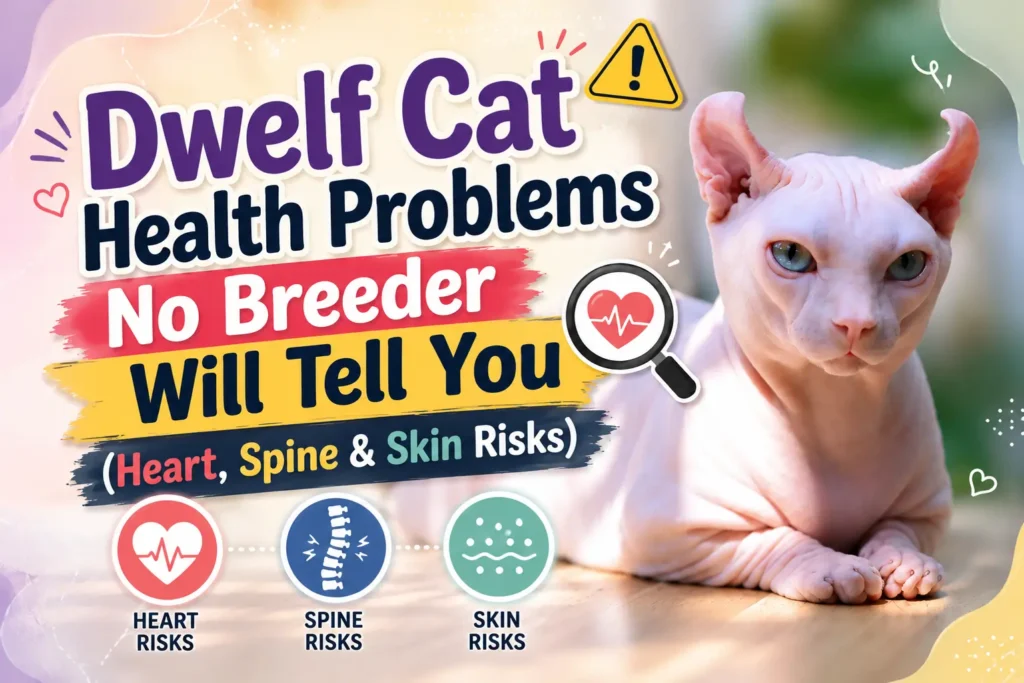
Dwelf cats are a mix of three breeds, so they can inherit health problems from all of them. The most common dwelf cat health problems are heart disease (called HCM), spine curving (called lordosis), and skin issues because they have no fur to protect them. HCM is a heart problem where the heart muscle gets thickened and stops working well.
Lordosis makes the spine curve down too much, and it can press on organs in bad cases. Skin issues happen because hairless skin gets oily, dirty, and sunburned very easily. Not every Dwelf cat will get these problems, but because of their mixed genes, the risk is higher than in normal cats. This is why learning about Dwelf cat health problems early is so important; it helps you catch warning signs fast and keep your cat healthy for many years.
Why Do Dwelf Cats Have More Health Risks Than Other Cats?
The Dwelf is a deliberate cross of the Sphynx, the Munchkin, and the American Curl. That’s charming on paper, but it also means the breed can inherit weaknesses from each side of its family tree: heart disease from the Sphynx line, skeletal quirks from the Munchkin’s dwarfism gene, and ear or cartilage issues from the Curl.
Because the breed only emerged in the early 2000s, long-term health data is still limited, and it isn’t yet widely recognized by major registries. That makes ongoing vet care even more important than it would be for an older, established breed.
The Dwelf Cat Is So Rare, People Will Pay Anything; Read more in People Are Losing Their Minds (and $3,000) Over the Dwelf Cat.
The Most Common Dwelf Cat Health Problems, Explained
Not every Dwelf develops these conditions, but responsible owners should know what to watch for.
Hypertrophic Cardiomyopathy (HCM): The Biggest Heart Concern
Hypertrophic cardiomyopathy, or HCM, thickens the heart muscle and is the most frequently reported heart disease in cats overall, with Sphynx bloodlines showing a particularly high genetic risk. The Cornell Feline Health Center notes that HCM can go unnoticed for years because early stages rarely show obvious symptoms. Left unmanaged, it can lead to lethargy, breathing difficulty, or sudden heart failure, which is why annual screening, often by echocardiogram, matters so much for this breed.
Lordosis and Pectus Excavatum: Rare but Serious Spinal Conditions
Lordosis is an inward curve of the spine, and pectus excavatum is a sunken or concave chest. Both trace back to the Munchkin’s dwarfism gene and can, in severe cases, press on internal organs or restrict breathing. Mild cases may never cause trouble, but a vet should monitor any Dwelf with an unusual sway in its back or a hollow-looking chest, since surgery is occasionally needed to relieve pressure on the heart or lungs.
Do Dwelf Cats Have Hair?
Yes, Dwelf cats have some hair, but it is very thin and short, so their skin still looks almost bare. They also lack whiskers and ear hair because of their genes.
Joint Problems, Ear Infections, and Skin Care
Short, sturdy legs put extra strain on joints, so arthritis and mobility trouble tend to show up earlier than in an average cat. Curled ears from the American Curl side also trap wax and debris, raising infection risk, while hairless Sphynx-type skin needs weekly bathing to prevent oily buildup, acne, and fungal problems. Together, these are the everyday dwelf cat health problems that shape routine care for this breed.
Dwelf Cat Health Problems: What’s the Most Common One?
Heart disease, specifically hypertrophic cardiomyopathy (HCM), is generally considered the most serious and most common health problem linked to Dwelf cats, largely because of their Sphynx ancestry. Spinal issues like lordosis and joint strain from their short legs come next in frequency.
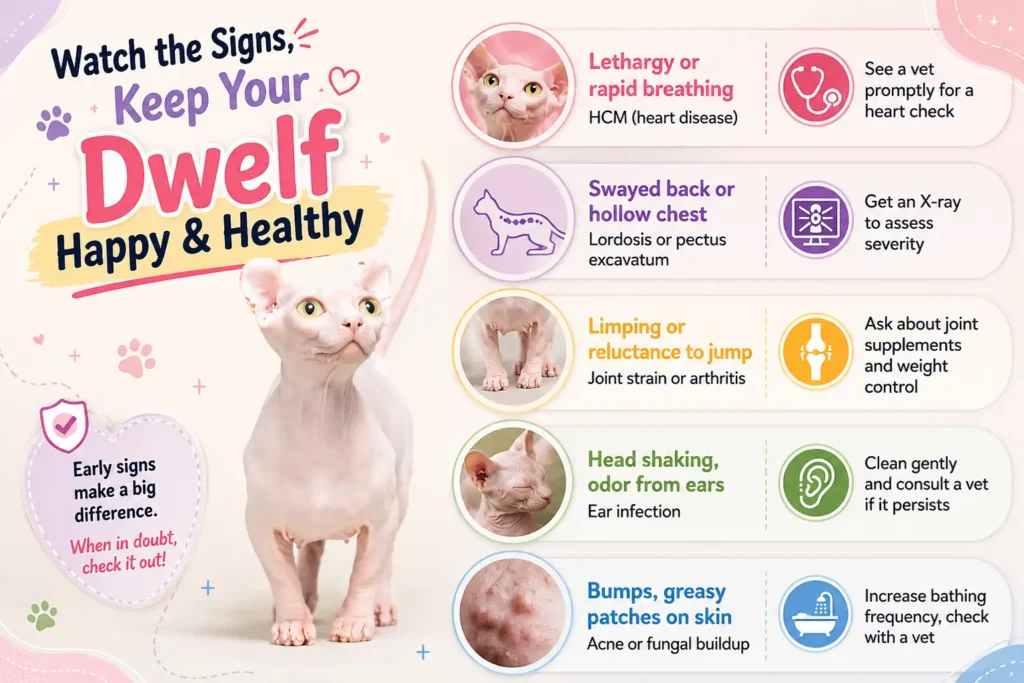
The table below breaks down the physical signs that most often point to trouble in a Dwelf cat, along with what they can mean.
| Sign to Watch For | Possible Cause | What to Do |
| Lethargy or rapid breathing | HCM (heart disease) | See a vet promptly for a heart check |
| Swayed back or hollow chest | Lordosis or pectus excavatum | Get an X-ray to assess severity |
| Limping or reluctance to jump | Joint strain or arthritis | Ask about joint supplements and weight control |
| Head shaking, odor from ears | Ear infection | Clean gently and consult a vet if it persists |
| Bumps, greasy patches on skin | Acne or fungal buildup | Increase bathing frequency, check with a vet |
How to Keep a Dwelf Cat Healthy
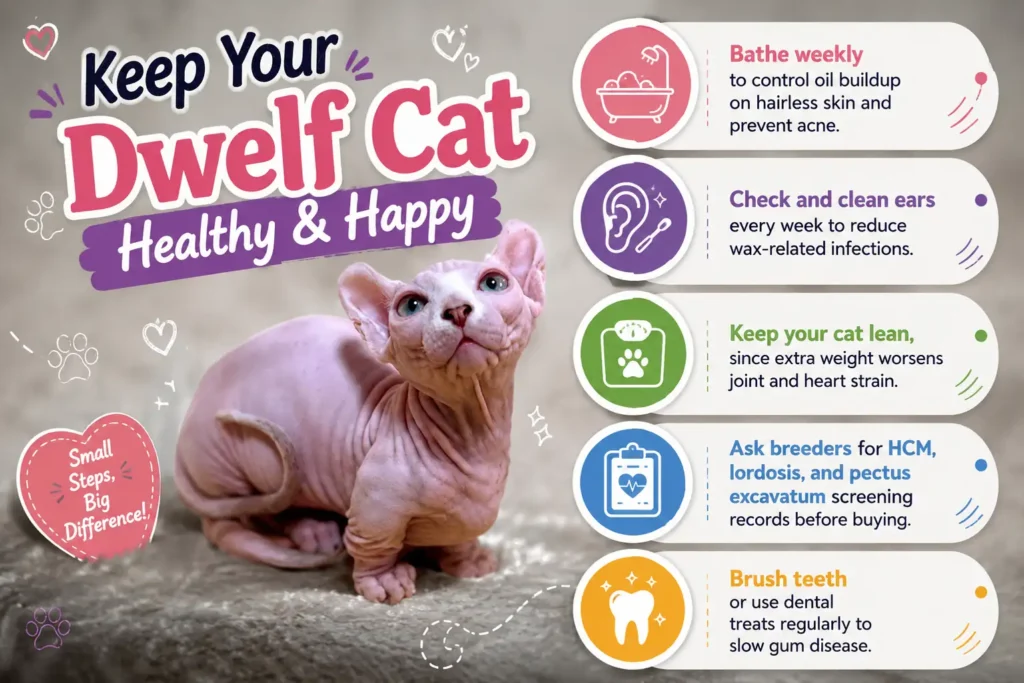
Most dwelf cat health problems are easier to manage when they’re caught early, so daily habits matter as much as vet visits. A few practical steps go a long way:
- Bathe weekly to control oil buildup on hairless skin and prevent acne.
- Check and clean ears every week to reduce wax-related infections.
- Keep your cat lean, since extra weight worsens joint and heart strain.
- Ask breeders for HCM, lordosis, and pectus excavatum screening records before buying.
- Brush teeth or use dental treats regularly to slow gum disease.
Groups such as The International Cat Association (TICA) encourage buyers to ask breeders directly for genetic and cardiac screening documentation, which is one of the simplest ways to avoid inheriting expensive problems down the line.
Are Dwelf Cats Hypoallergenic?
Dwelf cats are not truly hypoallergenic, since allergies come from a protein in their skin and saliva, not just fur. They may cause fewer reactions than other cats, but not none.
How Long Do Dwelf Cats Live With Proper Care?
Because the Dwelf is such a new breed, exact lifespan data is limited, but most sources estimate 8 to 12 years, similar to its Munchkin and Sphynx relatives. Cats that receive regular vet screening, a lean diet, and prompt treatment for skin or ear issues tend to land on the higher end of that range.
Here’s how the Dwelf compares with its closest relatives on lifespan and typical health concerns.
| Breed | Typical Lifespan | Main Health Concerns |
| Dwelf | 8–12 years | HCM, lordosis, pectus excavatum, skin, ears |
| Sphynx | 10–15 years | HCM, skin conditions, dental disease |
| Munchkin | 12–15 years | Lordosis, pectus excavatum, joint strain |
| Elf Cat | 9–13 years | HCM, skin care needs, ear infections |
Are Dwelf Cats Healthy Compared to Sphynx, Munchkin, and Elf Cats?
The Dwelf isn’t inherently less healthy than its relatives, but it can inherit risks from more directions at once since it combines three breeds instead of one. Sphynx cats mainly face heart and skin issues, Munchkins face spinal and joint issues, and the Dwelf can face a mix of both, plus the ear concerns tied to its curled-ear ancestry.
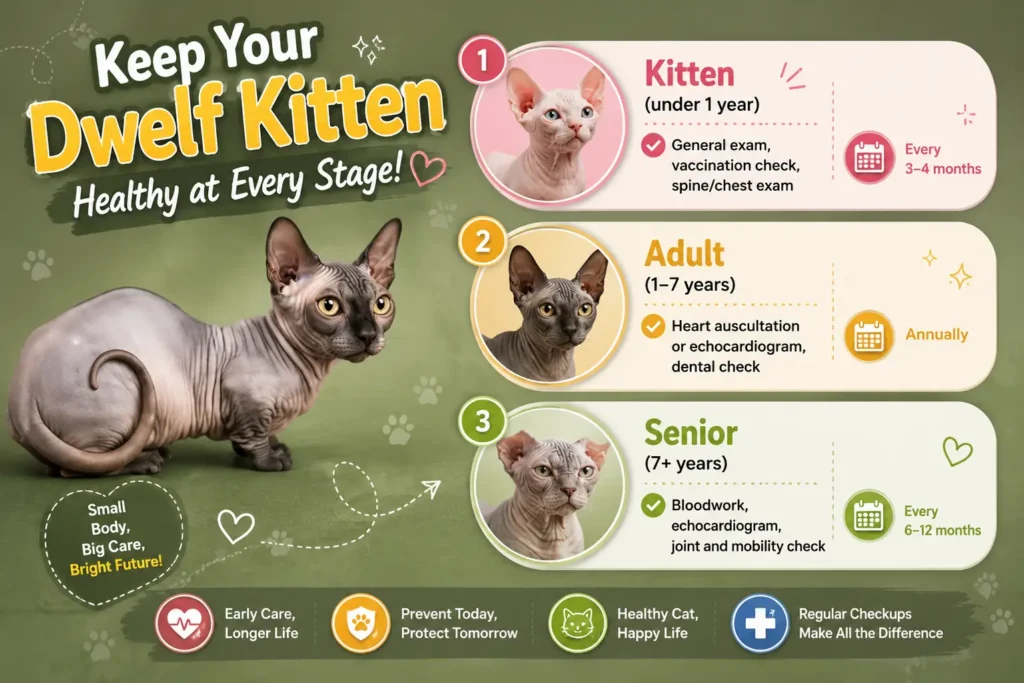
Routine screening catches most dwelf cat health problems long before they become emergencies, and the schedule below is a reasonable starting point to discuss with your vet.
| Age | Recommended Screening | Frequency |
| Kitten (under 1 year) | General exam, vaccination check, spine/chest exam | Every 3–4 months |
| Adult (1–7 years) | Heart auscultation or echocardiogram, dental check | Annually |
| Senior (7+ years) | Bloodwork, echocardiogram, joint and mobility check | Every 6–12 months |
Should You Buy a Dwelf Cat If You’re Worried About Health Problems?
A Dwelf can still make a wonderful, affectionate pet, but it isn’t the lowest-maintenance choice out there. If you’re prepared for weekly grooming, annual heart screening, and a vet who’s comfortable treating dwarf-breed cats, the health risks become manageable rather than overwhelming. If you’d rather avoid the added vet bills and monitoring that come with an experimental breed, a more established breed might suit you better.
Frequently Asked Questions
Are Dwelf cats healthy?
Dwelf cat health problems can be significant, but many Dwelfs live full, active lives with regular vet care, a lean diet, and consistent grooming.
What is the most common health problem in Dwelf cats?
Hypertrophic cardiomyopathy (HCM), inherited mainly from Sphynx ancestry, is generally viewed as the most common and most serious concern.
Do all Dwelf cats develop heart disease?
No. HCM risk is elevated due to Sphynx genetics, but not every Dwelf develops it; regular echocardiogram screening helps catch it early if it does appear.
Do Dwelf cats have genetic disorders?
Yes, they can inherit lordosis and pectus excavatum from Munchkin ancestry, along with a predisposition to HCM from the Sphynx side.
Are Dwelf cats high maintenance because of their health?
They require more attention than an average cat, weekly baths, ear cleaning, and annual heart checks, but this is manageable with a consistent routine.
Can Dwelf cats live a normal lifespan?
Yes, many reach 8 to 12 years or more, especially with early screening and prompt treatment of skin, ear, or joint issues.
How often should a Dwelf cat see a vet?
Kittens usually need visits every 3–4 months, while adults do well with annual checkups, moving to twice yearly after age seven.
Is pet insurance worth it for a Dwelf cat?
Given the potential cost of cardiac screening and joint or skin treatment, insurance can meaningfully offset the higher lifetime vet costs of this breed.