
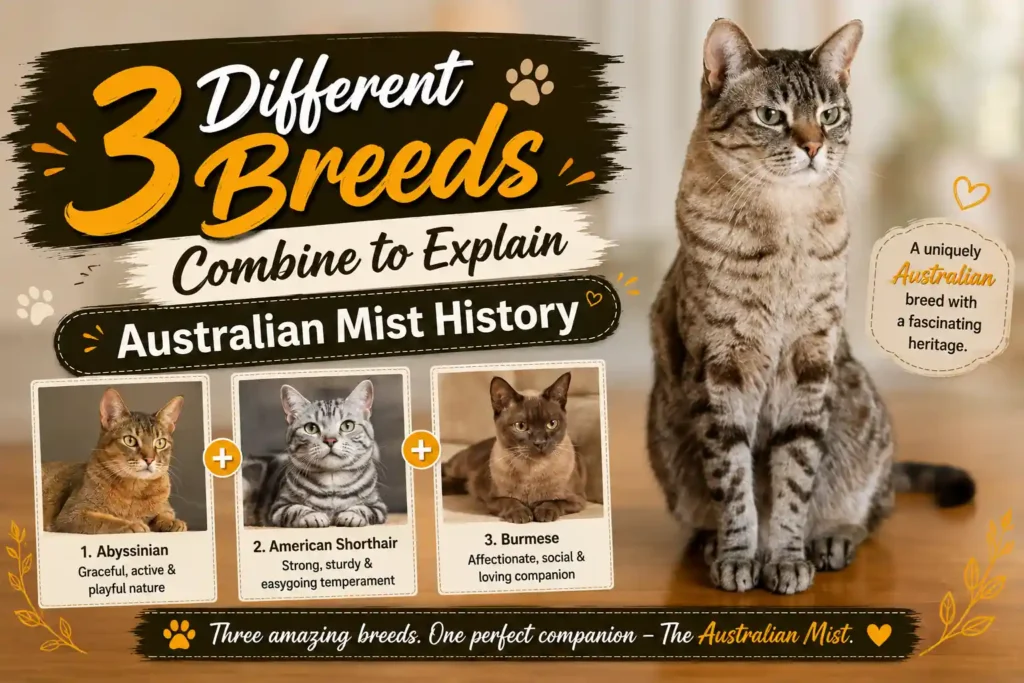
Australian Mist history starts in 1976, when Sydney geneticist Dr. Truda Straede planned to create Australia’s first native cat breed. She mixed Burmese, Abyssinian, and domestic shorthair cats to combine an affectionate nature, a striking spotted coat, and strong health. About thirty foundation cats formed the base of this new breed.
The first kitten was born in 1980, and the breed gained official recognition in 1986 under the name Spotted Mist. In 1998, breeders renamed it Australian Mist to include cats with marbled coats as well as spotted ones. This is the real story behind Australian Mist history: a planned, decade-long project that gave Australia its only home-grown cat breed.
Where Did Australian Mist History Begin?
The Australian Mist traces back to Sydney, where geneticist Dr. Truda Straede began experimenting with cat crosses in the mid-1970s. She wanted an indoor-friendly companion suited to Australian households, where growing concern about pet cats hunting native wildlife was reshaping attitudes toward cat ownership.
Rather than importing an existing breed, Straede decided to build one from the ground up. She combined the Burmese, the Abyssinian, and domestic shorthair tabbies, aiming for a cat with a soft, misted coat and an easygoing temperament. The project drew on roughly thirty foundation cats, giving the new breed an unusually broad, genetically healthy starting gene pool.
How the Australian Mist Breed Was Developed
Developing a new breed from scratch takes patience and a clear genetic plan, and the Australian Mist was no exception. Straede did not mix breeds at random; she chose each parent breed for a specific trait she wanted passed on. The process took years of controlled pairings and careful kitten evaluation before the coat pattern and temperament stabilised. That methodical approach is what separates a recognised breed from a casual crossbreed.
Explore the Evolution of the Australian Mist Cat. Read more in 7 Australian Mist Cat Facts, Including One Big Hypoallergenic Myth.
The Role of Truda Straede in Creating the Breed
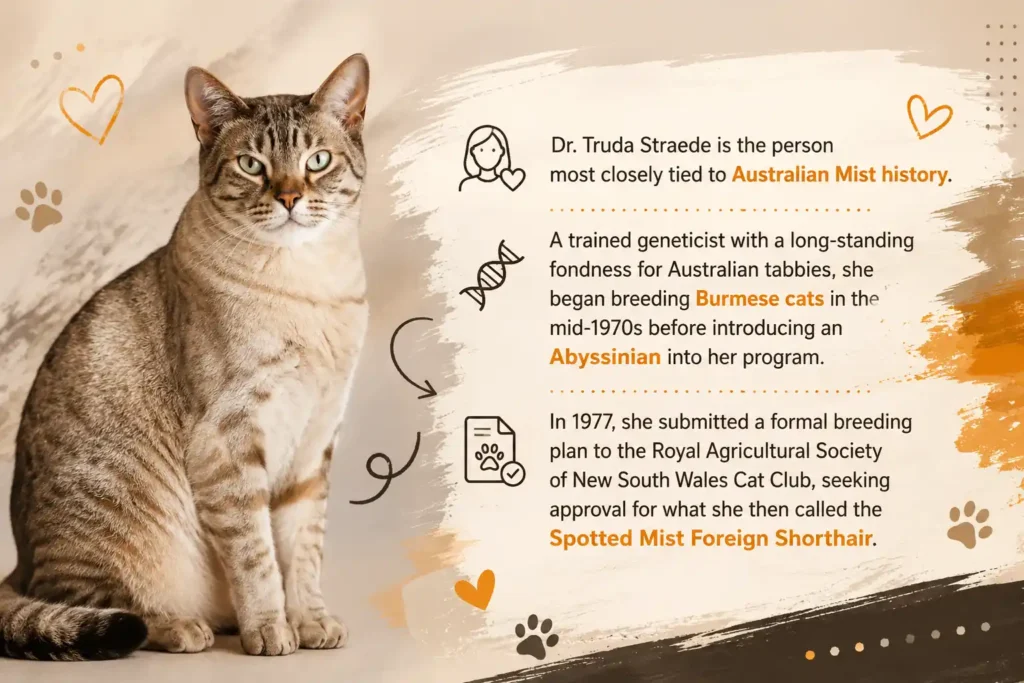
Dr. Truda Straede is the person most closely tied to Australian Mist history. A trained geneticist with a long-standing fondness for Australian tabbies, she began breeding Burmese cats in the mid-1970s before introducing an Abyssinian into her program. In 1977, she submitted a formal breeding plan to the Royal Agricultural Society of New South Wales Cat Club, seeking approval for what she then called the Spotted Mist Foreign Shorthair.
The breakthrough came with the birth of Nintu Horatio, widely regarded as the first true representative of the breed. Straede spent close to nine years refining bloodlines before the breed earned full registration.
The Breeds Used to Create the Australian Mist
Each foundation breed contributed something specific, and understanding that mix explains a lot about the Australian Mist’s look and personality today.
| Foundation Breed | Approx. Share | What It Contributed |
| Burmese | 50% | Body type, coat colour, and an affectionate, people-focused temperament |
| Abyssinian | 25% | The ticked hair shaft responsible for the breed’s soft, misted coat effect |
| Domestic Shorthair Tabby | 25% | Spotted patterning and genetic diversity for overall hardiness |
Why the Breed Was Originally Called the Spotted Mist: Early Australian Mist History
In the earliest chapter of Australian Mist history, the breed carried a different name entirely. Because the first generations only produced spotted coats, Straede and early breeders registered the cat as the Spotted Mist. The name described what breeders were seeing: a soft, hazy ground colour overlaid with distinct spots, created by the ticking inherited from the Abyssinian line. It took another two decades of breeding before a second coat pattern appeared and forced a rethink of the name.
When Was the Australian Mist Officially Recognized?
Recognition did not happen overnight or all at once across every country. Australian registries were first to grant the breed formal status, and international bodies followed at very different speeds over the next three decades. The gap between Australian recognition in 1986 and global recognition through bodies such as TICA in 2014 shows how slowly a new breed typically spreads beyond its country of origin.
How the Australian Mist Became a Recognized Breed
The path to recognition ran through several distinct milestones, each one expanding where the breed could be shown and bred officially.
| Registry | Year | Status Granted |
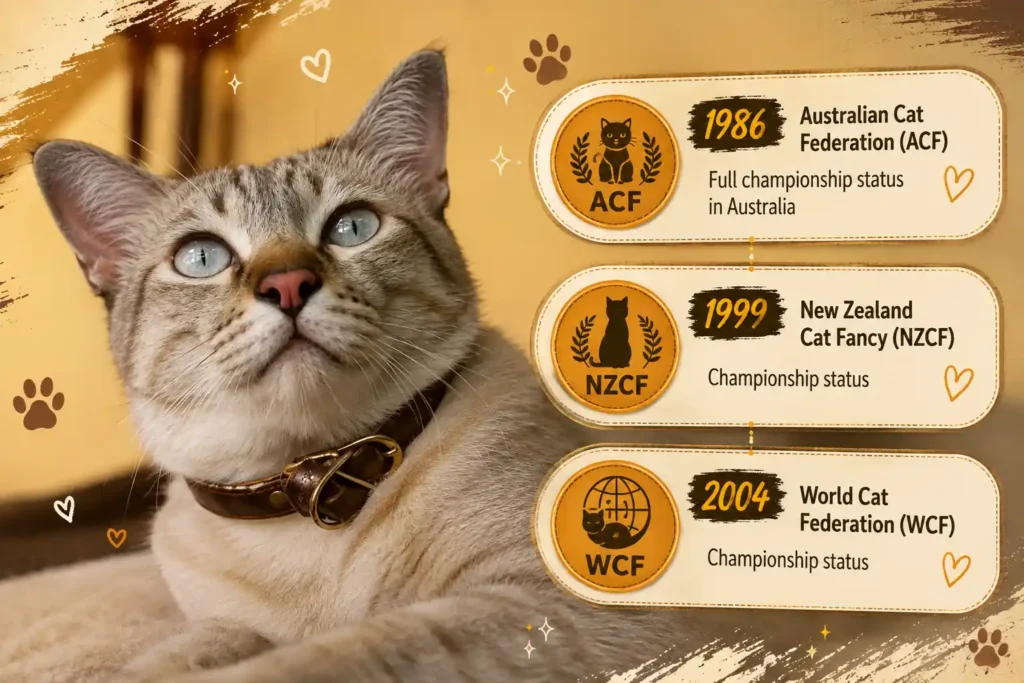
| Australian Cat Federation (ACF) | 1986 | Full championship status in Australia |
| New Zealand Cat Fancy (NZCF) | 1999 | Championship status |
| World Cat Federation (WCF) | 2004 | Championship status |
| Governing Council of the Cat Fancy (GCCF) | 2011 | Preliminary recognition in the UK |
| The International Cat Association (TICA) | 2014 | Championship status |
It’s worth noting that the International Cat Association (TICA), one of the world’s largest cat registries, only advanced the Australian Mist to championship status in May 2014, nearly 30 years after Australian recognition.
Who Created the Australian Mist Cat?
Dr. Truda Straede, a Sydney-based geneticist, created the Australian Mist. She began developing the breed in the mid-1970s by crossing Burmese, Abyssinian, and domestic shorthair tabby cats.
Australian Mist History in Australia
Australia took to its homegrown breed fairly quickly once the genetics stabilised. The Australian Cat Federation granted full championship recognition in 1986, letting breeders show their cats competitively and formalising the standard other catteries would breed toward.
Domestic demand grew steadily through the 1990s as more households looked for a cat suited to indoor living. Australian Mist history in this period is really a story about local cat councils, hobby breeders, and a slow build-up of trust in a brand-new breed.
How the Breed’s Name Changed to Australian Mist
By the late 1990s, selective breeding had produced something Straede’s original plan had not anticipated: a marbled coat variation alongside the classic spotted one. Rather than register two separate breeds, the Co-ordinating Cat Council of Australia and the Australian Cat Federation agreed unanimously to rename the breed.
In June 1998, “Spotted Mist” officially became “Australian Mist,” a name that covered both coat patterns and emphasised the breed’s national identity rather than a single physical trait.
The Australian Mist’s Development Outside Australia
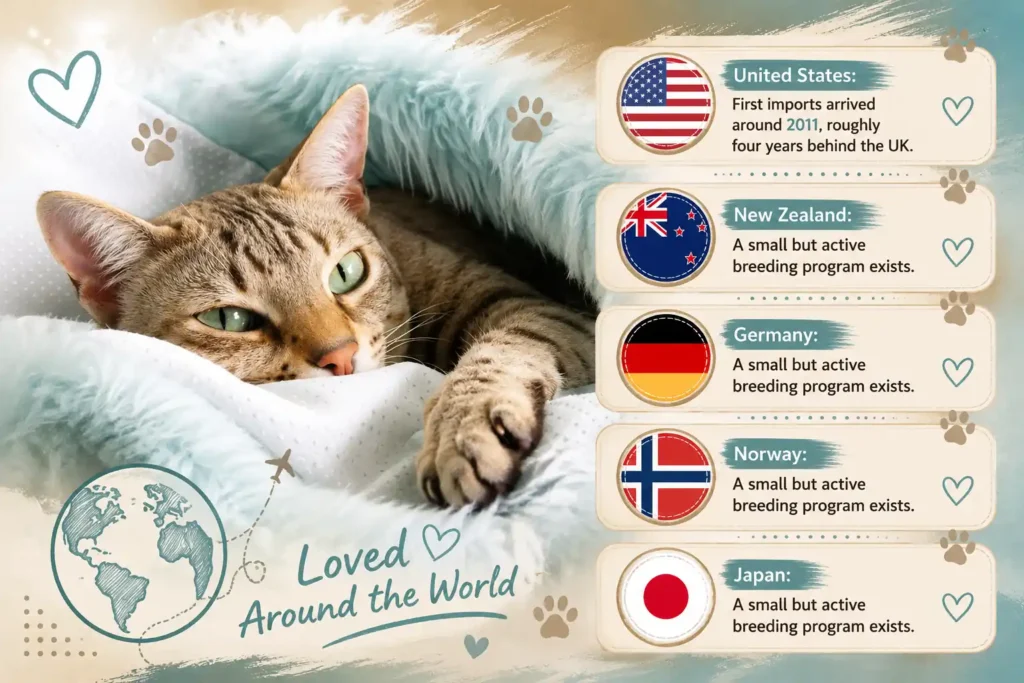
Exporting a brand-new breed is slow going, and the Australian Mist’s spread overseas reflects that. The first cats reached the United Kingdom in 2007, followed by preliminary GCCF recognition in 2011.
- United States: First imports arrived around 2011, roughly four years behind the UK.
- New Zealand: A small but active breeding program exists.
- Germany: A small but active breeding program exists.
- Norway: A small but active breeding program exists.
- Japan: A small but active breeding program exists.
- Recognition status: Major registries like the Cat Fanciers’ Association (CFA) and the Fédération Internationale Féline (FIFe) have yet to recognise the breed.
- Impact: This lack of major-registry recognition keeps international numbers modest compared to established breeds like the Burmese.
Australian Mist Breed Standards and Early Development
Early breed standards focused heavily on the coat: a short, dense texture with a soft misted look created by ticking over a spotted or marbled pattern. Straede’s original submission specified colours including brown, blue, chocolate, and lilac, with caramel, gold, and peach added later as the gene pool expanded.
Body type was modelled loosely on the Burmese: a moderate, muscular build rather than the extreme slenderness of some Oriental breeds. These standards gave overseas breeders something concrete to work toward once the cat began travelling beyond Australia.
How Australian Mist Cats Have Changed Over Time
The most visible change since the 1970s is coat pattern diversity, with marbled cats now shown alongside the original spotted type. Eye colour has also become more consistent, with adult cats reliably developing shades of green rather than the yellowish cast seen in kittens.
Breeders have continued refining temperament, and today’s adult Australian Mist is generally calmer than the notably lively kittens the breed produces. Coat colour can take up to two years to fully develop, a trait breeders now expect rather than treat as unusual.
Australian Mist History Timeline
A quick timeline makes it easier to see how gradually this breed actually developed, spanning roughly five decades from first idea to global, if still limited, recognition.
| Year | Milestone |
| 1975–76 | Dr. Truda Straede begins early crosses of Burmese and Abyssinian cats. |
| 1977 | Formal breeding plan submitted to the Royal Agricultural Society of NSW Cat Club |
| 1980 | Birth of Nintu Horatio, the first true Spotted Mist |
| 1986 | Full championship recognition from the Australian Cat Federation |
| 1998 | Breed renamed from Spotted Mist to Australian Mist |
| 1999 | Championship status granted by the New Zealand Cat Fancy |
| 2004 | Championship status granted by the World Cat Federation |
| 2007 | First Australian Mists imported into the United Kingdom |
| 2011 | Preliminary GCCF recognition; first US imports arrive. |
| 2014 | Championship status granted by The International Cat Association |
When Was the Australian Mist First Recognized?
The Australian Mist first earned full championship recognition from the Australian Cat Federation in 1986. International recognition came much later, with TICA granting championship status in 2014.
Why the Australian Mist Remains a Rare Cat Breed
Several factors keep the Australian Mist rare outside Australia even in 2026. Strict Australian biosecurity rules make exporting breeding cats difficult and costly, limiting how fast overseas catteries can grow. Major registries such as the Cat Fanciers’ Association still do not recognise the breed, reducing its visibility at North American shows, and the Governing Council of the Cat Fancy
in the UK still treats it as a newer, developing breed there. In Australia, kittens typically sell for roughly $800 to $2,000 USD depending on lineage, while international buyers can expect $2,500 to $5,000 USD once import fees, transport, and quarantine costs are added.
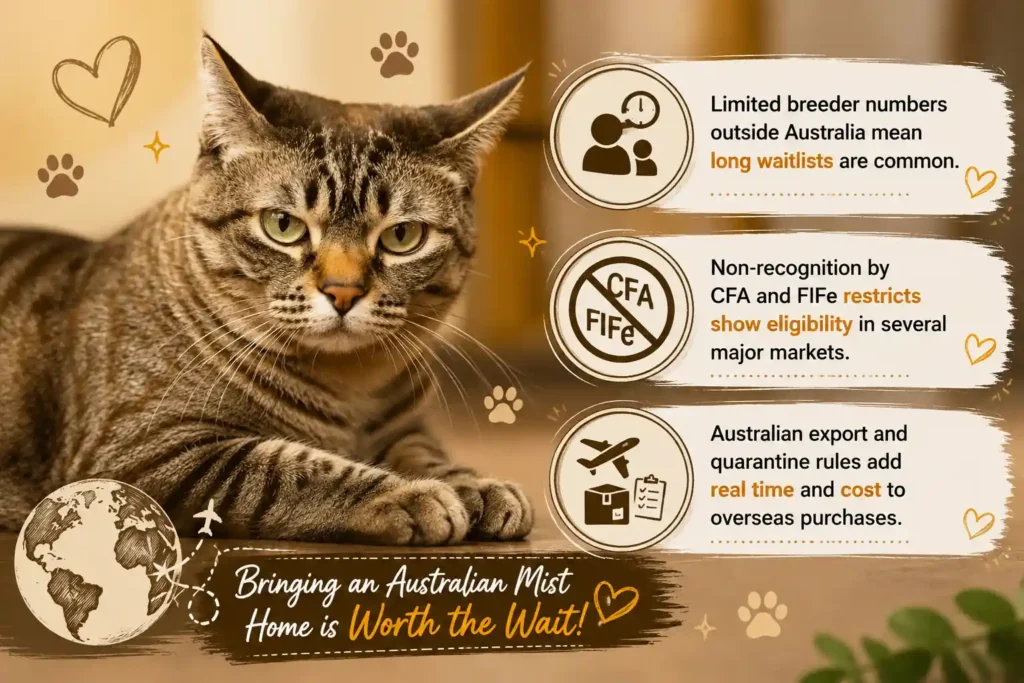
- Limited breeder numbers outside Australia mean long waitlists are common.
- Non-recognition by CFA and FIFe restricts show eligibility in several major markets.
- Australian export and quarantine rules add real time and cost to overseas purchases.
Is the Australian Mist a Rare Cat Breed?
Yes. The Australian Mist is considered a rare breed outside Australia, largely due to strict export rules, limited international breeder numbers, and non-recognition by major registries like the CFA.
The Legacy of Australian Mist History
Australian Mist history is a rare example of a cat breed built entirely by design rather than chance. What began as Dr. Truda Straede’s idea in 1976 grew into a breed with a clear identity, a stable coat pattern, and a temperament suited to modern indoor life. From the first litter in 1980 to full Australian recognition in 1986, and the name change to Australian Mist in 1998, every step reflects careful, patient breeding rather than luck.
Today, the breed remains closely tied to its Australian roots, with limited but growing recognition abroad through registries like TICA and the GCCF. Export restrictions and a small international breeder base keep the Australian Mist rare outside Australia, but that scarcity is also part of its appeal. Nearly fifty years after Straede’s original plan, the Australian Mist stands as proof that a well-planned breeding program can create not just a new cat, but a genuine piece of Australian heritage.
Frequently Asked Questions About Australian Mist History
Who developed the Australian Mist breed?
Dr. Truda Straede, a geneticist from Sydney, developed the Australian Mist starting in the mid-1970s by crossing Burmese, Abyssinian, and domestic shorthair tabby cats.
What was the Australian Mist originally called?
The breed was originally called the Spotted Mist. It kept that name until 1998, when marbled-coated cats were accepted, and the breed was renamed Australian Mist.
When did the Australian Mist get international recognition?
International recognition came gradually: New Zealand in 1999, the World Cat Federation in 2004, preliminary GCCF status in the UK in 2011, and TICA championship status in 2014.
Is the Australian Mist related to the Burmese cat?
Yes. The Burmese makes up roughly half of the Australian Mist’s genetic foundation and is largely responsible for its body type and affectionate temperament.
Why is the Australian Mist still considered rare?
Strict Australian export and biosecurity rules, limited breeder numbers abroad, and non-recognition by major registries like the CFA all keep global numbers low.