
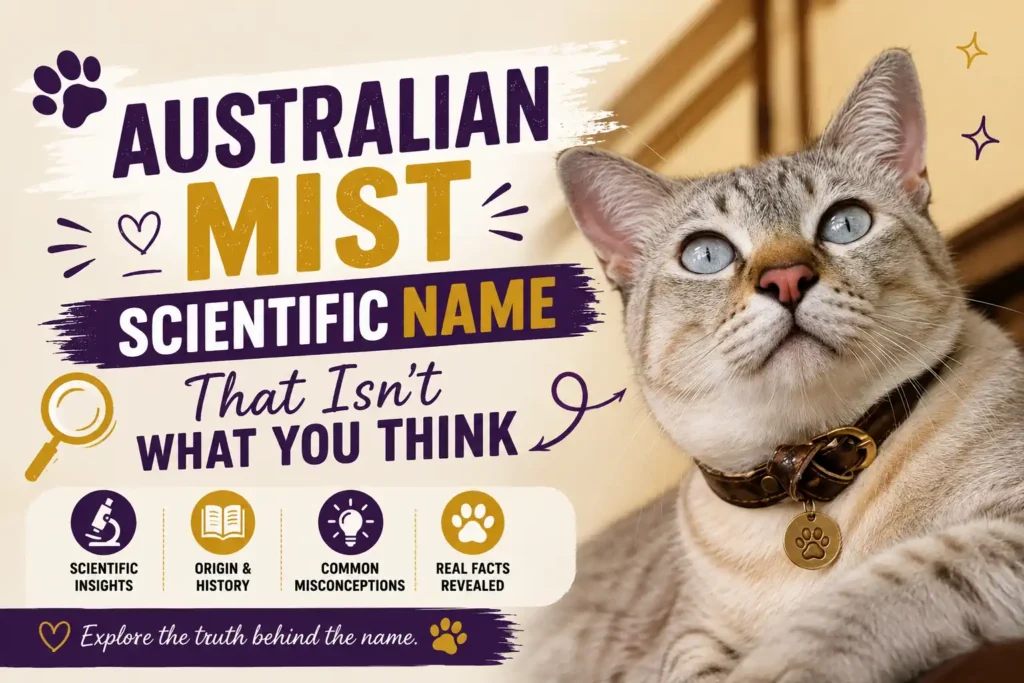
The Australian Mist’s scientific name is Felis catus, the same classification given to every domestic cat in the world. This fact often surprises people who expect a unique or exotic scientific title for such a distinctive breed. Despite sharing its scientific name with all house cats, the Australian Mist stands out through its genetics, history, and appearance rather than its taxonomy.
The breed was developed in Australia through careful crossbreeding of Abyssinian, Burmese, and domestic shorthair cats, resulting in a coat pattern found nowhere else. So while the Australian Mist Scientific Name tells you it belongs to the common cat species, the breed’s true identity lies in its spotted, marbled coat and its carefully documented development history.
Australian Mist Scientific Name
Felis catus applies to every domestic cat on Earth, and the Australian Mist Scientific Name is no exception to that global rule. Genetic testing across cat breeds confirms one shared ancestor, the African wildcat (Felis lybica), tamed roughly 10,000 years ago near the Fertile Crescent. Breed clubs use common names like “Australian Mist” purely for marketing and pedigree tracking, not for biological classification.
Scientists rely on binomial nomenclature instead, a two-part naming system created by Carl Linnaeus in 1758 that still governs every living species today. This distinction matters for buyers who assume a striking coat pattern signals a distinct species, because it does not. Genetics inside the Felidae family stay remarkably consistent even when coat colors and patterns vary this widely.
Scientific Classification
Kingdom Animalia sits at the top of the Australian Mist’s classification, followed by Chordata, Mammalia, and Carnivora, the same broad groups every big cat and house cat share. Family Felidae narrows things down to true cats, while genus Felis covers small, non-roaring cats built for close human contact. Species-level classification lands on Felis catus, confirmed by the Integrated Taxonomic Information System (ITIS), a government-run database that tracks accepted names for recognized organisms across North America. Recognizing the Australian Mist Scientific Name inside this system helps explain why the breed shares vaccination schedules, nutrition needs, and general veterinary care with any other domestic shorthair.
Breed-specific traits, like the ticked coat inherited from Abyssinian ancestors, sit entirely outside formal taxonomy. Taxonomists classify species, not breeds, so pedigree distinctions stay in the hands of cat registries rather than biologists.
The table below breaks down each taxonomic rank recognized for the breed, from kingdom down to species.
| Rank | Classification |
| Kingdom | Animalia |
| Phylum | Chordata |
| Class | Mammalia |
| Order | Carnivora |
| Family | Felidae |
| Genus | Felis |
| Species | Felis catus |
| Binomial Name | Felis catus (Linnaeus, 1758) |
Taxonomy of the Australian Mist
Binomial nomenclature groups the Australian Mist under Felis catus alongside dozens of recognized cat breeds tracked by major registries worldwide. Carl Linnaeus established this two-name system in 1758, pairing a genus and species name for every organism he catalogued. Felis, the genus name, includes seven wildcat species plus the domestic cat, according to feline taxonomy records maintained by conservation researchers.
Catus, the species name, distinguishes domesticated cats from wild relatives like the European wildcat (Felis silvestris) and the jungle cat (Felis chaus). None of these taxonomic ranks reference coat pattern, temperament, or country of origin, which explains why breed names exist as a separate, informal layer. Cat fanciers created the term “Australian Mist” decades after Linnaeus’s system was already in place, purely to market a homegrown breed.
Australian Mist Scientific Name: Quick Answer
Felis catus is the correct answer, identical to the classification used for every other domestic cat breed recognized worldwide. Breed distinctions like spotted or marbled coats exist below the species level and never change the underlying taxonomy.
Breed Origin and Development
Sydney, Australia hosted the first breeding experiments during the 1970s, led by geneticist Dr. Truda Straede. Abyssinian, Burmese, and non-pedigreed spotted domestic shorthairs formed the three-way cross that eventually produced the breed. Nine years of selective breeding passed before the Royal Agricultural Society Cat Club accepted the first generation into an experimental category in May 1980.
Breeders called early litters “Spotted Mist” throughout the 1980s, referencing the ticked, spotted coat pattern that set kittens apart from ordinary tabbies. A marbled coat variety followed in June 1997, prompting a full name change to “Australian Mist” in 1998 once both patterns gained equal recognition. Coat color itself takes up to two years to fully develop, so kittens often look quite different from their adult selves.
- Abyssinian: contributed the lively personality and ticked coat
- Burmese: contributed the easy-going nature and sepia coloring
- Domestic shorthair: contributed genetic diversity and overall hardiness
This timeline highlights the key dates that shaped the breed’s development and its eventual name change.
| Year | Milestone |
| 1970s | Breeding program begins in Sydney under Dr. Truda Straede |
| May 1980 | First generation accepted into RASCC experimental category |
| 1986 | “Spotted Mist” reaches championship status in Australia. |
| June 1997 | Marbled coat pattern officially accepted |
| 1998 | Breed renamed “Australian Mist” |
| 2014 | TICA grants full championship status |
Australian Mist Breed Recognition
The International Cat Association granted the Australian Mist full championship status on May 1, 2014, opening the door to competition across North America. The Governing Council of the Cat Fancy followed a similar path, offering preliminary recognition in October 2011 before upgrading to championship status in February 2017. New Zealand Cat Fancy recognized the breed even earlier, on January 1, 1999, making it one of the first international registries to do so.
World Cat Federation added its own recognition in August 2004, extending the breed’s reach across continental Europe. The Cat Fanciers’ Association has not yet added the Australian Mist to its list, which keeps the breed rarer in the United States compared with Australia or the UK. Fewer than a handful of catteries currently operate outside Australia, with small numbers reported in the UK, the US, and Norway.
The timeline below shows exactly when each major registry recognized the breed, which helps explain its patchy availability outside Australia.
| Registry | Status | Year |
| TICA | Championship | 2014 |
| GCCF | Championship | 2017 (preliminary 2011) |
| New Zealand Cat Fancy | Championship | 1999 |
| World Cat Federation | Recognized | 2004 |
| CFA | Not yet recognized | N/A |
Is the Australian Mist a Separate Species?
Felis catus covers the Australian Mist just as it covers a Maine Coon, a Persian, or an alley cat with no pedigree at all. Breeders never introduced wild feline DNA into the foundation lines, a fact that rules out any classification change at the species level. Coat pattern, ticking, and temperament come from selective breeding within the same species, not from cross-species hybridization.
Some breeds, like the Bengal, do carry wildcat ancestry (Prionailurus bengalensis) and face different ownership regulations in certain countries as a result. Australian Mist kittens face no such restrictions, since their entire genetic background traces back to domestic cat lines. Veterinary care, vaccination schedules, and nutrition recommendations stay identical to any other domestic shorthair for exactly this reason.
Quick Answer: Is It a Separate Species?
No. Felis catus applies to the Australian Mist and every other domestic cat breed, since selective breeding changes appearance, not species classification.
Scientific Name vs. Common Name: What’s the Difference?
Common names like “Australian Mist” describe appearance, origin, and breeder marketing, while scientific names describe biological classification. Confusion often starts here, since the Australian Mist Scientific Name (Felis catus) gives zero information about coat pattern, color, or personality. Breed standards published by cat registries fill that gap instead, listing acceptable colors, eye shape, and body type for judges and buyers. Seven main colors currently qualify under most breed standards, and each carries equal standing within the registry. Spotted and marbled patterns represent the only two coat types accepted across major registries. Anyone researching a specific breed should check both the scientific classification and the official breed standard, since each one answers a different question.
- Brown, blue, chocolate, lilac
- Gold, peach, caramel
Quick Answer: Scientific Name vs. Common Name
Felis catus is the biological classification shared by all domestic cats. “Australian Mist” is the common name describing this specific breed’s coat, origin, and temperament.
Conclusion
Felis catus remains the Australian Mist’s scientific name, a fact that ties this breed to every other domestic cat despite its distinctive coat. Scientific classification places the breed under Kingdom Animalia, Family Felidae, and Genus Felis, exactly like any tabby or Persian. Taxonomy traces back to Linnaeus’s 1758 naming system, which never accounts for breed-specific traits like ticking or marbling. Sydney breeder Dr. Truda Straede spent nine years developing the foundation lines during the 1970s and 1980s.
Major registries, including TICA, GCCF, and the World Cat Federation, have since granted the breed recognition or championship status internationally. Species-level classification confirms the Australian Mist is not a separate species, just a selectively bred variation of Felis catus. Common names and scientific names answer different questions: one about biology, one about breed identity. Buyers researching this rare, $800-$1,200 breed now have both pieces of the puzzle in one place.
Frequently Asked Questions
What is the scientific name of the Australian Mist cat?
Felis catus is the scientific name, shared with every other domestic cat breed on the planet.
Is the Australian Mist a separate cat species?
No. It belongs to Felis catus and carries no wildcat ancestry in its foundation lines.
Who developed the Australian Mist breed?
Dr. Truda Straede, a Sydney-based geneticist, developed the breed during the 1970s and 1980s.
Is the Australian Mist recognized by TICA and GCCF?
Yes. TICA granted championship status in 2014, and GCCF followed in 2017 after preliminary recognition in 2011.
How much does an Australian Mist kitten cost in 2026?
Reputable breeders typically charge between $800 and $1,200 per kitten, depending on pedigree and location.
What is the average lifespan of an Australian Mist?
Most Australian Mist cats live between 12 and 16 years with regular veterinary care.