

The Blue and Gold Macaw (Ara ararauna) is a large South American parrot known for its bright blue back, golden-yellow chest, and green forehead, and these Blue and Gold Macaw Facts start with its impressive size: adults grow up to 34 inches long and can weigh nearly 3 pounds, making them one of the biggest parrot species in the world.
They live in tropical forests, savannas, and swamp areas across countries like Brazil, Peru, and Colombia, often near rivers where they find clay licks rich in minerals that help neutralize toxins from the seeds and fruits they eat. Wild pairs form lifelong bonds and can live between 30 and 35 years, while birds in captivity sometimes reach 50 years or more with proper care. Their strong, curved beaks let them crack open tough nuts and seeds that most other animals cannot open, showing just how well-adapted these Blue and Gold Macaw Facts prove them to be for survival in their natural habitat.
Blue and Gold Macaw Facts
The quick-reference table below gathers the core numbers before each section explores the details further. Every figure comes from established zoological and conservation sources, and each one gets a closer look later on the page. Skimming this overview first makes the deeper sections on biology, geography, and conservation status much easier to follow.
| Category | Detail |
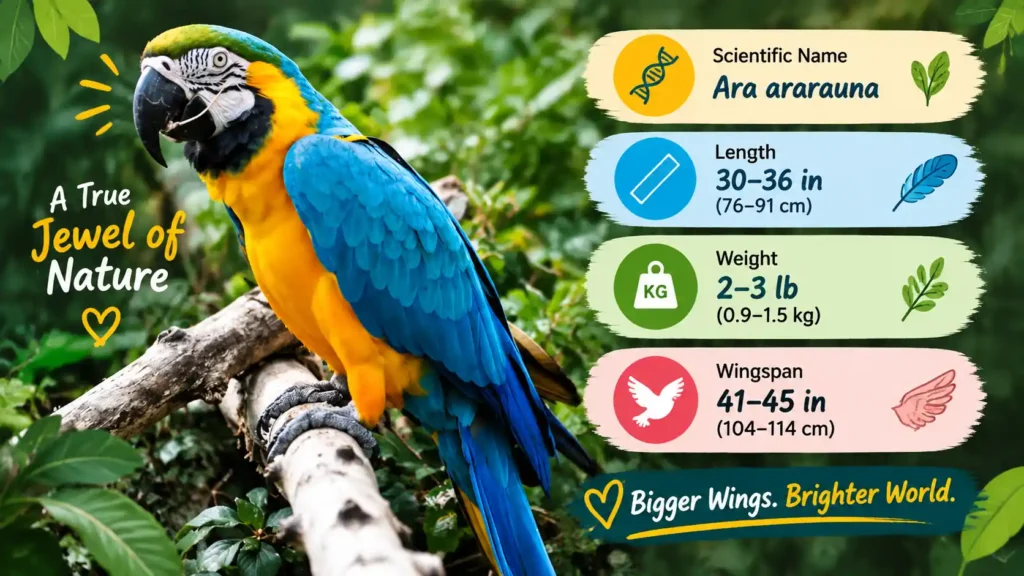
| Scientific Name | Ara ararauna |
| Length | 30–36 in (76–91 cm) |
| Weight | 2–3 lb (0.9–1.5 kg) |
| Wingspan | 41–45 in (104–114 cm) |
| Lifespan | 30–35 years wild; 60+ years captive |
| Colors | Blue, gold, green, white, black |
| Habitat | Tropical forest, savanna, palm swamp |
| Diet | Seeds, nuts, fruit, clay |
| Conservation Status | Least Concern (IUCN) |
Blue and Gold Macaw Scientific Name
Ara ararauna serves as the formal scientific name, assigned by Swedish naturalist Carl Linnaeus back in 1758. Ornithologists group the species under the genus Ara, family Psittacidae, and order Psittaciformes alongside every other true parrot. No recognized subspecies exist, which keeps the taxonomy fairly straightforward compared to other macaws. English speakers often use blue-and-yellow macaw and blue-and-gold macaw interchangeably, since both names describe the identical bird. Museum specimens and modern DNA studies continue to confirm this classification with very little dispute among ornithologists.
- Genus: Ara
- Species: ararauna
- Family: Psittacidae
- Common alternate name: Blue-and-yellow macaw
Blue and Gold Macaw Size
Adult birds typically measure 30 to 36 inches from beak to tail tip, placing this species among the larger members of the genus Ara. Roughly half of that total length comes from the long, tapering tail feathers rather than the body itself. Compared to smaller mini-macaws, this size difference explains why the species needs generous cage or aviary dimensions in captivity.
Bone structure and flight muscle built for sustained travel also support the considerable wingspan covered further below. Full adult size is usually reached by around one year of age, though feather color continues to deepen slightly afterward.
Blue and Gold Macaw Weight
Body weight generally falls between 2 and 3 pounds, or roughly 900 grams to 1.5 kilograms, depending on age, sex, and individual build. Males and females look nearly identical, so weight and subtle skeletal differences remain among the few visual clues experts use before DNA testing.
Chicks gain weight quickly during their first four months, since fledging depends on reaching adult flight muscle mass. A healthy adult weight matters clinically too, and sudden loss often signals illness that warrants an avian veterinarian’s attention. Regular weigh-ins are a standard part of routine care for captive birds.
How Big Do Blue and Gold Macaws Get?
Blue and gold macaws typically reach 30 to 36 inches in length and weigh between 2 and 3 pounds, making them one of the larger parrot species commonly seen in aviculture and in the wild.

Blue and Gold Macaw Lifespan
Wild populations average 30 to 35 years, while well-cared-for captive birds regularly reach 60 years and occasionally beyond. One of the more surprising Facts involves this longevity gap, since a captive macaw can easily outlive the person who first brought it home. Sexual maturity arrives between three and six years of age, considerably later than most companion animals reach adulthood. Genetics, diet quality, and veterinary care all influence how close a given bird gets to that upper lifespan range. This long lifespan is exactly why potential owners are urged to plan for lifelong, multi-decade care before adoption.
How Long Do Blue and Gold Macaws Live?
Blue and gold macaws live around 30 to 35 years in the wild and up to 60 years or more in captivity, making them one of the longest-lived parrot species kept as companion birds.
Blue and Gold Macaw Wingspan
A fully extended wingspan reaches 41 to 45 inches, or roughly 104 to 114 centimeters, giving the species powerful, sustained flight across open canopy gaps. That wing surface area helps birds cover long daily distances between roosting sites and feeding grounds. Strong pectoral muscles anchor to a deep keel bone, the same structural feature found in other long-distance flying parrots.
Improperly clipped wings in captivity can affect balance and stress levels, so professional guidance is always recommended. Flight also plays a major role in natural exercise and mental stimulation, which is why aviary space matters so much for captive birds.
Blue and Gold Macaw Habitat
Wild birds favor tropical and subtropical lowland forest, especially varzea floodplain forest that floods seasonally along major rivers. Open savanna, palm swamp, and the edges of terra firme forest also support healthy populations across the range. Among the more practical Facts for birdwatchers, nesting almost always happens inside dead or dying palm trunks, particularly Mauritia flexuosa palms.
Riverside cliffs and clay banks double as social gathering points, a detail that connects directly to the diet section below. Flocks tend to roost communally each night, then split into pairs or small groups to forage during the day. Canopy height and tree density both influence nest-site selection, since taller, more established forest tends to offer safer, more stable cavities.
Where Do Blue and Gold Macaws Live?
Native range stretches across a wide swath of tropical South America and a narrow strip of Central America. Countries with established wild populations include Panama, Venezuela, Colombia, Ecuador, Peru, Bolivia, Brazil, Paraguay, Guyana, Suriname, and French Guiana. Small non-native breeding populations also persist in Miami-Dade County, Florida, and Puerto Rico, both likely descended from escaped or released pet birds.
Local extinction has already occurred in Trinidad, and numbers continue shrinking in parts of Paraguay because of habitat pressure. The table below breaks down where wild and non-native populations currently stand.
| Region | Status |
| Panama | Native, limited range |
| Colombia, Venezuela, Ecuador, Peru, Bolivia, Brazil | Core native range |
| Guyana, Suriname, French Guiana | Native range |
| Trinidad | Locally extinct |
| Florida (Miami-Dade), Puerto Rico | Non-native, self-sustaining |
What Do Blue and Gold Macaws Eat?
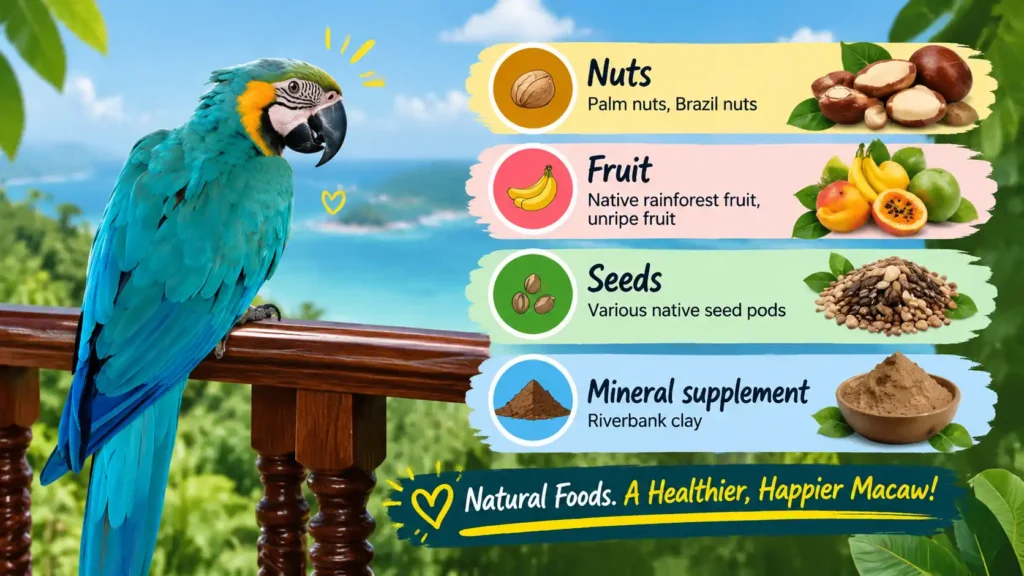
Wild diet centers heavily on palm nuts, seeds, fruit, and berries gathered from the forest canopy and understory. Powerful, hooked beaks apply enough force to crack shells that would defeat most other birds outright. Several regularly eaten plants contain natural toxins, so macaws visit exposed riverbank clay licks to neutralize those compounds before or after feeding.
The Association of Avian Veterinarians advises that captive macaws need a varied, pellet-based diet rather than an all-seed mix, since seed-heavy diets are linked to obesity and nutrient deficiencies. The table below lists the main food categories found in a wild diet.
| Food Type | Examples |
| Nuts | Palm nuts, Brazil nuts |
| Fruit | Native rainforest fruit, unripe fruit |
| Seeds | Various native seed pods |
| Mineral supplement | Riverbank clay |
- Strong beaks crack hard palm nuts most other birds cannot open
- Clay licks help neutralize natural plant toxins
- Captive diets should combine pellets, fresh produce, and limited seed
Blue and Gold Macaw Colors
Bright turquoise-blue feathers cover the back, wings, and tail, while a rich golden-yellow washes across the chest and belly. A band of green crosses the forehead just above the beak, fading gradually into the blue of the crown. Bare white facial skin features thin lines of tiny black feathers, giving each bird a slightly different facial pattern, almost like a fingerprint.
These color patterns rank among the most photographed Facts shared across birdwatching communities, since no two faces look quite the same. Feather color also plays a role in mate selection, with brighter, bolder plumage generally signaling a stronger, healthier bird. Juvenile feathers look slightly duller at first and gradually brighten as the young bird matures over its first year.
Are Blue and Gold Macaws Endangered?
The IUCN Red List currently classifies the species as Least Concern, reflecting its large range and generally stable overall population. That status does not mean the species faces no pressure, since population trends are listed as declining across several regions. International trade falls under CITES Appendix II, which restricts and monitors commercial export rather than banning it outright.
Habitat loss from deforestation and continued illegal capture for the pet trade remain the two biggest ongoing threats. Conservation groups continue monitoring regional population trends closely, since a Least Concern rating can change if those pressures intensify.
Quick Facts on Conservation Status
Blue and gold macaws are currently listed as Least Concern by the IUCN, though CITES Appendix II protections regulate international trade because of ongoing habitat loss and capture for the pet trade.
Summing Up a Remarkable Bird
Taken together, these Blue and Gold Macaw Facts paint the picture of a genuinely remarkable bird. The scientific name Ara ararauna ties the species to a well-documented taxonomic history, while its size and weight explain why it ranks among the larger parrots seen in aviculture. A wide wingspan supports the strong, sustained flight this species relies on across its native range, and lifespan numbers reveal just how long a commitment this bird represents.
Habitat preferences point toward river-adjacent forest and palm swamp, and the list of countries where these macaws live shows how far that range extends across South and Central America. Diet details highlight a resourceful feeding strategy built around tough nuts, ripe fruit, and toxin-neutralizing clay. Vivid coloring remains the trait most people notice first, and current conservation status confirms the species is holding steady for now, even as habitat loss and trapping continue to chip away at wild numbers.
Frequently Asked Questions
What is the scientific name of the Blue and Gold Macaw?
Ara ararauna is the accepted scientific name, first described by Carl Linnaeus in 1758.
How big do Blue and Gold Macaws get?
Adults typically measure 30 to 36 inches long and weigh between 2 and 3 pounds, with a wingspan of 41 to 45 inches.
How long do Blue and Gold Macaws live?
Wild birds average 30 to 35 years, while captive macaws with good care often live 60 years or more.
What do Blue and Gold Macaws eat in the wild?
Wild macaws eat palm nuts, seeds, fruit, and berries, and they visit clay licks to neutralize natural plant toxins.
Are Blue and Gold Macaws endangered?
No, the IUCN lists the species as Least Concern, though CITES Appendix II regulates international trade due to habitat loss and pet trade pressure.