
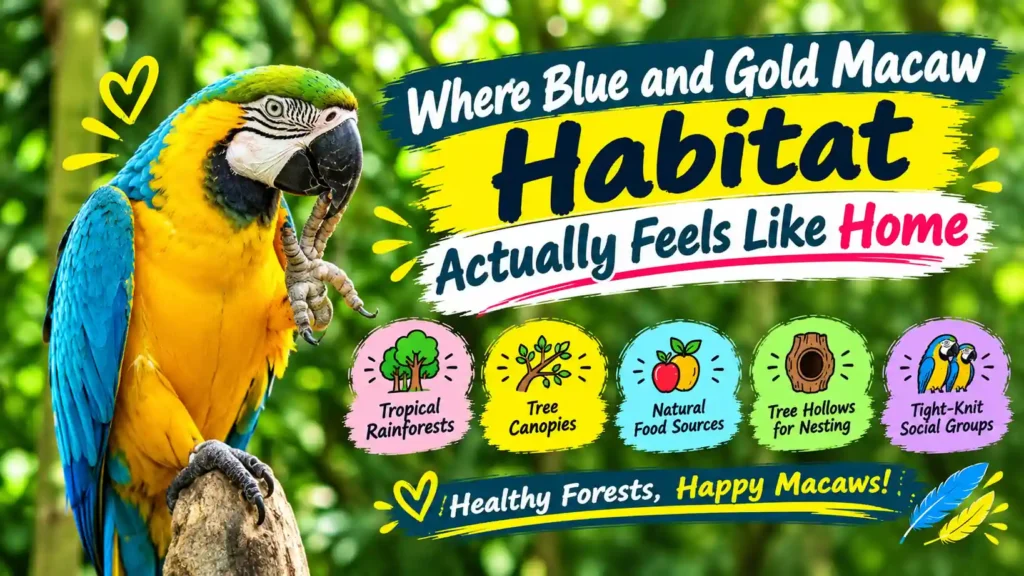
The natural Blue and Gold Macaw Habitat spans humid lowland forests, wooded savannas, and swamp regions from Panama down through Colombia, Venezuela, Ecuador, Peru, Brazil, and Bolivia. These birds favor areas near rivers, where tall Mauritia palm trees grow in large numbers, since the fruit from these palms makes up a major part of their diet. Flocks nest in natural holes found high inside dead or dying trees, often thirty meters or more above the ground, which keeps their eggs and chicks safe from most predators.
Clay licks along riverbanks are another key feature of the Blue and Gold Macaw Habitat, since the birds gather there in large groups to eat mineral-rich soil that helps neutralize toxins from the seeds and unripe fruit they consume. Deforestation, especially the clearing of palm swamps for farming and logging, has steadily reduced the size of suitable nesting and feeding grounds across the species’ range.
Where Do Blue and Gold Macaw Habitat Birds Live
Blue and gold macaws occupy a broad swath of northern and central South America, with isolated populations reaching into Central America. Wild birds favor lowland tropical zones below 500 meters in elevation, though they occasionally forage higher.
A healthy Blue and Gold Macaw Habitat depends on more than open space. Wooded areas near rivers, lakes, and swamps give these macaws everything they need: nesting cavities, fruiting trees, and safety from ground predators. Palm groves are especially important because dead moriche palms provide the soft, rotted wood that macaws hollow out for nests.
Key countries within their range include:
- Brazil
- Bolivia
- Peru
- Ecuador
- Colombia
- Venezuela
- Guyana, Suriname, and French Guiana
- Eastern Panama and parts of Trinidad and Tobago
Farmland and cleared pasture rarely support breeding pairs. Mature trees with usable nest cavities take decades to form, so cleared regions often stay unsuitable for years after logging stops.
Blue and Gold Macaw Natural Range
Ornithologists describe the natural range as a mosaic rather than one continuous block. Populations cluster around river systems such as the Amazon, Orinoco, and their many tributaries, since waterways offer both food and the mineral-rich clay licks macaws visit daily.
Some regional gaps exist because of natural barriers like the Andes Mountains, which the birds rarely cross. Genetic studies suggest limited mixing between far-flung populations, though all belong to the same species, Ara ararauna.
Three factors shape where wild flocks settle:
- Access to fruiting palms, particularly Mauritia flexuosa
- Proximity to exposed clay banks for mineral supplementation
- Low human disturbance during nesting season
Countries Within Blue and Gold Macaw Habitat
Brazil, Bolivia, Peru, Ecuador, Colombia, Venezuela, Guyana, Suriname, French Guiana, Panama, and Trinidad and Tobago all host wild populations. Brazil’s Amazon basin holds the largest and most stable numbers, according to range data compiled by conservation researchers.
Rainforest and Wetland Habitat Types
Lowland tropical rainforest forms the backbone of Blue and Gold Macaw Habitat, but these birds are more flexible than many parrot species. Gallery forests lining rivers, seasonally flooded swamp forest, and even savanna edges with scattered palms all support feeding flocks.
Open country foraging happens more often than people expect. Macaws will cross grassland or agricultural clearings to reach a reliable food source, then return to forest cover to roost each evening.
The table below summarizes the main environments these birds use.
| Habitat Type | Primary Function | Typical Vegetation |
| Lowland rainforest | Roosting, breeding cavities | Tall hardwoods, palms |
| Swamp and gallery forest | Feeding, nesting sites | Moriche palm, riverside trees |
| Savanna edge | Seasonal foraging | Scattered palms, grasses |
| Riverbank clay licks | Mineral intake | Exposed clay, sparse cover |
Climate and Elevation Requirements
Warm, humid conditions define almost every corner of their native range. Average temperatures across the macaw’s territory rarely drop below 20°C, and humidity often exceeds 70% for much of the year.
Elevation limits are fairly strict. Wild sightings above roughly 500 meters are uncommon, since cooler mountain air and different vegetation don’t support the fruiting trees these birds rely on.
Rainfall patterns influence breeding timing as well:
- Breeding season often falls between December and March in Colombia
- Surinamese populations tend to nest slightly later, from February through March
- Dry-season food shortages can delay clutches in some regions
What Climate Do Blue and Gold Macaws Need
Blue and gold macaws thrive in warm, humid tropical climates with temperatures generally between 24°C and 33°C and elevations under 500 meters. Consistent rainfall supports the fruiting palms and trees that make up most of their diet.
Habitat Loss and Conservation Concerns
Deforestation for agriculture, logging, and cattle ranching removes nesting trees faster than new ones mature, which puts long-term pressure on wild flocks even though the species overall remains widespread. Roughly a third of historical range habitat has already been altered by human activity, according to conservation summaries referenced by wildlife organizations.
Illegal capture for the pet trade compounds habitat pressure. Poachers often destroy nest cavities to reach chicks, permanently removing that tree from future breeding use.
Common threats include:
- Clear-cutting for cattle pasture and soy farming
- Illegal wildlife trafficking
- Competition for nest sites with other cavity-nesting species
- Climate-driven shifts in fruiting cycles
The IUCN Red List currently classifies the species as Least Concern, though population trends are listed as decreasing in several assessments. The Convention on International Trade in Endangered Species of Wild Fauna and Flora lists the bird under Appendix II, which restricts commercial international trade.
Recreating Blue and Gold Macaw Habitat for Captive Birds
Pet owners cannot replicate a rainforest, but thoughtful housing choices borrow lessons directly from the wild. Large flight cages or dedicated bird rooms come closest to meeting a macaw’s need for space and mental stimulation.
Humidity and temperature matter indoors too. Dry indoor heating during winter months can affect feather and skin condition, so many owners add humidifiers or regular misting sessions.
Suggested minimum housing specifications appear below.
| Housing Element | Wild Equivalent | Suggested Minimum |
| Cage or aviary size | Open canopy space | 4 ft W x 4 ft D x 6 ft H |
| Humidity | Tropical rainforest air | 50-60% |
| Foraging enrichment | Wild seed and fruit search | Daily puzzle feeders |
| Perching variety | Mixed branch diameters | 3+ perch types |
How Much Space Do Blue and Gold Macaws Need
Blue and gold macaws need the largest cage a household can reasonably provide, ideally no smaller than 4 feet wide, 4 feet deep, and 6 feet tall, along with several hours of supervised out-of-cage flight or exercise daily.
Diet Connections to Their Native Environment
Wild diet directly reflects what grows within their habitat: palm fruits, nuts, seeds, berries, and occasional flowers or nectar. Captive diets should mirror this variety rather than relying on seed mixes alone.
A balanced approach includes:
- Fresh vegetables and low-sugar fruits
- Nuts in moderation, given their high fat content
- Pelleted diets formulated for large parrots
- Occasional access to safe branches for natural chewing behavior
Veterinary nutritionists generally recommend limiting seed-only diets, since they lack the vitamin and mineral balance wild birds get from a varied rainforest menu.
Family and Household Compatibility
Households considering a macaw should weigh how closely they can match natural behaviors like foraging, flying, and vocalizing. These birds are loud by nature, a trait tied directly to long-distance flock communication in open rainforest canopy.
Families with older children, consistent routines, and enough space for a large cage tend to have the most success. Noise-sensitive households or those in apartments with thin walls may find the vocal volume challenging.
Anyone unsure about a bird’s health or behavior should consult an avian veterinarian rather than guessing, since parrots often mask illness until symptoms become serious. The Association of Avian Veterinarians offers directories for finding a qualified specialist in most regions.
Blue and Gold Macaw Habitat knowledge helps new owners set realistic expectations from day one, long before the bird ever arrives home.
Wrapping Up: The Blue and Gold Macaw Habitat
Understanding the Blue and Gold Macaw Habitat helps explain why these birds behave, eat, and communicate the way they do, both in the wild and at home. From palm swamps and riverside clay licks to the humid lowland forests of Brazil, Bolivia, and Peru, every part of their natural range shapes their needs. Protecting what remains of the Blue and Gold Macaw Habitat matters for wild populations, and it also gives pet owners a clear blueprint for creating a healthier, more natural life for captive birds.
Frequently Asked Questions
Where is the natural Blue and Gold Macaw Habitat located?
These macaws live across lowland tropical South America, including Brazil, Bolivia, Peru, Ecuador, Colombia, Venezuela, Guyana, Suriname, French Guiana, and parts of Panama.
Are Blue and Gold Macaws endangered?
The IUCN Red List currently lists the species as Least Concern, though several regional populations show decreasing trends due to habitat loss and illegal trapping.
How big should a cage be to mimic natural space needs?
A minimum of 4 feet wide, 4 feet deep, and 6 feet tall is generally recommended, paired with daily supervised flight time outside the cage.
Do Blue and Gold Macaws need high humidity indoors?
Yes, humidity between 50-60% helps mirror the tropical rainforest air these birds evolved in, supporting healthier skin and feathers.
What is the biggest threat to their wild habitat?
Deforestation for agriculture and cattle ranching, combined with illegal capture for the pet trade, remain the leading pressures on wild populations.