

A commonly cited minimum blue and gold macaw cage size is around 30 inches wide, 48 inches deep, and 60 inches tall, although larger is better. A more comfortable target is 36 × 48 × 72 inches or larger, giving an adult macaw more room to move around furnishings and stretch its wings. An adult macaw is 32 to 36 inches long with a wingspan of 41 to 45 inches, so the cage should provide enough clear space for turning, climbing, and wing movement without the bird repeatedly hitting the bars.
Sources do not always agree on exact minimum dimensions, so you will see some variation in recommendations. However, all of the commonly cited guidance points toward a very large cage rather than a small enclosure. A cage this size also needs a solid stand and a wide door, so measure the available space in your home before you buy. Getting the blue and gold macaw cage size right from the start gives your bird more usable space and reduces the likelihood of needing to replace the cage later.
Why Blue and Gold Macaw Cage Size Matters for Health
Wild blue and gold macaws climb, fly, and forage across forests and savannas, and a cage limits every one of those habits. Space alone will not solve behavior problems, yet a small cage makes each one worse.
Body measurements explain the challenge. A long tail needs vertical clearance, and wide wings need horizontal room. Many birds live 40 to 60 years in captivity with good care, so buying big once usually beats upgrading later. A generous blue and gold macaw cage size also leaves space for perches, bowls, and toys without crowding the bird. Key measurements that drive cage planning:
- Length: about 32 to 36 inches (81 to 91 cm)
- Wingspan: about 41 to 45 inches (104 to 114 cm)
- Weight: roughly 2 to 3 pounds (0.9 to 1.5 kg)
- Captive lifespan: commonly 40 to 60 years with good care
Cramped housing can contribute to:
- Boredom and low activity
- Weaker muscles from limited climbing and flapping
- Stress behaviors such as constant screaming or feather damage

Blue and Gold Macaw Cage Dimensions Explained
Published minimums differ between care sources, but most agree on a large floor, a tall frame, and extra flying space outside the cage. The table below shows commonly cited minimums next to a more comfortable target.
| Measurement | Commonly cited minimum | More comfortable target |
| Floor space | 30 × 48 in (76 × 122 cm) | 36 × 48 in (91 × 122 cm) or larger |
| Height | 60 in (152 cm) | 72 in (183 cm) or taller |
| Overall example | 30 × 48 × 60 in | 36 × 48 × 72 in or larger |
Blue and Gold Macaw Cage Width and Depth
Width matters because wings open to 41 to 45 inches. A 48-inch side lets the bird spread its wings fully, while a 30-inch side leaves room for turning and climbing. Helpful width and depth tips:
- Rectangular cages give more usable floor space than tall, narrow designs.
- Horizontal bars on at least two sides help with climbing.
- Extra depth keeps the tail from pressing against the back wall during turns.
Blue and Gold Macaw Cage Height
Height should reach at least 60 inches, and many guides recommend up to 72 inches. Long tail feathers need clearance from the floor grate, and tall cages still need width for sideways movement. Quick height checks before buying:
- Tail feathers stay off the grate when the bird sits on the lowest perch.
- Head clears the roof when the bird stands on the top perch.
- Stand or base feels stable when the bird climbs and shakes the bars.
What Is the Best Blue and Gold Macaw Cage Size?
A commonly cited minimum for an adult blue-and-gold macaw is around 30 × 48 inches of floor space and 60 inches in height. A more comfortable target is 36 × 48 × 72 inches or larger, particularly when the cage contains multiple perches, bowls, and toys. Bigger is better when the design still provides safe bar spacing, strong construction, and enough clear space for movement.
Blue and Gold Macaw Cage Bar Spacing and Materials
Bar thickness matters just as much as spacing. Bars should feel too stiff to bend by hand, because a macaw beak can damage thin wire. Spacing also works together with the blue and gold macaw cage size you choose, since a huge cage with wide gaps is still unsafe. Quick bar checks:
- Measure the gap between bars with a ruler before buying.
- Look for smooth welds and no sharp points.
- Watch for rust, flaking paint, or white residue on the wire.
Material choice affects safety too. The Merck Veterinary Manual notes that zinc toxicosis is frequently reported in pet birds, with galvanized wire, mesh, and toys among the known sources. Each cage material comes with its own strengths and risks, as the table shows.
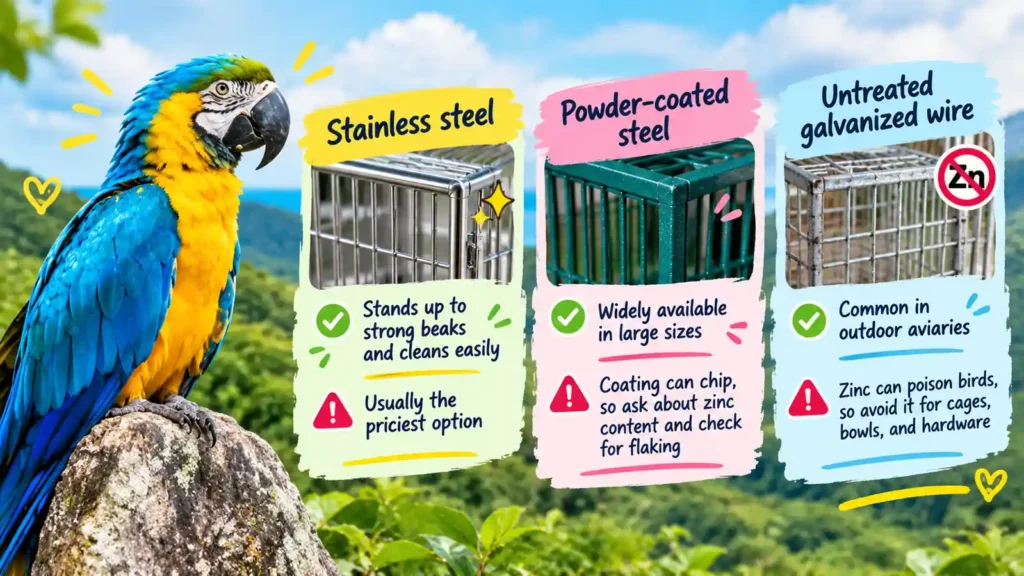
| Material | Strengths | Watch-outs |
| Stainless steel | Stands up to strong beaks and cleans easily | Usually the priciest option |
| Powder-coated steel | Widely available in large sizes | Coating can chip, so ask about zinc content and check for flaking |
| Untreated galvanized wire | Common in outdoor aviaries | Zinc can poison birds, so avoid it for cages, bowls, and hardware |
How Far Apart Should Cage Bars Be for a Blue and Gold Macaw?
Bar spacing of 1 to 1.25 inches (about 2.5 to 3.2 cm) suits an adult blue and gold macaw, and some guides accept up to 1.5 inches. Wider gaps raise the risk of trapped heads or feet, and a young bird may slip through altogether.
Blue and Gold Macaw Cage Requirements Beyond Size
Size is only the starting point. Strong beaks and sharp minds mean the cage must stay secure, stimulating, and easy to clean. Essential features to check:
- Secure locks: Clever birds can defeat basic latches, so choose heavy-duty locks or add a secure clip.
- Varied perches: Natural wood in different diameters helps keep feet healthy.
- Stainless steel bowls: Galvanized dishes should be avoided because zinc can leach into water.
- Chew toys: Large, bird-safe toys give a strong beak something safe to destroy.
- Play stand: A stand outside the cage adds another place to stretch and climb.
Time outside the cage counts as part of the housing plan:
- Daily time: many care guides suggest at least 3 to 4 hours of supervised time outside the cage.
- Flight access: the World Parrot Trust lists a large enclosure about 15 m (50 ft) long for part of the year in its blue-and-yellow macaw profile.
Regular veterinary care belongs on the requirements list too. The Association of Avian Veterinarians recommends regular checkups for companion birds and offers a Find-a-Vet tool, so a professional can review both health and housing.
Blue and Gold Macaw Cage Setup Step by Step
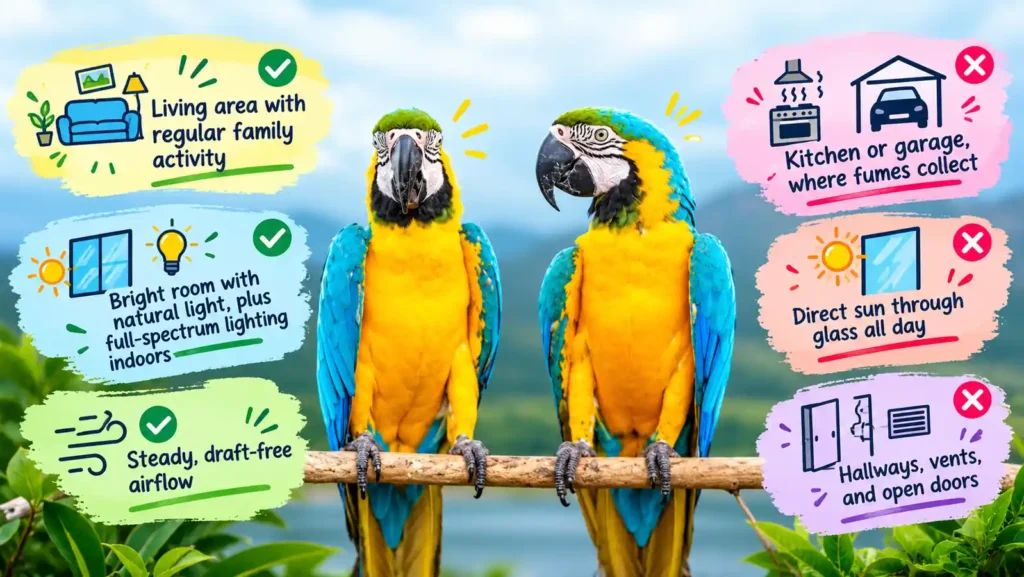
Placement shapes daily life as much as measurements do. A busy family room helps a social bird feel included, while a calm spot supports deep rest at night. The table below compares good placement choices with spots to skip.
| Factor | Better choice | Spots to avoid |
| Room | Living area with regular family activity | Kitchen or garage, where fumes collect |
| Light | Bright room with natural light, plus full-spectrum lighting indoors | Direct sun through glass all day |
| Air | Steady, draft-free airflow | Hallways, vents, and open doors |
| Sleep | Dark, quiet spot overnight | Rooms with late lights and noise |
How Do You Set Up a Cage for a Blue and Gold Macaw?
Choose a bright, draft-free spot in a family room, place the cage on level ground, and fit perches at different heights. Add stainless steel bowls, a few sturdy toys, and a secure lock, then check every wire and clip for sharp or loose parts before the bird moves in.
Smart layout stretches even a generous blue and gold macaw cage size much further. Simple layout rules:
- Main perch: near the upper third, with clear space for wings and tail.
- Bowls: at a comfortable height, not directly under perches.
- Toys: a few at a time, rotated often, so movement stays easy.
Common Cage Safety Mistakes to Avoid
Most cage problems come from small oversights rather than dramatic failures. Frequent mistakes include:
- Buying a cage sized for a smaller parrot and planning to upgrade later.
- Choosing wide bar spacing because the cage looks larger.
- Ignoring flaking paint, rust, or white residue on the wire.
- Placing the cage near kitchen fumes, nonstick cookware, or strong sprays.
- Overcrowding the cage with toys until movement becomes difficult.
Health signs deserve quick action:
- Regurgitation or weakness
- Appetite loss or unusual droppings
Such signs can point to poisoning or illness, including zinc exposure, so an avian veterinarian should assess the bird promptly. Guidance here supports general planning and does not replace professional advice.
Final Thoughts on Choosing the Right Cage
Health comes first, since a cramped home affects muscles, feathers, and mood in a bird that may live for decades. Dimensions follow from body size, with 30 × 48 × 60 inches representing a commonly cited minimum and 36 × 48 × 72 inches or larger providing a more comfortable target for an adult blue-and-gold macaw. Bar spacing and materials protect against trapped heads, damaged bars, and zinc exposure, so 1 to 1.25 inches and sturdy stainless steel are worth prioritizing.
Requirements beyond size include secure locks, varied perches, safe bowls, chew toys, out-of-cage time, and a trusted avian vet. A step-by-step setup turns those pieces into a calm, well-placed home with a clear layout. Safety mistakes such as galvanized wire, flaking coating, and harmful fumes are easy to prevent with regular inspection. Choose big, check the details, and revisit the setup as the bird settles in. Answers to common questions follow below.
Frequently Asked Questions
How many hours should a blue and gold macaw spend outside the cage?
Many care guides suggest at least 3 to 4 hours of supervised time daily, and more is better.
Is stainless steel better than powder-coated for a macaw cage?
Stainless steel generally handles strong beaks better. Powder-coated cages can work when the coating stays intact, and the maker confirms it is zinc-free.
Where should a macaw cage go in the house?
A family living area with natural light works well, provided the spot avoids drafts, kitchen fumes, and all-day direct sun.
Do blue and gold macaws need a flight cage?
A large flight enclosure, about 15 m (50 ft) long, is suggested for part of the year, alongside a properly sized daily cage.
What are the signs that a macaw cage is too small?
Wings hitting the bars, a tail touching the grate, and little room to climb or turn all suggest more space is needed.