

Aphrodite Giant Cat history starts with feral cats that lived wild in the mountains of Cyprus for thousands of years, long before anyone called them a breed. Some breeders connect these cats to a burial site on the island where a cat was found next to a human, dated to about 9,500 years ago, though TICA and other cat groups say the modern cat actually evolved on its own from local feral cats.
Another part of Aphrodite Giant Cat history comes from a Byzantine legend about a monastery on Cyprus that used cats to hunt venomous snakes in the 4th century AD. The real turning point happened in 2005, when British breeder Teresa Litherland moved to Cyprus and noticed how large and muscular the local cats were compared to other breeds.
She started a breeding program, and by 2008 a World Cat Federation judge wrote the first breed standard and gave the cat its name. TICA later recognized the breed in 2017, calling it simply the Aphrodite.
What is the Aphrodite Giant Cat history?
The Aphrodite Giant Cat, also called the Cyprus cat or Aphrodite’s Giant, is a large, muscular breed that developed naturally on the island of Cyprus. It is not a designer cross created in a lab; breeders simply selected the biggest, healthiest examples from Cyprus’s existing feral population.
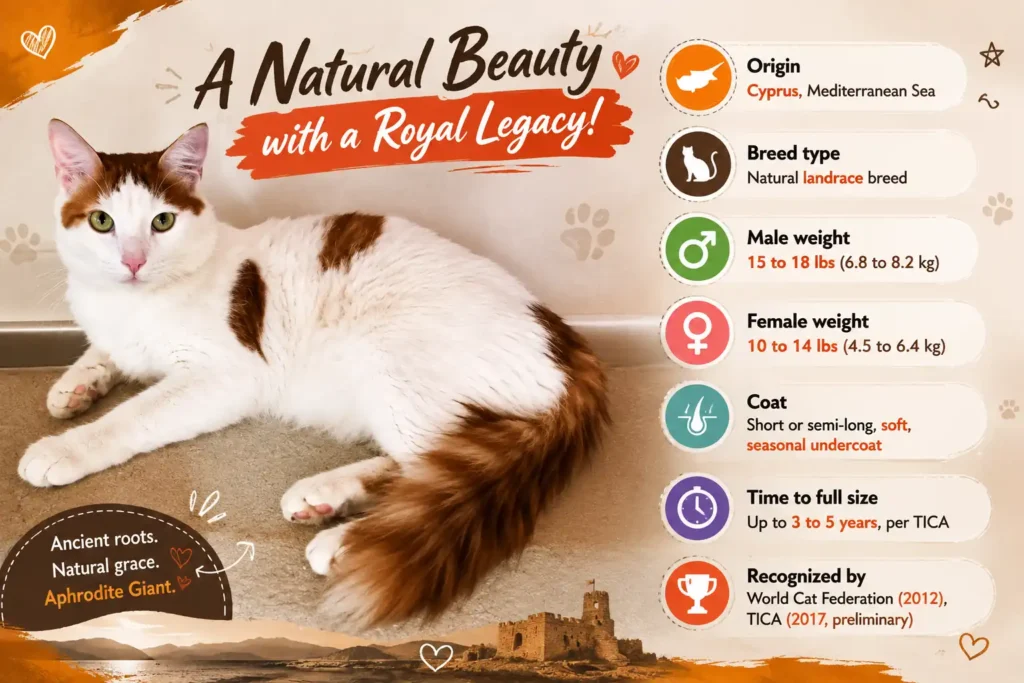
The cat’s back legs are noticeably longer than its front legs, a trait it shares with the Manx, which helps it climb steep, rocky ground. Its coat can be short or semi-long, with a thicker undercoat that grows in during colder months. The breed is known for being affectionate and social, often following its owners from room to room. Here is a quick snapshot of the breed’s basic traits.
Learn Everything You Need to Know About the Aphrodite Giant Cat. Read more in Rare Aphrodite Giant Facts Most Cat Lovers Don’t Know.
| Trait | Detail |
| Origin | Cyprus, Mediterranean Sea |
| Breed type | Natural landrace breed |
| Male weight | 15 to 18 lbs (6.8 to 8.2 kg) |
| Female weight | 10 to 14 lbs (4.5 to 6.4 kg) |
| Coat | Short or semi-long, soft, seasonal undercoat |
| Time to full size | Up to 3 to 5 years, per TICA |
| Recognized by | World Cat Federation (2012), TICA (2017, preliminary) |
Where Did the Aphrodite Giant Cat Originate?
The Aphrodite Giant Cat originated on Cyprus, an island in the eastern Mediterranean where cats have lived alongside people for thousands of years. Its foundation stock most likely traces back to cats brought over from Egypt, based on the shared traits and shipping routes common in the ancient world. Over centuries, these cats bred largely on their own, with little outside influence from mainland cat populations.
That isolation let a distinct, locally adapted type take shape, especially in the island’s cooler, mountainous interior. Feral cats matching this description are still found across Cyprus today, from the Troodos Mountains to coastal towns and cities.
The History of the Aphrodite Cat in Cyprus
Cyprus has one of the oldest documented relationships between cats and humans anywhere in the world. Archaeologists working at the Neolithic site of Shillourokambos uncovered a cat buried deliberately next to a human, dated to roughly 9,500 years ago. That discovery, published in the journal Science, predates the earliest Egyptian cat imagery by around 4,000 years.
It does not prove a direct line to today’s Aphrodite Giant Cat, but it confirms Cyprus as one of the earliest places where cats and people lived closely together. This deep background is a key part of Aphrodite Giant Cat history, even though modern breeders cannot claim unbroken descent from those first cats.
How Old Is Aphrodite Giant Cat History?
Aphrodite Giant Cat history stretches back to at least 9,500 years ago, when a cat was deliberately buried near a human at a Neolithic site in Cyprus. The modern breed itself is much younger: organized breeding only began around 2006, with formal recognition following between 2012 and 2017.
How the Aphrodite Giant Cat Developed
Local breeders began working with Cyprus’s feral cats around 2006, aiming to preserve their natural size and structure rather than invent new features. Teresa Litherland noticed these cats had large bodies, long hind legs, bushy tails, and big ears.
Two cats she named Cassidy and Lady became the foundation pair for a deliberate breeding program. Selective pairing over several generations reinforced the traits already present in the wild population instead of introducing anything new. This approach is why cat associations classify the Aphrodite Giant Cat as a natural or traditional breed rather than a hybrid.
Why Is It Known as the Aphrodite Cat?
The breed takes its name from Aphrodite, the Greek goddess of love, who, according to myth, was born from the sea near the shores of Cyprus. A World Cat Federation judge who evaluated the cats in 2008 chose the name specifically to reflect both their impressive size and the island’s connection to the goddess.
The word “Giant” was added to describe their large, muscular frame compared with that of average domestic cats. Some national associations, including the Australian Cat Federation, later shortened the name to simply “Aphrodite” when they recognized the breed. Both names refer to the same cat and are used somewhat interchangeably depending on the organization.
The Role of Cyprus in the Breed’s History
Cyprus shaped this breed in very direct, physical ways. Cooler, wetter conditions likely favored thicker coats and larger, sturdy bodies built for hunting rats, lizards, and snakes. The Troodos Mountains are frequently mentioned as a source region for foundation cats used in early breeding programs.
Cyprus’s monasteries also play a role in local cat history, since religious communities have kept and fed cats for pest control for centuries. One site near Akrotiri, known as Saint Nicholas of the Cats, is tied to a legend involving hundreds of cats sent to fight a snake infestation.
Is the Aphrodite Giant Cat a Real Ancient Breed?
Not exactly. Cyprus has ancient cat history, but no proven genetic link to today’s Aphrodite Giant Cat. The breed itself, as a standardized line with a written standard, only dates back to the 2000s.
How the Aphrodite Cat Became Recognized as a Breed
Getting the Aphrodite Giant Cat accepted by major registries took years of showing, documentation, and genetic study. A World Cat Federation judge wrote the first standard of points in 2008 after meeting a Cyprus-based breeder. Local supporters then formed the Cyprus Cats National Breed Association, which received government approval in late 2009.
A geneticist from the University of California, Davis worked with the National Geographic Society to compare Cyprus cats with mainland Turkish populations, concluding in a January 2012 report that the cats were genetically distinct enough to support a breed. That research helped the association win formal recognition a few months later.
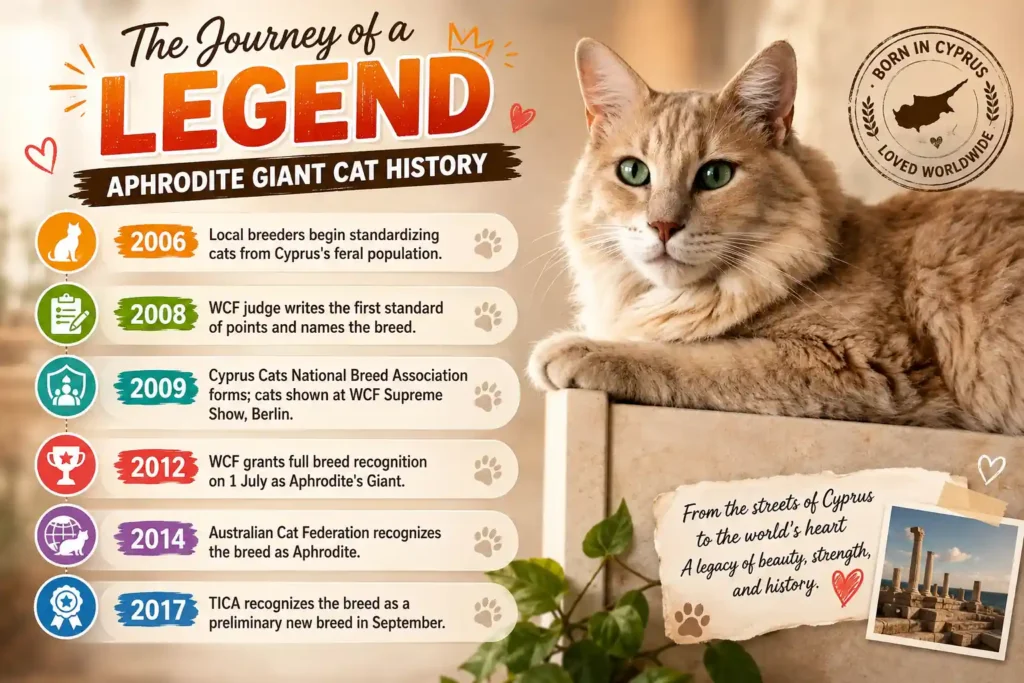
| Year | Milestone |
| 2006 | Local breeders begin standardizing cats from Cyprus’s feral population. |
| 2008 | WCF judge writes the first standard of points and names the breed |
| 2009 | Cyprus Cats National Breed Association forms; cats shown at WCF Supreme Show, Berlin |
| 2012 | WCF grants full breed recognition on 1 July as Aphrodite’s Giant |
| 2014 | Australian Cat Federation recognizes the breed as Aphrodite. |
| 2017 | TICA recognizes the breed as a preliminary new breed in September |
Aphrodite Giant Cat Breed Standards and Recognition
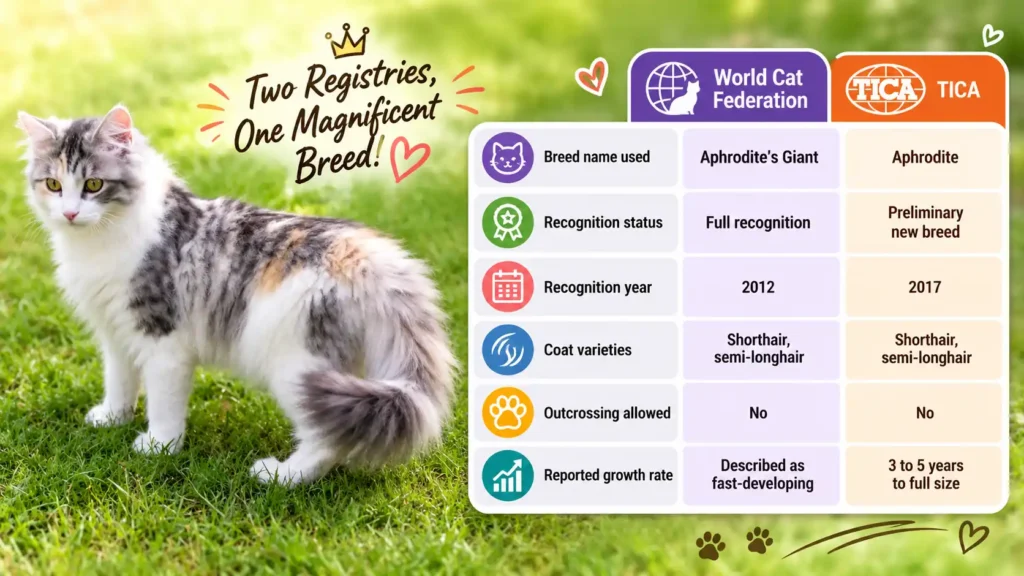
Two major registries currently recognize this breed, though they use slightly different names and standards. The World Cat Federation calls it Aphrodite’s Giant and fully recognized it in 2012, covering both short haired and semi-longhaired versions. The International Cat Association uses the shorter name Aphrodite and granted preliminary recognition in September 2017, also with two coat lengths.
Both standards call for a muscular, big-boned body, hind legs longer than front legs, and a long, triangular head with wide-set ears. Neither registry permits outcrossing to other breeds, which keeps the gene pool tied closely to Cyprus’s original feral population.
When Did the Aphrodite Cat Become an Official Breed?
The Aphrodite Giant Cat became an officially recognized breed on 1 July 2012, when the World Cat Federation granted full recognition. The International Cat Association followed later, giving the breed preliminary status in September 2017 under the shorter name Aphrodite.
| Feature | World Cat Federation | TICA |
| Breed name used | Aphrodite’s Giant | Aphrodite |
| Recognition status | Full recognition | Preliminary new breed |
| Recognition year | 2012 | 2017 |
| Coat varieties | Shorthair, semi-longhair | Shorthair, semi-longhair |
| Outcrossing allowed | No | No |
| Reported growth rate | Described as fast-developing | 3 to 5 years to full size |
How the Breed Changed Over Time
The Aphrodite Giant Cat moved from an unnamed feral population to a documented breed in roughly a decade. Before 2006, these cats existed without any formal breeding program, valued mostly as working cats around farms and monasteries. The 2008 standard of points gave breeders a written target for size, coat, and structure for the first time.
Full WCF recognition in 2012 opened the door to international showing. Then, the Australian Cat Federation recognized the breed in 2014. Later, TICA’s 2017 decision added a second major registry and encouraged breeding programs outside Cyprus. As a result, each step increased the breed’s visibility without changing the core traits of the original feral stock.
The Aphrodite Giant Cat in Modern Times
Today, the Aphrodite Giant Cat remains a relatively rare breed still working toward full recognition with every major registry. TICA members have started breeding programs in Europe, Asia, and the United States, moving the breed beyond its island origins. Feral populations matching the breed’s traits still live throughout Cyprus, including in cities, so wild and pedigreed lines continue to overlap.
Because the breed is still young, exact figures on population size, price, and average lifespan vary between sources and are not yet well documented. Most breeders and owners describe the cat as affectionate, people-oriented, and comfortable in active family homes.
Interesting Historical Facts About the Aphrodite Giant Cat
A few details make Aphrodite Giant Cat history stand out from most other breeds.
- The 9,500-year-old cat burial at Shillourokambos predates known Egyptian cat imagery by about 4,000 years.
- Legend credits Saint Helena of Constantinople with shipping two boatloads of cats to a Cyprus monastery in 328 AD to fight a snake infestation.
- The monastery, still called Saint Nicholas of the Cats, reportedly rang one bell to call cats for meals and another to send them out hunting.
- The foundation pair for the modern breed, named Cassidy and Lady, were found in a breeder’s own garden rather than sourced from a formal cattery.
- A genetic study organized with the National Geographic Society found Cyprus cats form a distinct population within the Mediterranean.
- Greek Nobel laureate Giorgos Seferis once wrote a poem inspired by the monastery’s snake-hunting cats.
The Legacy of Aphrodite Giant Cat History
Aphrodite Giant Cat history moves from an ancient burial site to feral mountain cats to a breed judged at international shows in under twenty years of formal recognition. The core of the story is continuity: breeders worked with what Cyprus already had, rather than reshaping the cat into something new. Anyone curious about the breed today is really looking at a living connection to one of the oldest cat populations on record.
Frequently Asked Questions About Aphrodite Giant Cat History
What is the Aphrodite Giant Cat?
It is a large, muscular natural breed from Cyprus, developed from the island’s feral cat population rather than created through planned crossbreeding.
Where does the Aphrodite Giant Cat come from?
It comes from Cyprus, an island in the eastern Mediterranean, with foundation stock likely linked to cats originally brought from Egypt.
When was the Aphrodite Giant Cat officially recognized?
The World Cat Federation gave full recognition on 1 July 2012. TICA followed with preliminary recognition in September 2017.
Why is the Aphrodite Giant Cat named after a goddess?
It is named after Aphrodite, the Greek goddess said to have been born from the sea near Cyprus. The name was chosen because of this connection by the judge who wrote the first breed standard in 2008.
Is the Aphrodite Giant Cat descended from ancient Cypriot cats?
There is no proven genetic link, despite some breeder claims. Cyprus does have a 9,500-year-old cat burial, but it predates the modern breed by thousands of years.
Which organizations recognize the Aphrodite Giant Cat breed?
The World Cat Federation and the International Cat Association both recognize it, along with the Australian Cat Federation, which approved it in 2014.
How big does an Aphrodite Giant Cat get?
Under the TICA standard, adult males typically weigh 15 to 18 pounds, and females weigh 10 to 14 pounds, with full growth taking up to five years.