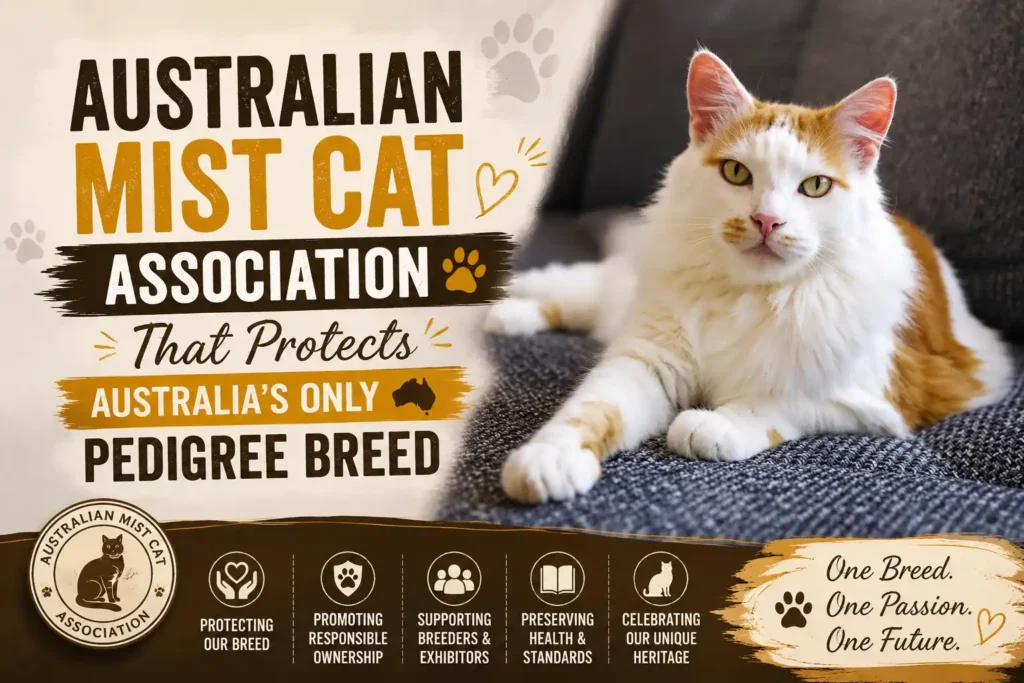
The Australian Mist Cat Association manages breed standards, registration, and health testing for this rare Australian breed. It approves official coat colours and patterns, from spotted to marbled. It also checks that every cat meets strict physical and temperament standards before breeding or showing. Breeders who use the Australian Mist name must register with the association. They must follow its health screening rules and agree to its welfare code.
This code covers things like minimum rehoming age and proper kitten socialisation. For buyers, this system matters a lot. It is the easiest way to confirm a kitten comes from a real, health-tested Australian Mist line, not a look-alike cat. The association also works with sister registries in the UK, New Zealand, and the US. This teamwork helps keep the small global population genetically healthy.
What Is the Australian Mist Cat Association?
Formed to support breeders and owners of this Australian-developed breed, the Australian Mist Cat Association operates as a Governing Council of the Cat Fancy full membership club in the United Kingdom, giving it official standing within one of the world’s most established cat registries. Membership grants access to breed-specific health guidance, a directory of registered breeders, and a community built around one of the few genuinely new cat breeds developed in the last fifty years.
Beyond paperwork, the club organises shows, publishes welfare advice, and works directly with the GCCF to refine the breed’s registration policy and standard of points. Kitten buyers benefit most directly, since association-listed breeders agree to specific health testing before their cats can be advertised through the club. Current membership fees and application details are best confirmed directly through the organisation’s own channels, since these figures change from year to year. For anyone serious about owning or breeding an Australian Mist responsibly, this club functions as the most reliable starting point.
Australian Mist Cat History and Origin
The Australian Mist history, kmjn began in Sydney in 1976, when Dr. Truda Straede started a careful breeding program. Her goal was to create a cat that could live safely indoors while reducing the risk to local wildlife. She worked with 30 foundation cats, including roughly half Burmese, one-quarter Abyssinian, and one-quarter domestic shorthair tabbies. Each breed contributed important traits: Burmese cats added soft, dilute colours, Abyssinians introduced fine ticking, while domestic cats brought distinctive spotting and valuable genetic diversity.
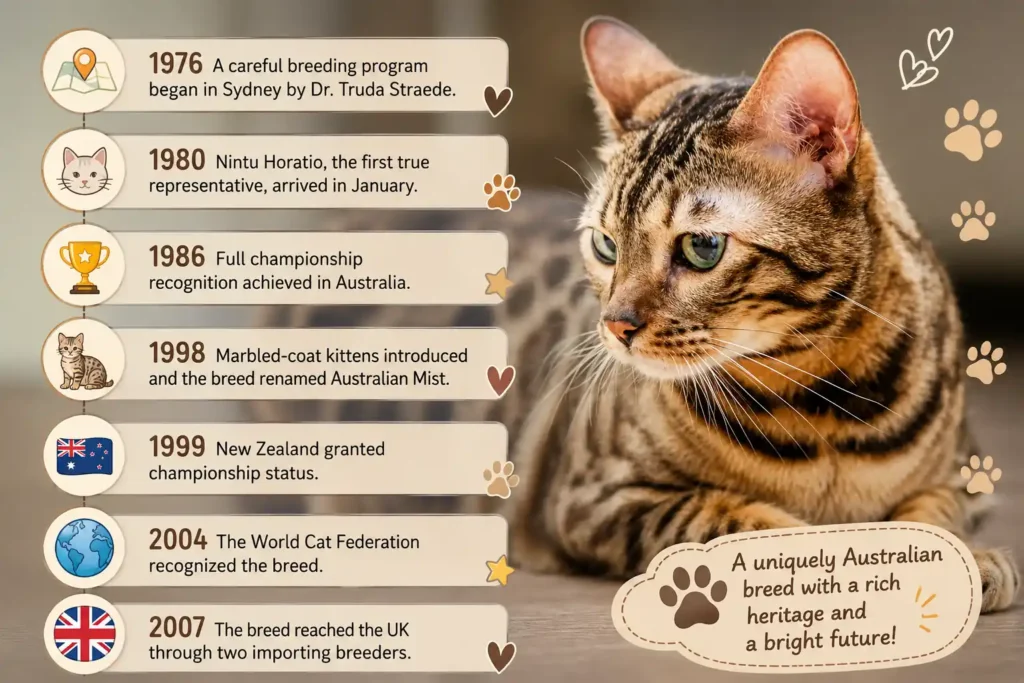
Nintu Horatio, the first true representative of the breed, arrived in January 1980, and full championship recognition followed in Australia by 1986. Marbled-coat kittens appeared later in the program, and breed authorities folded them into the same breed by 1998, prompting the name change from Spotted Mist to Australian Mist. New Zealand granted championship status in 1999, the World Cat Federation followed in 2004, and the breed reached the UK in 2007 through two importing breeders.
Breed Standard, Colours, and Coat Patterns
Judges assess the Australian Mist against a specific breed standard covering body type, head shape, and coat quality, with GCCF and TICA versions differing only slightly in wording. Medium to large in size, the ideal cat carries a moderately foreign body type with no extreme features, rounded contours, and an open, gentle facial expression.
Large green eyes represent the standard expectation, though some registries also accept gold tones in young kittens whose colour hasn’t fully settled. Two coat patterns exist within the breed: spotted, with distinct rounded spots, and marbled, showing a classic tabby swirl softened by fine ticking that creates the “misted” look the breed is named for. Full coat colour and pattern development can take up to two years, so kittens often look quite different from how they’ll appear as adults. The table below breaks down the seven officially recognised colours.
| Colour | What It Looks Like |
| Brown | Rich, warm brown ground colour with darker brown pattern markings |
| Blue | Soft blue-grey base, a dilute form of brown |
| Chocolate | Warm milk-chocolate tone, lighter than brown |
| Lilac | Pale dove-grey with a pinkish undertone, a dilute of chocolate |
| Gold | Warm cinnamon-based colour inherited from the Abyssinian line |
| Peach | A diluted form of gold with a soft apricot tone |
| Caramel | Cooler-toned dilute colour, recognised by TICA and other registries |
Personality and Temperament
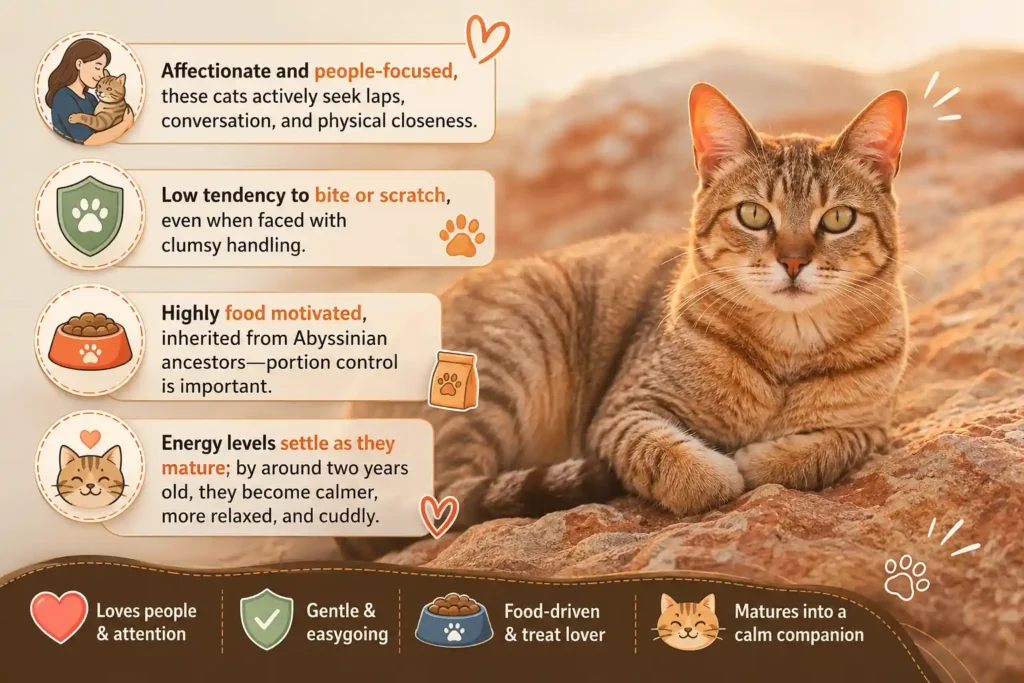
Bred specifically for indoor living, the Australian Mist personality is as carefully shaped as its distinctive coat. Affectionate and people-focused, these cats actively seek laps, conversation, and physical closeness rather than simply tolerating human attention. Their gentle nature makes them well suited to families, as children and other pets rarely trigger defensive behaviour. The breed also has a documented low tendency to bite or scratch, even when faced with clumsy handling.
Food motivation runs unusually high, a trait inherited from the Abyssinian foundation stock, which makes portion control genuinely important. Extended solitude doesn’t suit the breed well, so households away for long workday stretches may benefit from a feline companion. Australian Mist temperament is playful and affectionate, especially during kittenhood. As they mature, their energy gradually settles, and by around two years old, they often become calmer, more relaxed, and wonderfully cuddly.
Is the Australian Mist a Good Family Cat?
Yes. Bred for gentle, people-oriented behaviour, the Australian Mist tolerates handling well, rarely scratches, and forms close bonds with children and other household pets, making it one of the more forgiving pedigree breeds for first-time owners.
Registration, Pedigree, and Recognised Registries
Pedigree paperwork confirms lineage rather than just cuteness, and registered Australian Mist kittens come with documentation tracing several generations of ancestry. Multiple registries recognise the breed today, though requirements vary slightly between them.
The Australian Cat Federation served as the founding registry in Australia, while the Governing Council of the Cat Fancy administers UK registration and requires DNA testing for Pyruvate Kinase Deficiency before breeding cats can be registered. The International Cat Association granted full recognition on 1 May 2014, opening show rings across North America and parts of Europe. Buyers should always request registration papers directly from the relevant body rather than relying on a breeder’s word alone.
| Registry | Region | Recognition Status |
| Australian Cat Federation (ACF) | Australia | Full Register, 1986 |
| Governing Council of the Cat Fancy (GCCF) | United Kingdom | Preliminary recognition, 2011 |
| World Cat Federation (WCF) | International | Championship status, 2004 |
| New Zealand Cat Fancy (NZCF) | New Zealand | Championship status, 1999 |
| The International Cat Association (TICA) | International | Full recognition, 2014 |
Finding Registered Breeders and Attending Shows
Breeder searches go faster when they start with an official registry rather than a general web listing, since registry directories only include breeders who meet documented health and welfare standards. Australia holds the largest population of registered Australian Mist breeders given the breed’s origin, while UK, US, and New Zealand breeder numbers remain comparatively small. Cat shows organised through GCCF, TICA, and regional Australian cat clubs offer a practical way to meet breeders and ask direct questions about temperament and health history before committing to a kitten. Genuine breeders welcome detailed questions, while reluctance to answer basic ones is a reasonable warning sign.
Useful questions to ask before reserving a kitten:
- Has the breeding pair been DNA tested for Pyruvate Kinase Deficiency?
- What age were kittens when they left their mother? Most welfare guidelines recommend no earlier than 12–13 weeks.
- Can vaccination and worming records be provided in writing?
- Is a written health guarantee included with the sale?
Breeding Guidelines, Health, and Welfare Standards
Responsible breeding programs follow specific guidelines set by registries rather than personal preference alone. DNA testing for Pyruvate Kinase Deficiency stands as the clearest example, required under GCCF policy after early screening identified a single carrier among tested foundation cats. Outcrossing remains permitted under most registry rules specifically to protect genetic diversity within a still-developing breed.
General health across the Australian Mist population looks strong, with no widely documented breed-specific conditions beyond that one carrier risk, based on breed information published by TICA and GCCF. Weight management deserves particular attention given the strong food drive noted earlier, since obesity raises the risk of diabetes and joint strain in cats generally, a pattern the American Veterinary Medical Association has documented across the wider domestic cat population.
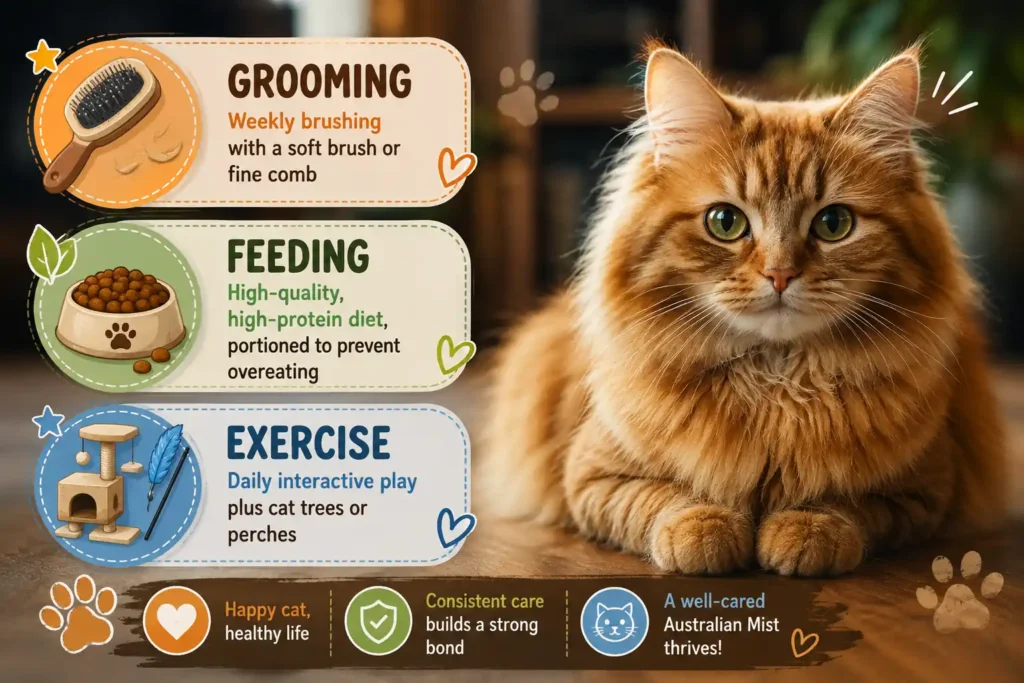
A quick reference for day-to-day care keeps expectations realistic before bringing a kitten home.
| Category | Recommendation |
| Grooming | Weekly brushing with a soft brush or fine comb |
| Feeding | High-quality, high-protein diet, portioned to prevent overeating |
| Exercise | Daily interactive play plus cat trees or perches |
| Vet checkups | Annual wellness exam and core vaccinations |
| Genetic testing | DNA screening for Pyruvate Kinase Deficiency before breeding |
Are Australian Mist Cats Prone to Health Problems?
No major inherited conditions are widely documented in the breed beyond a single identified carrier gene for Pyruvate Kinase Deficiency, which registries now screen for directly. Routine veterinary care and steady weight management cover the rest of this generally healthy breed’s needs.
Membership, Rules, and Standards for Owners
Full membership with the Australian Mist Cat Association requires an application, payment of dues, and agreement to the club’s code of ethics covering breeding practices and cat welfare. Standards set by the association align closely with GCCF policy, since the club operates under that federation’s framework rather than setting entirely independent criteria. Breeders who violate welfare rules, misrepresent health testing, or breach the code of ethics risk suspension or removal from the club’s breeder directory.
Ordinary owners without breeding plans can usually join as associate or pet members, gaining newsletters, show information, and community access without the obligations placed on registered breeders. Rules exist primarily to protect a still-small gene pool and keep the breed’s excellent temperament and health record intact for future generations.
What Does the Australian Mist Cat Association Actually Do for Members?
Beyond registration paperwork, the Australian Mist Cat Association connects members with vetted breeders, publishes welfare and health testing guidance, and organises shows where owners and breeders can meet face to face.
From History to Home
Pulling all of this together, the Australian Mist Cat Association sits at the centre of a breed built with real intention rather than accident. History traces back to Dr Truda Straede’s 1976 program in Sydney, blending Burmese, Abyssinian, and domestic shorthair genetics into a cat suited for indoor life.
Breed standards define a medium-to-large, green-eyed cat available in seven colours across spotted and marbled patterns, each taking up to two years to fully develop. Temperament remains the breed’s strongest selling point, with affectionate, low-scratch behaviour that suits families and multi-pet households alike. Registration through bodies like the ACF, GCCF, and TICA protects pedigree integrity, while breeder directories and cat shows make finding a healthy, well-socialised kitten far more straightforward.
Breeding guidelines and DNA testing for Pyruvate Kinase Deficiency keep the gene pool healthy, and membership rules hold breeders accountable to welfare standards rather than profit alone. Anyone considering this breed gains the most by starting with an official registry rather than an unverified online listing.
Frequently Asked Questions
How much does an Australian Mist kitten cost?
Registered Australian Mist kittens typically cost between $800 and $1,800 USD depending on pedigree, colour, and breeder location, with prices often running higher outside Australia due to limited breeder availability.
Are Australian Mist cats hypoallergenic?
No cat breed is truly hypoallergenic, and the Australian Mist is no exception, since allergens come from the Fel d 1 protein present in saliva and skin regardless of coat length.
How long do Australian Mist cats live?
Average lifespan runs between 12 and 16 years with routine veterinary care and a healthy weight, similar to other medium-sized shorthair breeds.
Can Australian Mist cats be registered in the United States?
Yes, through The International Cat Association, which granted full recognition in 2014, though the Cat Fanciers’ Association does not currently recognise the breed.
Do Australian Mist cats need a lot of grooming?
No. Weekly brushing is generally enough to manage their short, dense coat and keep shedding under control.