
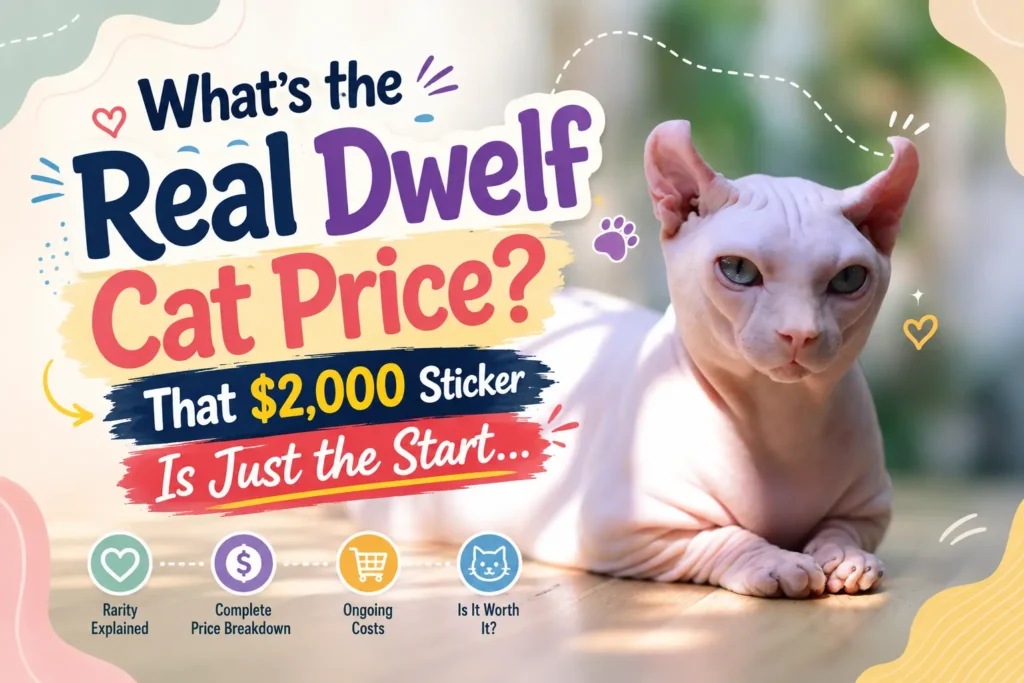
The dwelf cat price in the United States is usually between $2,000 and $3,000 in 2026. Some cats cost as little as $900, especially adult cats that need a new home. Others cost up to $3,650, especially show-quality kittens.
The price changes based on a few things: the breeder’s reputation, health tests done on the cat, the quality of its coat, and how rare its bloodline is. Knowing what affects the dwelf cat price can help you decide if the price you are paying is fair before you pay a deposit.
Question: What is the dwelf cat price range?
Answer: Dwelf cats typically cost between $1,500 and $3,000 USD, though prices can go up to $3,500+ from rare or high-quality breeders, since it’s an exotic and rare breed.
How Much Do Dwelf Cats Cost?
Kittens cost more because breeders absorb three months of feeding, vaccination, and socialisation. Retired adults often sell for half that, already neutered.
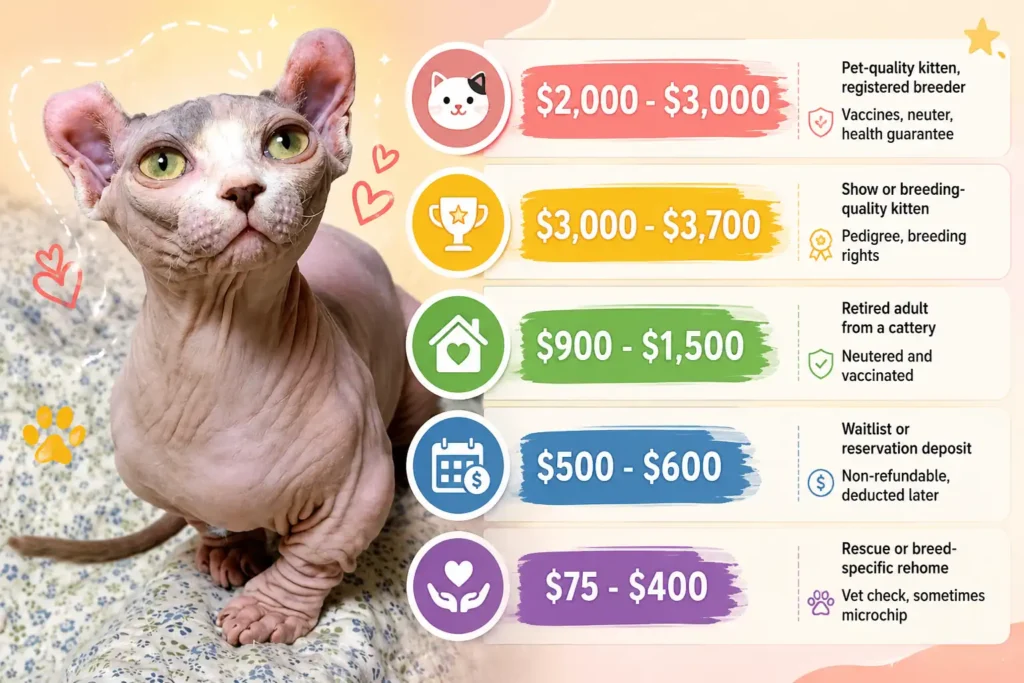
The table below shows typical 2026 Dwelf costs by source and age, drawn from active breeder and marketplace listings.
| Source or type | Typical price (USD) | Usually included |
| Pet-quality kitten, registered breeder | $2,000 – $3,000 | Vaccines, neuter, health guarantee |
| Show or breeding-quality kitten | $3,000 – $3,700 | Pedigree, breeding rights |
| Retired adult from a cattery | $900 – $1,500 | Neutered and vaccinated |
| Waitlist or reservation deposit | $500 – $600 | Non-refundable, deducted later |
| Rescue or breed-specific rehome | $75 – $400 | Vet check, sometimes microchip |
Why People Are Paying Thousands for the Dwelf Cat? Read more in People Are Losing Their Minds (and $3,000) Over the Dwelf Cat.
What is the average Dwelf cat price?
The average Dwelf cat price in 2026 is $2,000 to $3,000 from a reputable US breeder. Rare colouring, blue eyes, or breeding rights push kittens higher, while retired adults cost $900 to $1,500. Deposits of $500 to $600 are standard and rarely refundable, so treat them as spent.
Dwelf Prices Around the World
Regional pricing swings with import rules, breeder density, and health-testing rules. Few catteries work with this breed outside North America, so buyers abroad pay a transport premium. All figures are in USD.
| Country | Typical kitten price (USD) | Main price driver |
| United States | $2,000 – $3,200 | Largest breeder pool |
| Canada | $2,200 – $3,500 | Provincial licensing rules |
| United Kingdom | $2,400 – $3,900 | Stricter standards, few breeders |
| Australia | $2,300 – $3,600 | Quarantine and flights |
| Western Europe | $2,500 – $4,000 | Pedigree and transport costs |
What Affects the Dwelf Cat Price?
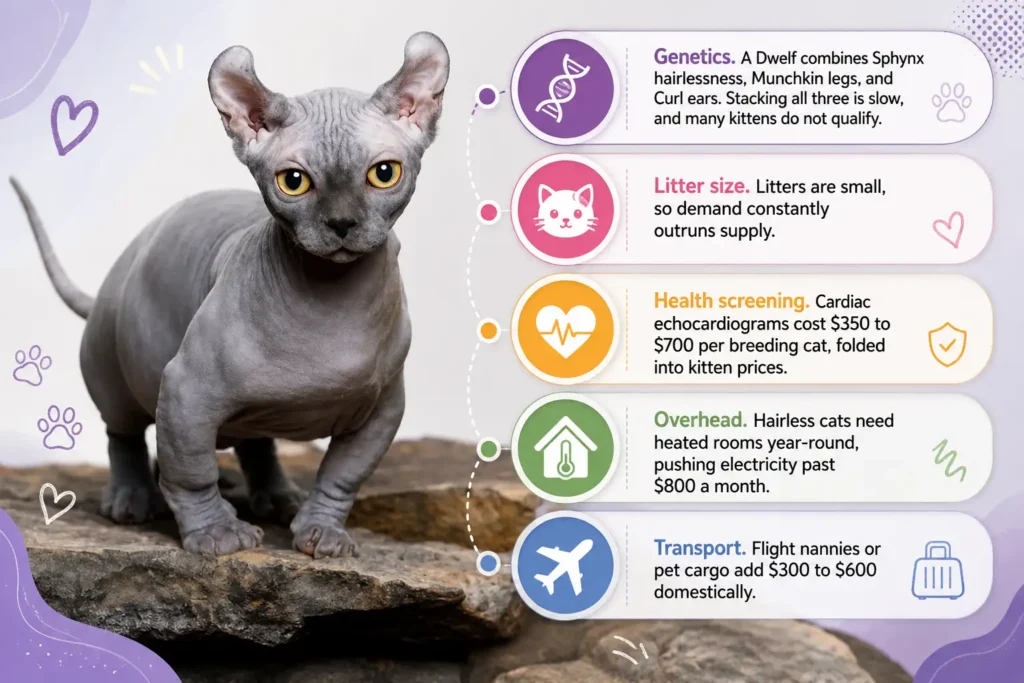
Five things move the number most:
- Genetics. A Dwelf combines Sphynx hairlessness, Munchkin legs, and Curl ears. Stacking all three is slow, and many kittens do not qualify.
- Litter size. Litters are small, so demand constantly outruns supply.
- Health screening. Cardiac echocardiograms cost $350 to $700 per breeding cat, folded into kitten prices.
- Overhead. Hairless cats need heated rooms year-round, pushing electricity past $800 a month.
- Transport. Flight nannies or pet cargo add $300 to $600 domestically.
Breeder vs Adoption, and the Costs Buyers Forget
Adoption looks cheaper, but it is rarely realistic. Dwelfs are too new and too few for shelters to see often. Hairless-breed rescues do take in surrendered Sphynx-type cats a few times a year, with fees of $75 to $400. The American Society for the Prevention of Cruelty to Animals (ASPCA) suggests checking breed-specific rescue networks before assuming a breeder is the only route.
The bigger trap is treating the purchase price as the real cost. Year one also brings heated bedding, sweaters, medicated skin wipes, ear cleaner, higher-calorie food, and a neuter fee if the breeder skipped it.
How much does it cost to own a Dwelf cat per month?
A Dwelf costs roughly $105 to $185 per month once settled, covering food, litter, skin care, insurance, and routine vet visits. That sits above the ASPCA average of about $53 a month for a typical cat, because hairless breeds need extra bathing supplies, warmth, and closer monitoring.
First-Year and Ongoing Cost Breakdown
The first year is the most expensive, because setup and initial vet work land together. This table separates one-off spending from ongoing monthly costs.
| Expense | First year (USD) | Monthly after (USD) |
| Food and supplements | $400 | $32 |
| Litter | $260 | $22 |
| Routine vet, vaccines, exams | $420 | – |
| Spay or neuter, if not included | $200 | – |
| Pet insurance | $480 | $40 |
| Skin care, baths, warmth | $240 | $18 |
| Setup: carrier, box, beds, toys | $365 | – |
| Total, excluding purchase price | $2,365 | $112 – $185 |
Dwelf vs Sphynx, Bambino, and Elf Cat
All four share Sphynx ancestry, and price tracks how hard the mix is to produce. Sphynx kittens are the most widely bred and cheapest, at $1,200 to $4,500. Bambinos, adding Munchkin legs, run $2,500 to $3,500. Elf cats, adding curled ears, sit near $3,000 to $3,650. The Dwelf stacks both traits onto the Sphynx base, so it is usually priciest and hardest to find.
How to Spot a Reputable Breeder
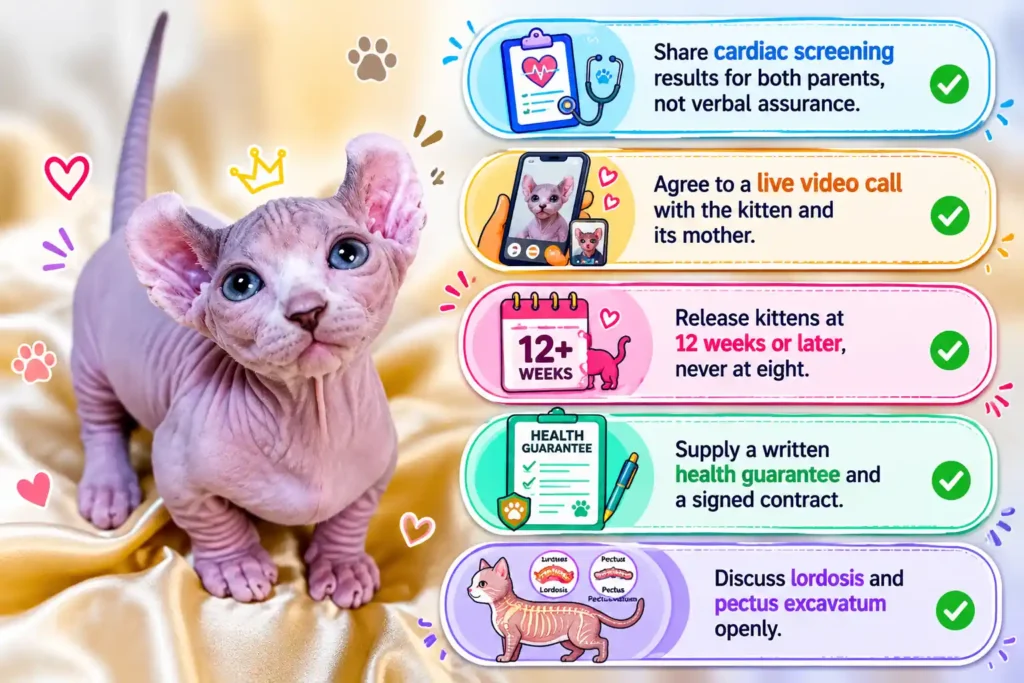
A cheap Dwelf is cheap for a reason. The breed is still tracked as experimental rather than recognised for championship by The International Cat Association (TICA), so no standard forces breeders to prove anything. Check that they:
- Share cardiac screening results for both parents, not verbal assurance.
- Agree to a live video call with the kitten and its mother.
- Release kittens at 12 weeks or later, never at eight.
- Supply a written health guarantee and a signed contract.
- Discuss lordosis and pectus excavatum openly.
Are cheap Dwelf cats worth buying?
Usually not. Kittens listed well under $1,500 often come from unscreened lines, and inherited spinal or chest-wall problems cost thousands to manage. Paying $2,500 for a health-tested kitten is often cheaper across a lifetime than paying $1,000 for one that is not.
What You Are Paying to Care For
The Dwelf is small: 6 to 7 inches tall, 4 to 9 pounds, with a 12 to 15-year lifespan. Skin is hairless and wrinkled, from pale pink to near-black. Temperament is the real selling point. They are affectionate, chatty, and dog-like, good with children and other pets, and small enough for apartments. They are also bright enough to get bored, so puzzle feeders beat another plush mouse.
Grooming is not zero just because the coat is. Weekly baths, ear cleaning, and skin-fold care are permanent jobs, and heated bedding is not optional in cold climates. Short legs plus hairlessness carry real risk of lordosis and pectus excavatum, and vaccination timing should follow guidance from the American Association of Feline Practitioners (AAFP). Price insurance early, because pre-existing conditions get excluded fast.
Is a Dwelf Cat Worth the Price?
It depends on how you weigh risk. If you want an unusual, deeply affectionate indoor cat and could absorb a surprise $3,000 vet bill without panic, probably yes. If the purchase price alone would stretch your budget, this is the wrong breed, because ongoing costs are the harder part. Many vets also remain uneasy about breeding two skeletal mutations together, and that concern deserves real weight.
Common Questions About Dwelf Cat Cost
What is the average Dwelf cat price?
Between $2,000 and $3,000 from a registered breeder in 2026. Retired adults cost roughly $900 to $1,500.
Why is the Dwelf cat cost so high?
Three combined mutations, small litters, cardiac screening, and heated cattery facilities all push prices up.
How much does it cost to own a Dwelf cat per month?
Around $105 to $185 monthly for food, litter, skin care, insurance, and routine veterinary care.
Can you adopt a Dwelf cat?
Occasionally, through hairless-breed rescue networks. Fees run $75 to $400, but availability is limited.
Is pet insurance worth it for a Dwelf cat?
Generally yes. Policies average $32 to $50 a month, and this breed carries above-average spinal and chest-wall risk.
Are Dwelf cats rare?
Yes. Major registries still treat the breed as experimental, and only a handful of catteries produce it worldwide.
What should you check before paying for a Dwelf cat?
Parent health testing, a written contract, full vaccination records, a live video, and a release age of 12 weeks or more.