
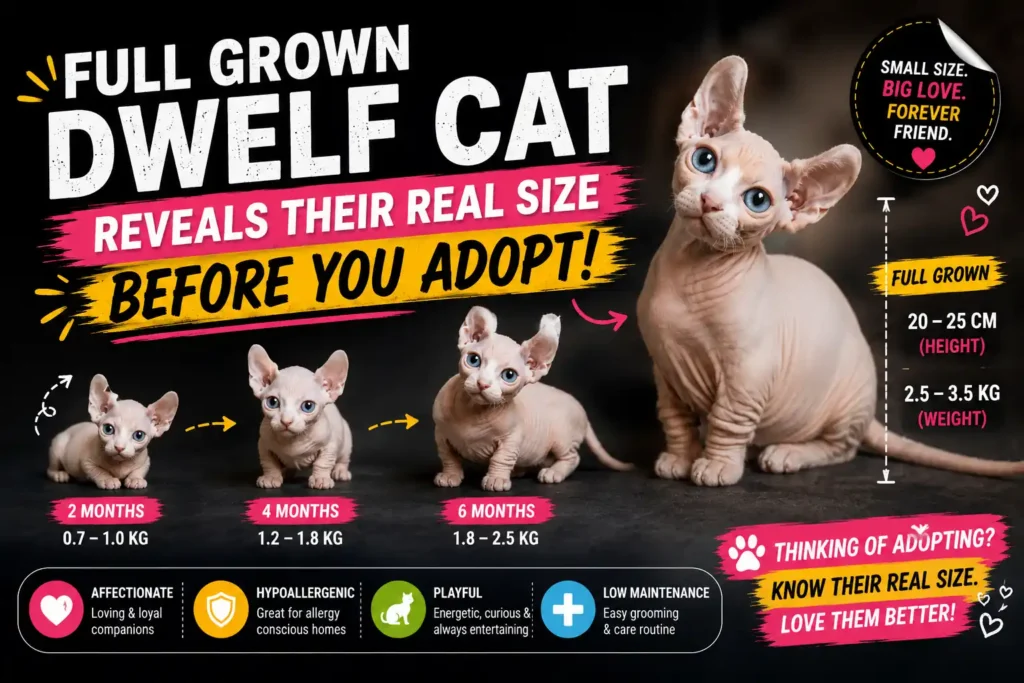
A full-grown Dwelf cat rarely weighs more than nine pounds, and that small size is one of the main reasons people fall in love with this breed right away. If you picture a cat that stays kitten-sized forever, you are close to the truth. A full-grown Dwelf cat keeps its short legs, curled ears, and soft, wrinkled skin even as an adult. But being small does not mean the cat is simple to care for.
Before bringing one home, it is helpful to know how big these cats really get, when they stop growing, and what a healthy adult Dwelf cat should look like.
What Does a Full-Grown Dwelf Cat Look Like?
Picture a Sphynx cat that borrowed its ears from an American Curl and its legs from a Munchkin, and you have the full-grown Dwelf cat. The body is stocky and muscular, with a rounded belly and short, thick legs that never quite catch up to the rest of the frame.
Ears curl gently backward, eyes are large and walnut-shaped, and the skin is soft, warm, and often wrinkled around the shoulders and head. Most adults have little to no fur, although a light peach-fuzz coat is common. Wrinkles tend to deepen slightly with age, especially around the neck.
Discover What a Full-Grown Dwelf Cat Really Looks Like. Read more in People Are Losing Their Minds (and $3,000) Over the Dwelf Cat.
At What Age Is a Dwelf Cat Fully Grown?
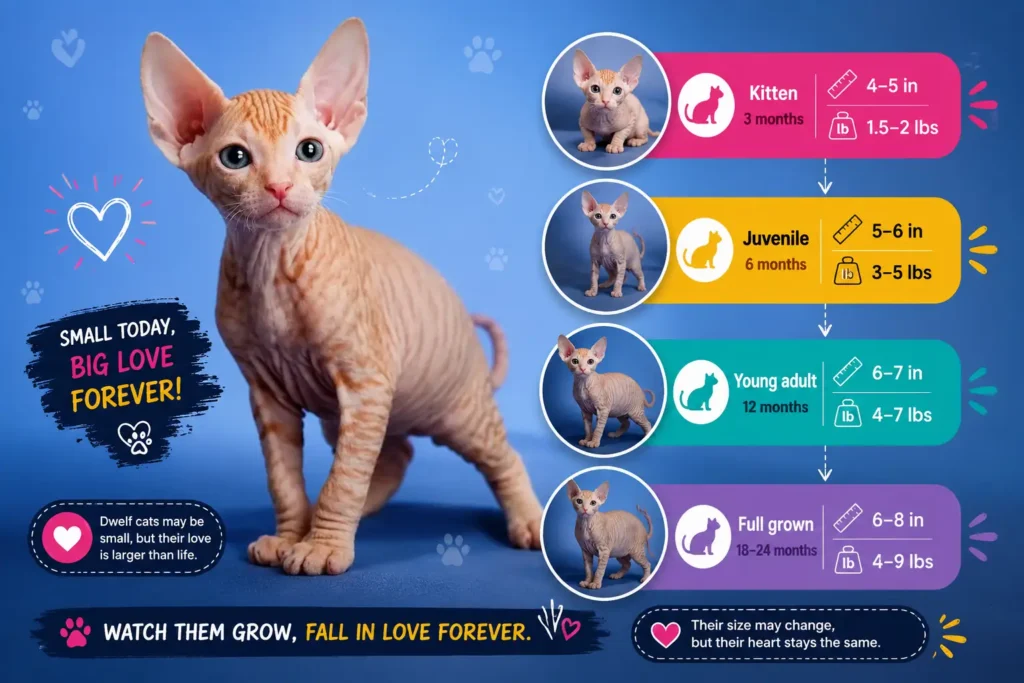
Most Dwelf cats reach close to their adult height by around twelve months old, but full muscle and body fill-out can take up to eighteen to twenty-four months. This slower timeline comes from the Munchkin dwarfism gene, which affects bone growth more than overall development speed.
So if your one-year-old Dwelf still looks a little gangly, that is completely normal. Give it another six months to a year before comparing it to breed weight charts.
Full-Grown Dwelf Cat Size (Height, Length & Body Build)
A full-grown Dwelf cat typically stands only six to eight inches tall at the shoulder, making it one of the shortest domestic cat breeds around. Despite the tiny stature, the body itself is long and low, similar to a Munchkin’s, with a slight arch from the longer hind legs.
Bone structure is medium, not fragile, and the chest is broad for the cat’s size. Here is a quick look at how height and weight change across the breed’s growth stages, which also tends to earn attention in size comparisons.
| Growth Stage | Approx. Age | Approx. Height | Approx. Weight |
| Kitten | 3 months | 4-5 in | 1.5-2 lbs |
| Juvenile | 6 months | 5-6 in | 3-5 lbs |
| Young adult | 12 months | 6-7 in | 4-7 lbs |
| Full grown | 18-24 months | 6-8 in | 4-9 lbs |
Dwelf Cat Adult Weight: What’s Normal?
On average, an adult Dwelf cat weighs between four and nine pounds, or roughly 1.8 to 4 kilograms, depending on sex, bone density, and diet. That is close to half the weight of an average domestic shorthair. Because hairless cats burn more calories keeping warm, a healthy Dwelf often looks leaner than a Munchkin of the same age.
Ribs should be easy to feel but not visible, and the belly should have a gentle curve rather than a hard, rounded shape.
Average Weight for a Dwarf Cat vs Dwelf Cat
In short, a general dwarf cat such as a Munchkin usually weighs five to nine pounds, while a Dwelf sits slightly lower at four to nine pounds because the hairless trait reduces overall body mass. Both breeds share the short-leg gene, but the Dwelf’s leaner frame usually makes it the smaller of the two overall.
Why Are Dwelf Cats So Small?
The Dwelf’s small size comes down to genetics, not poor nutrition or stunted growth. The Munchkin gene shortens the long bones in the legs without shrinking the spine, and the Sphynx influence trims body fat and fur, making the cat look even more compact.
The Dwelf is not yet a fully recognized breed under major registries such as The International Cat Association (TICA), which means breed standards can still vary a fair amount between catteries.
Male vs Female Full-Grown Dwelf Cat Size
Male Dwelf cats generally weigh six to nine pounds once fully grown, while females tend to stay closer to four to six pounds. Height differences are less noticeable, since both sexes carry the same short-leg gene. If you want a slightly larger, more solid-bodied Dwelf, a male is usually the better bet.
Does a Dwelf Cat Stay Kitten-Sized Forever?
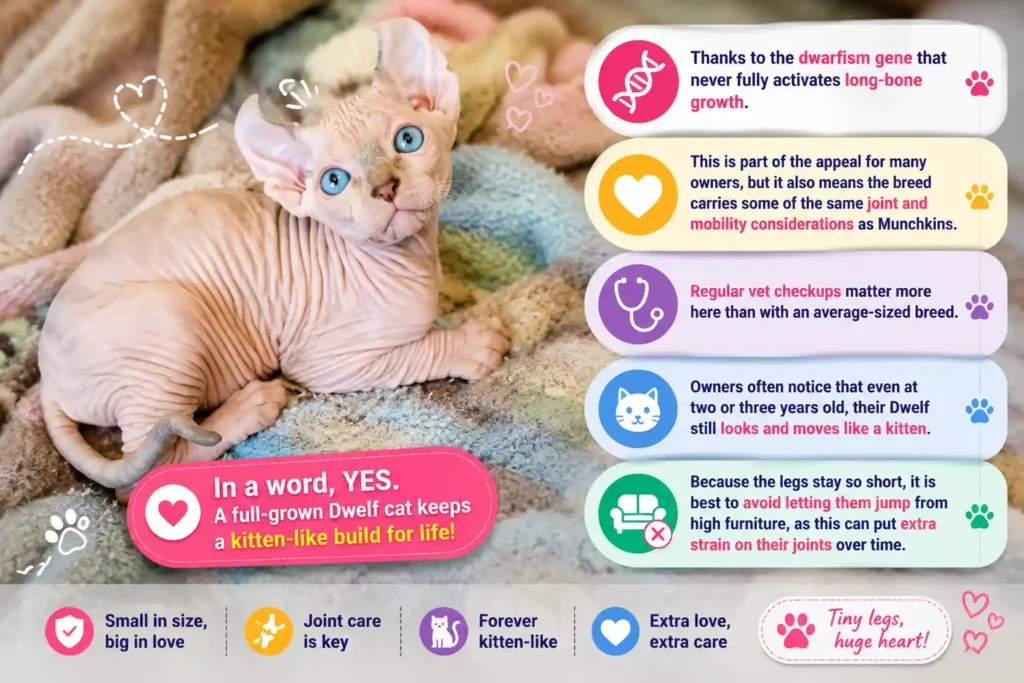
In a word, yes. A full-grown Dwelf cat keeps a kitten-like build for life, thanks to the dwarfism gene that never fully activates long-bone growth. This is part of the appeal for many owners, but it also means the breed carries some of the same joint and mobility considerations as Munchkins.
Regular vet checkups matter more here than with an average-sized breed. Owners often notice that even at two or three years old, their Dwelf still looks and moves like a kitten, which can be surprising if you are used to normal-sized cats. Because the legs stay so short, it is best to avoid letting them jump from high furniture, as this can put extra strain on their joints over time.
Coated Dwelf Cat: Can a Dwelf Have Fur?
Yes, a Dwelf can occasionally have fur, even though hairlessness is the breed’s signature trait. Because the hairless gene is recessive, some litters produce coated Dwelf kittens with a soft, short coat instead of bare skin. These cats are still purebred Dwelfs; they simply did not inherit two copies of the hairless gene.
A coated Dwelf usually has the same short legs, curled ears, and playful personality as its hairless siblings, so the only real difference is the fur. Breeders sometimes sell coated Dwelfs for a lower price since most buyers specifically want the hairless look.
Hairless vs Light Fuzz: Understanding the Dwelf Coat
Most Dwelf cats fall somewhere between fully bald and lightly fuzzy, with a suede-like texture that feels warm to the touch. A true-coated Dwelf is rarer and is usually not shown competitively, since breed standards favor the hairless look. Either way, skin care needs, including regular bathing and sun protection, stay the same.
How the Dwelf Cat’s Curled Ears and Short Legs Change Its Adult Appearance
As a Dwelf matures, the ear curl tightens and becomes more defined, often not settling into its final shape until the cat is close to a year old. The short legs also become more visually striking as the body fills out, giving adults a low, almost bulldog-like stance compared to leggy kittens.
These two traits together are what make a full-grown Dwelf cat instantly recognizable, even from across a room. The wrinkled skin, especially around the face and shoulders, also becomes more noticeable with age, adding to the breed’s unique look. Combined with their large, alert eyes, these features give adult Dwelf cats an expression that many owners describe as a mix of curious and comical.
Does Diet Affect a Full-Grown Dwelf Cat’s Size?
Diet will not make a Dwelf taller, since height is set by genetics, but it strongly affects healthy weight and muscle tone. Underfeeding can leave the spine and hips too prominent, while overfeeding adds fat the short legs were never built to carry.
A calorie-dense, high-protein diet suited to the cat’s higher metabolism, along with feeding guidance similar to that recommended by The ASPCA for small-breed cats, gives the best shot at a proportionate adult build.
Healthy Weight Signs for an Adult Dwelf Cat
A healthy adult Dwelf has a visible waist when viewed from above, ribs you can feel with light pressure, and a belly that curves gently rather than sagging or bulging. If the legs look too heavy for the body, or the cat tires quickly during play, a vet visit to reassess diet is worth scheduling soon.
Common Growth Problems in Dwelf Cats
Because Dwelf cats combine three sets of structural genes, growth issues are more common here than in single-breed cats. Lordosis, an inward-curving spine, and pectus excavatum, a sunken chest, can appear in kittens carrying certain gene combinations, sometimes affecting breathing or mobility as the cat reaches adult size.
According to the Cornell Feline Health Center, responsible breeders should screen for these structural conditions before pairing cats, and any reputable seller should be able to discuss health testing openly.
Full-Grown Dwelf Cat Compared to Other Hairless and Dwarf Breeds
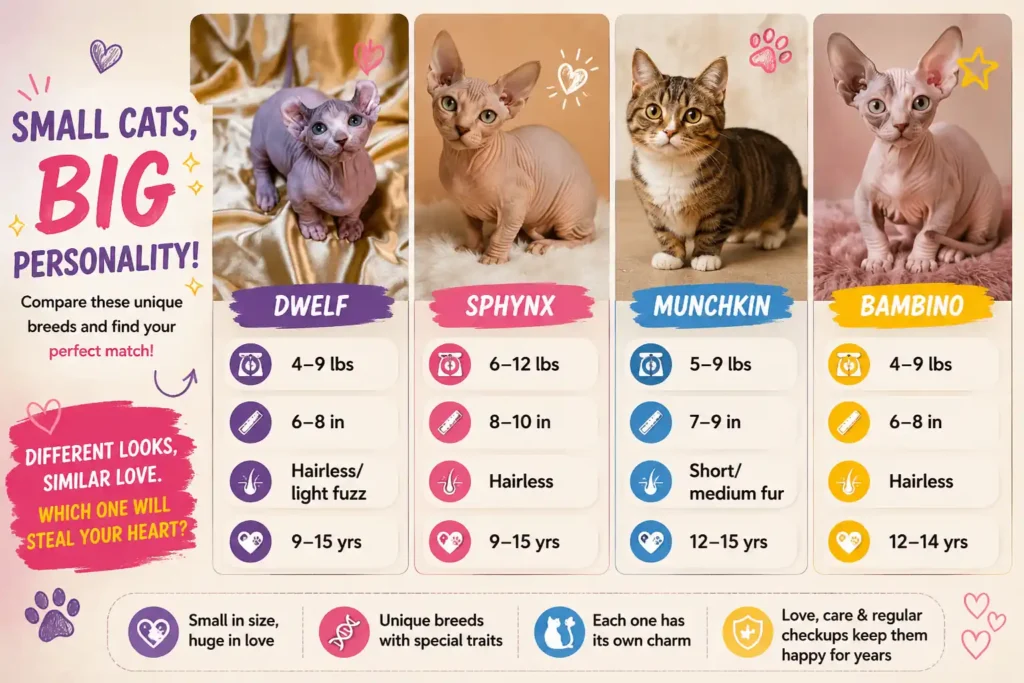
If you are torn between a Dwelf and a related breed, size and coat are usually the deciding factors. A full-grown Dwelf cat sits between the Sphynx and the Munchkin in almost every measurable way, shorter than a Sphynx but hairless, unlike a typical Munchkin. The table below lines up the key numbers side by side.
| Breed | Avg. Adult Weight | Avg. Height | Coat | Lifespan |
| Dwelf | 4-9 lbs | 6-8 in | Hairless/light fuzz | 9-15 yrs |
| Sphynx | 6-12 lbs | 8-10 in | Hairless | 9-15 yrs |
| Munchkin | 5-9 lbs | 7-9 in | Short/medium fur | 12-15 yrs |
| Bambino | 4-9 lbs | 6-8 in | Hairless | 12-14 yrs |
Frequently Asked Questions About Full-Grown Dwelf Cats
How big is a full-grown Dwelf cat?
A full-grown Dwelf cat usually stands six to eight inches tall and weighs between four and nine pounds.
How much does an adult Dwelf cat weigh?
Most adults weigh four to nine pounds, with males typically landing on the heavier end of that range.
Is a Dwelf cat smaller than a Sphynx?
Yes, the Dwelf is usually shorter and lighter than the Sphynx because of its Munchkin leg genetics.
Can a Dwelf cat have fur?
Occasionally, yes. A recessive gene combination can produce coated Dwelf kittens with a soft, short coat.
Are coated Dwelf cats rare?
Yes, coated Dwelfs are less common than hairless ones and are rarely shown competitively.
Do Dwelf cats stop growing after one year?
Height mostly stops around twelve months, but muscle and body fill-out can continue until eighteen to twenty-four months.
What is the average weight for a dwarf cat?
Most dwarf cat breeds, including the Munchkin, average five to nine pounds as adults.
Do male Dwelf cats get bigger than females?
Yes, males typically weigh six to nine pounds while females average four to six pounds.