

Korean Bobtail cat training works best when owners understand this breed’s natural intelligence and playful energy from day one. A Korean Bobtail is a rare, short-tailed cat from Korea, and it learns new commands much faster than many common breeds because it loves food rewards and human attention. Basic Korean Bobtail cat training usually starts with simple actions like sitting, coming when called, or touching a target stick, and most kittens understand the idea within the first two weeks if the sessions are short and happen daily.
A calm room, small treats, and a clicker or a simple word like “yes” help the cat connect the action with the reward right away. Consistency matters more than long sessions, since five minutes twice a day works better than one long, tiring session. Owners who stay patient and keep training fun instead of forceful usually see real progress much sooner than they expect.
Can Korean Bobtail Cats Be Trained Easily?
Yes, and it is not just breed hype. Korean Bobtail cat training tends to go smoother than average because this breed is naturally curious, food-motivated, and genuinely eager to interact with people. Unlike more independent breeds, Korean Bobtails often seek out engagement, which makes short sessions feel like play rather than a chore. That said, easy does not mean instant. You still need consistency, the right rewards, and realistic expectations. Most owners see visible progress within the first two to three weeks of regular practice.
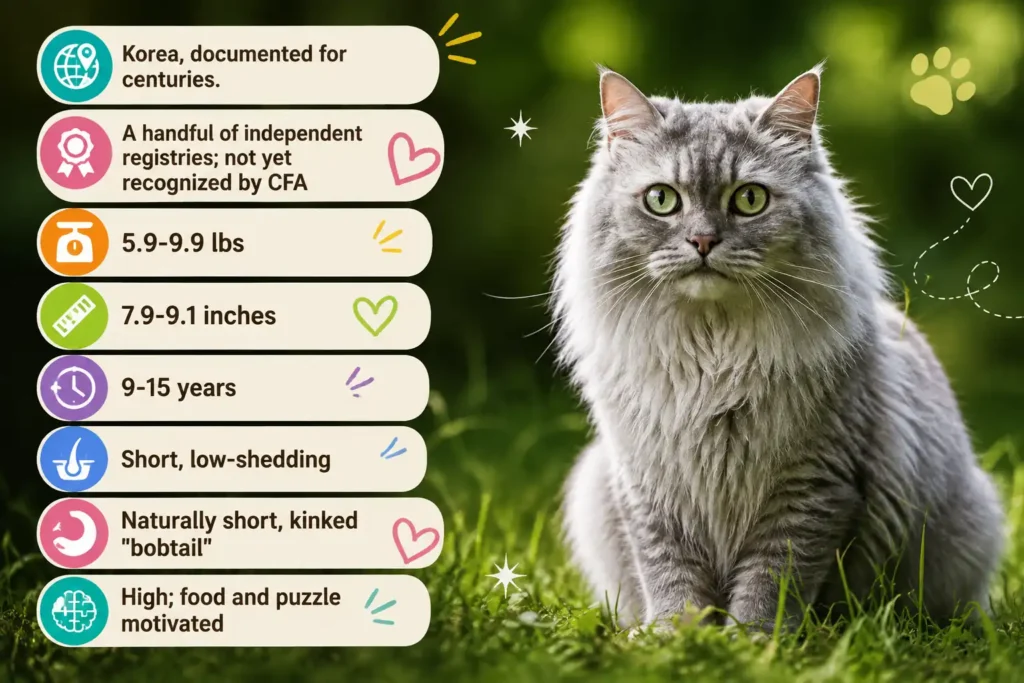
Before getting into methods, it helps to know exactly what breed you are working with, so here is a quick snapshot.
| Trait | Detail |
| Origin | Korea, documented for centuries. |
| Recognition | A handful of independent registries; not yet recognized by CFA |
| Weight | 5.9-9.9 lbs |
| Height | 7.9-9.1 inches |
| Lifespan | 9-15 years |
| Coat | Short, low-shedding |
| Tail | Naturally short, kinked “bobtail” |
| Trainability | High; food and puzzle motivated |
When to Start Korean Bobtail Cat Training
The best window for Korean Bobtail cat training starts around 8 to 10 weeks old, right after a kitten settles into its new home. Young kittens pick up litter habits and basic cues faster since they have not formed competing habits yet. That does not mean adult cats are a lost cause, either. Korean Bobtails stay food-motivated well into their senior years, so older cats can still learn new behaviors, just on a slightly longer timeline. Starting early simply gives you a head start, not a guarantee.
earn When Your Korean Bobtail Is Ready to Learn. Read more in Korean Bobtail Cat That Looks Rare but Isn’t Officially Recognized.
What Age Should You Start Korean Bobtail Cat Training?
Most veterinary behaviorists recommend starting basic Korean Bobtail cat training between 8 and 10 weeks of age, once a kitten is eating solid food and settled into its new home. Short five-minute sessions work best at this stage.
How to Prepare for Korean Bobtail Cat Training
Good preparation saves you weeks of frustration later on. Start by picking a quiet, low-distraction corner of the house for practice sessions. Stock up on small, soft treats your cat genuinely loves, since freeze-dried chicken or tuna flakes tend to work well for this breed.
Guidance from the American Association of Feline Practitioners points out that short two-to-five-minute sessions, repeated several times a day, work far better than one long session. Keep a clicker or a consistent verbal marker on hand, and try to end every session on a successful note.
Basic Commands to Teach a Korean Bobtail Cat
Start with commands that build on a cat’s instincts rather than fighting them, since these early wins keep motivation high for both of you.
- Sit: lure upward with a treat held above the head
- Come: pair a whistle or word with feeding time
- High-five: shape it from a natural paw-swipe motion
- Stay: build duration in tiny increments
Once your cat masters one command reliably, move on to the next. Rushing several commands at once usually backfires.
Litter Box Training for a Korean Bobtail Cat
Most Korean Bobtail kittens pick up litter habits almost instinctively, since the behavior is largely hardwired into cats generally. Still, setup matters quite a bit. Use one box per cat plus one extra, place them in quiet corners, and scoop daily without fail.
Unscented, fine-grain litter tends to be preferred over heavily perfumed options. If accidents happen, resist the urge to punish; instead, check for a dirty box, a disliked litter type, or stress nearby. Litter box training rarely needs tricks beyond good hygiene and sensible placement.
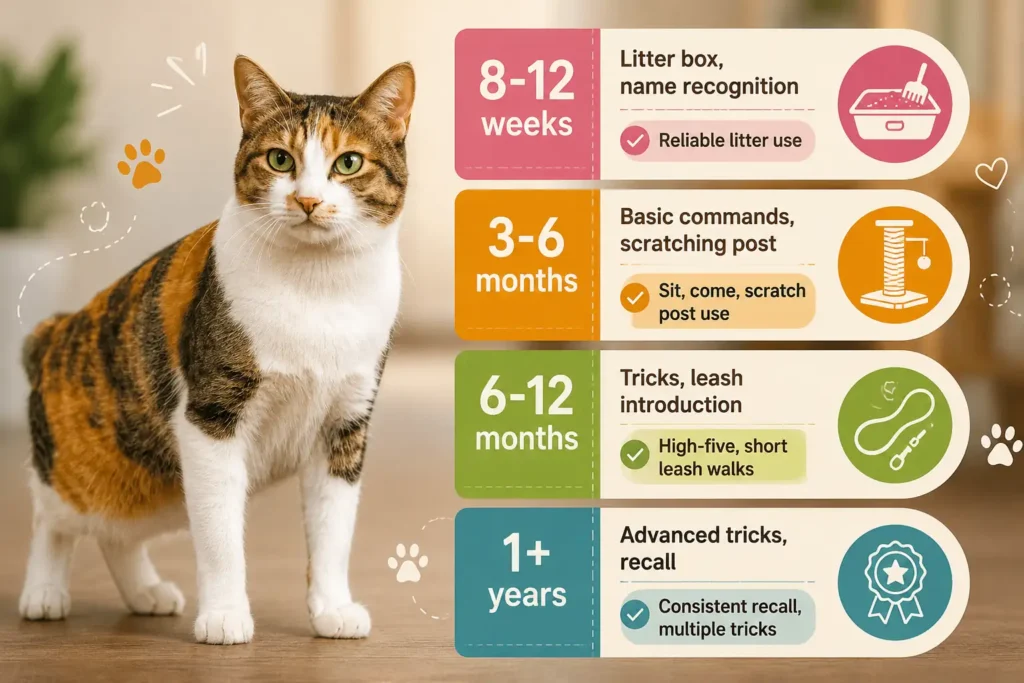
Here is a rough timeline of what to expect as Korean Bobtail cat training progresses across different life stages.
| Age | Focus | Typical Outcome |
| 8-12 weeks | Litter box, name recognition | Reliable litter use |
| 3-6 months | Basic commands, scratching post | Sit, come, scratch post use |
| 6-12 months | Tricks, leash introduction | High-five, short leash walks |
| 1+ years | Advanced tricks, recall | Consistent recall, multiple tricks |
Scratching Post Training for Korean Bobtail Cats
Scratching is a normal, necessary behavior, not something to eliminate outright, so the real goal is redirecting it. Place a sturdy post near a favorite scratching spot, like a couch corner, and rub it with catnip or silvervine to build interest fast.
Reward any contact with the post immediately; even accidental swipes count. Meanwhile, make off-limits furniture less appealing with double-sided tape or foil for a while. Trim nails every two to three weeks to limit damage as the habit forms. Consistency here usually pays off within two to four weeks.
Clicker Training for Korean Bobtail Cats
Clicker training works exceptionally well for this breed because it thrives on clear, fast feedback. The click marks the exact moment your cat does something right, followed immediately by a treat. Start by charging the clicker, meaning click then treat, repeated ten to fifteen times, so your cat links the sound to a reward. From there, you can shape almost any behavior, from targeting a stick to spinning in a circle. Keep sessions short, and always click before you treat, never after.
How Long Does Clicker Training Take to Work?
Most cats start associating the clicker sound with a reward after 10 to 15 repetitions, often within a single short session. Full behaviors typically take one to two weeks of daily practice to become reliable.
Leash Training a Korean Bobtail Cat
Introduce the harness indoors first, letting your cat wear it around the house for a few minutes daily before ever attaching a leash. Once your cat seems comfortable, clip on a lightweight leash and let them drag it briefly under supervision. Only then move to gentle, guided walks in a secure, quiet area outside. Korean Bobtails, being naturally curious and active, often adapt to leash walking better than many other breeds do. Never force or drag a cat forward; let curiosity set the pace instead.
How to Train a Korean Bobtail Cat to Come When Called
Pick one consistent word or sound, such as a specific whistle, and pair it only with something rewarding, whether that is food, play, or affection. Practice at feeding time by calling before the bowl goes down, so the association builds naturally and fairly quickly.
Gradually increase distance and distractions once your cat responds reliably indoors. Never call your cat to come for something negative, like nail trims, or the cue loses meaning over time. Consistency across every family member matters just as much as consistency across sessions.
Teaching Fun Tricks During Korean Bobtail Cat Training
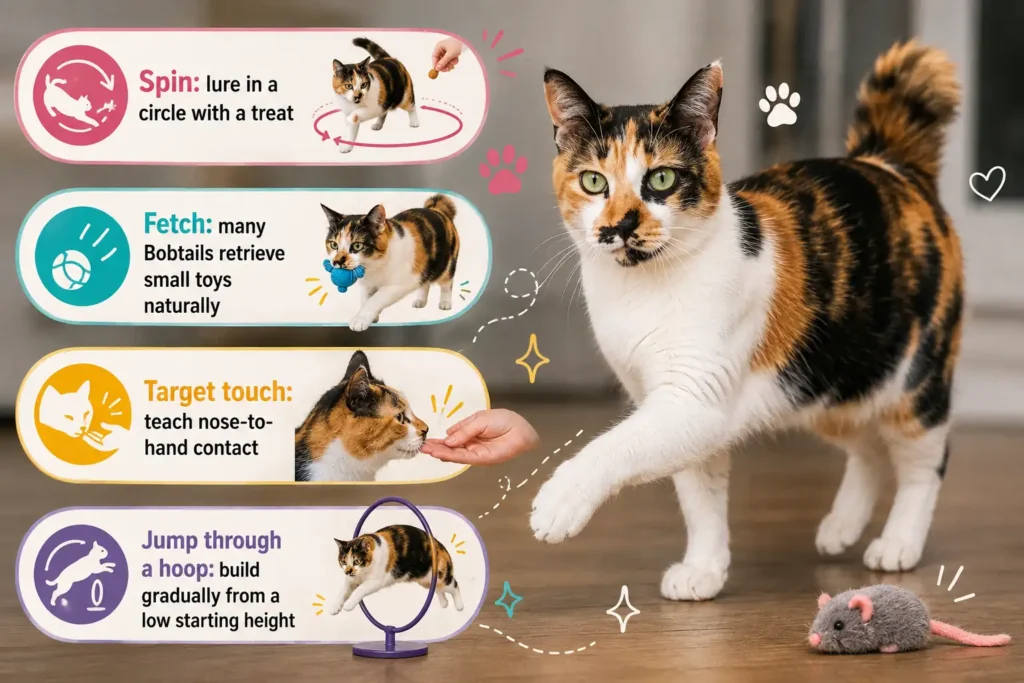
Once the basics stick, tricks keep a smart, active breed like this one mentally engaged, and boredom is often behind unwanted behavior anyway.
- Spin: lure in a circle with a treat
- Fetch: many Bobtails retrieve small toys naturally
- Target touch: teach nose-to-hand contact
- Jump through a hoop: build gradually from a low starting height
Rotate tricks regularly so your cat does not lose interest.
How to Correct Bad Habits Without Punishment
Punishment tends to backfire with cats, often increasing fear or anxiety rather than fixing the behavior itself. The American Society for the Prevention of Cruelty to Animals recommends redirecting unwanted behavior toward an acceptable alternative, paired with removing whatever is rewarding the bad habit in the first place. If your cat scratches furniture, redirect to a post and make the furniture less appealing. If it bites during play, stop the interaction immediately and resume only once calm. Ignoring attention-seeking behavior, when it is safe to do so, often works better than scolding.
Using Positive Reinforcement in Korean Bobtail Cat Training
Positive reinforcement is the backbone of effective Korean Bobtail cat training, and honestly, it is the only method with real scientific support behind it for cats. Reward desired behavior immediately, within one to two seconds, so your cat connects the action to the outcome clearly.
Rewards do not always need to be food; praise, play, or a favorite toy work too, especially once training progresses further. Vary rewards occasionally to keep sessions interesting rather than predictable. Cats trained this way tend to stay more engaged and less anxious overall.
Common Korean Bobtail Cat Training Mistakes to Avoid
Even motivated owners fall into a few predictable traps along the way. Sessions that run too long tend to exhaust a cat’s patience before real progress happens. Inconsistent cues confuse cats faster than almost anything else, since they rely heavily on clear patterns. Skipping rewards, or rewarding too late, weakens the entire learning process over time. Expecting dog-level obedience also sets owners up for disappointment. Recognizing these patterns early on makes a real difference.
A quick side-by-side makes these mistakes easier to spot and fix right away.
| Mistake | Better Approach |
| Long, 20+ minute sessions | Short 2-5 minute sessions |
| Punishing accidents | Redirecting and removing triggers |
| Inconsistent household cues | One shared word per command. |
| Rewarding minutes later | Rewarding within 1-2 seconds |
What Is the Single Biggest Cat Training Mistake?
The most common mistake is inconsistency, meaning different family members use different words or rewards for the same behavior. This confuses cats and slows progress far more than any single training method choice.
How Long Does Korean Bobtail Cat Training Take?
There is no single timeline, since it depends on the behavior, the cat’s age, and how consistent practice actually is. Simple habits, like using a scratching post, often click within two to four weeks. More advanced tricks can take one to two months of regular, short sessions. Guidance from the Cornell Feline Health Center notes that cats generally retain learned behaviors well once trained, so the upfront time investment tends to pay off long-term. Patience matters more than speed here.
FAQs About Korean Bobtail Cat Training
Are Korean Bobtail cats easy to train?
Generally, yes. Their intelligence and food motivation make Korean Bobtail cat training smoother than average, though every cat still has its own pace.
What age should Korean Bobtail cat training start?
Most experts suggest starting around 8 to 10 weeks old, once a kitten is settled and eating solid food.
Can adult Korean Bobtail cats still be trained?
Yes. Adults can learn new behaviors too; it usually just takes a bit longer than it does with kittens.
Is clicker training necessary for this breed?
It is not required, but it speeds things up considerably by marking the exact moment a behavior is correct.
How long until a Korean Bobtail learns basic tricks?
Simple tricks often click within one to two weeks of short, consistent daily sessions.
Do Korean Bobtail cats need leash training?
It is optional, but many owners enjoy it since this breed tends to adapt well to leash walks outdoors.