
The Ojos Azules cat extinct story traces back to 1984, when a tortoiseshell cat named Cornflower was found in a feral colony in New Mexico with strikingly deep blue eyes. She was bred to non-blue-eyed males, and her kittens inherited the same trait, proving it was dominant. TICA accepted the breed for registration in 1991, but by 1992 only ten Ojos Azules cats were known to exist.
Breeders later discovered that the gene causing the blue eyes could also cause cranial defects, and breeding was temporarily suspended to protect the cats’ health. That single decision marks the true start of the Ojos Azules cat extinct label, since breeders chose animal welfare over keeping the rare trait alive.
What Is the Ojos Azules Cat and Why Did It Go Extinct
The Ojos Azules is a rare domestic cat breed that originated in the United States, and its name is Spanish for “blue eyes.” Unlike Siamese cats, whose blue eyes come from a colorpoint gene that also strips pigment from the coat, Ojos Azules cats could show deep sapphire-blue eyes on literally any coat color. That unusual combination made the breed instantly recognizable among serious cat fanciers. The International Cat Association granted the breed experimental recognition in 1991, though it never reached full championship status before problems emerged.
Discover the Fascinating Story Behind This Blue-Eyed Breed. Read more in Ojos Azules Cats With Eyes That Break Every Rule.
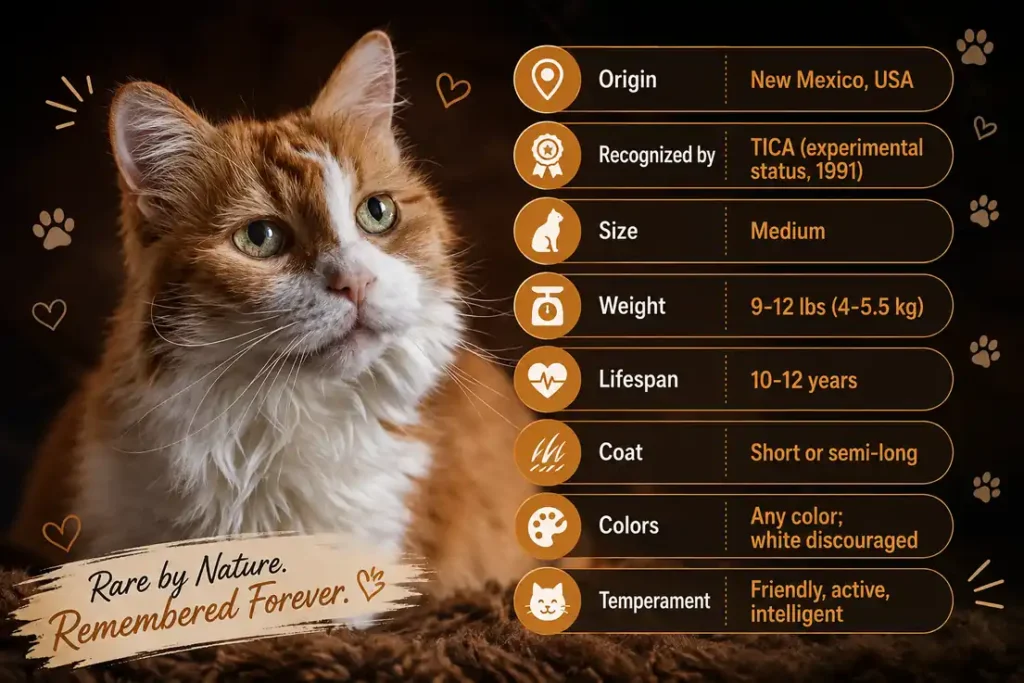
Ojos Azules cats were medium-sized, typically weighing between 9 and 12 pounds, with an estimated lifespan of 10 to 12 years during the years the breed was actively bred. Their coat came in short or semi-long varieties, and owners described their temperament as friendly, active, and genuinely intelligent. That rare beauty, unfortunately, is part of the reason the breed struggled to survive long-term.
Here’s a quick snapshot of the Ojos Azules cat’s core traits before the breed effectively disappeared.
| Trait | Detail |
| Origin | New Mexico, USA |
| Recognized by | TICA (experimental status, 1991) |
| Size | Medium |
| Weight | 9-12 lbs (4-5.5 kg) |
| Lifespan | 10-12 years |
| Coat | Short or semi-long |
| Colors | Any color; white discouraged |
| Temperament | Friendly, active, intelligent |
History and Origin of the Ojos Azules Cat
The Ojos Azules story begins in 1984, when a family in New Mexico noticed a tortoiseshell feral cat with unusually dark blue eyes and named her Cornflower. Ordinarily, blue eyes in adult cats link back to the white gene or the Siamese colorpoint gene, so a tortoiseshell cat with sapphire eyes was genuinely unusual. Feline geneticist Solveig Pfleuger studied Cornflower’s offspring and confirmed that a dominant, previously undocumented gene was responsible for the color.
Breeders then paired Cornflower’s descendants with American Shorthairs to see whether the trait would reliably pass down, and it did. By 1991, the breed had earned experimental status, yet by 1992 only about ten known Ojos Azules cats existed anywhere in the world. That extreme rarity, combined with what researchers would soon discover about the gene, set the stage for everything that followed.
This timeline lays out exactly how quickly the breed rose and then faded from view.
| Year | Event |
| 1984 | Cornflower discovered in a feral colony in New Mexico. |
| Late 1980s | Geneticist Solveig Pfleuger studies the dominant blue eye gene. |
| 1991 | TICA grants the Ojos Azules experimental recognition |
| 1992 | Only about 10 known Ojos Azules cats exist worldwide. |
| 1990s | Cranial malformation risks come to light; breeding slows. |
| 2014 | TICA moves the breed to registration-only status |
When Did Ojos Azules Go Extinct?
Health concerns that emerged in the early-to-mid 1990s caused Ojos Azules breeding to decline sharply. Instead of ending on a single official date, most breeders gradually discontinued their programs, which is why the breed’s timeline often confuses people.
The International Cat Association kept the breed’s paperwork on record, but active recognition faded as fewer breeders continued the work. By 2014, TICA had moved the Ojos Azules breed back to registration-only status.
Breeders could still register existing cats, but they no longer continued active breeding programs or promoted the breed in cat shows under the official breed standard. Consequently, most breed experts now treat the Ojos Azules as functionally extinct, even without one official worldwide extinction announcement. It’s a slow fade rather than a dramatic collapse, which honestly makes the story feel even sadder.
Is the Ojos Azules Cat Extinct?
Yes, most veterinary and feline genetics sources now describe the Ojos Azules cat as extinct or functionally discontinued.Today, no verified breeding programs exist, and experts haven’t confirmed any sightings of purebred Ojos Azules cats in recent years.
What Caused the Ojos Azules Cat to Become Extinct?
The core problem traces directly back to genetics. Researchers eventually discovered that the dominant blue eye gene responsible for the breed’s signature look was lethal when a kitten inherited two copies of it, one from each parent. Even in cats with just one copy of the gene, some individuals developed cranial malformations that affected their skull structure and overall health.
Because breeders couldn’t reliably predict which kittens would develop problems, every litter carried real risk. That uncertainty made responsible breeding extremely difficult, and it directly conflicts with modern animal welfare standards that reputable registries now enforce. Once this pattern became clear, continuing to breed for the trait started to look less like preserving a rare breed and more like gambling with kittens’ health.
Why Did Ojos Azules Breeding Stop?
Ethical breeders faced a genuinely difficult choice once the health risks became obvious, and most of them chose welfare over rarity. Organizations focused on feline health, including groups like the American Association of Feline Practitioners, have long emphasized that breed standards should never come at the cost of an animal’s basic well-being. As word spread among cat fanciers about the cranial defects linked to the gene, fewer breeders were willing to continue the experimental program.
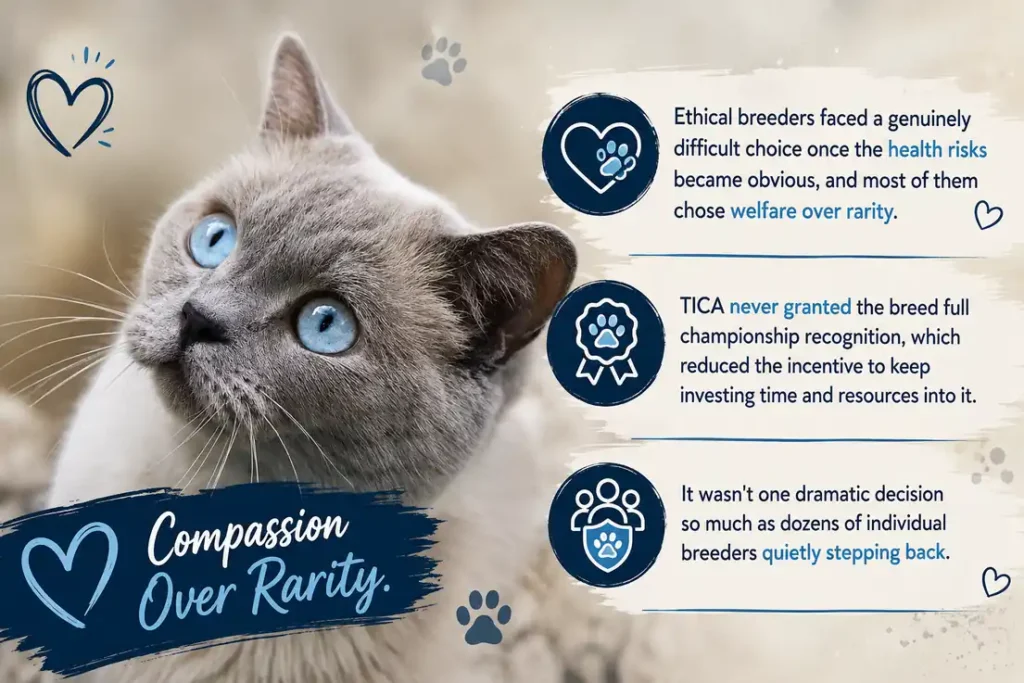
TICA never granted the breed full championship recognition, which also reduced the incentive to keep investing time and resources into it. Combine that with the breed’s naturally tiny population, and the difficulty of finding unrelated cats to prevent inbreeding, and the breeding programs essentially ran out of road. It wasn’t one dramatic decision so much as dozens of individual breeders quietly stepping back.
Health and Genetic Problems Behind the Breed’s Decline
The gene behind the Ojos Azules cat’s eye color is often referred to as the dominant blue eye, or DBE, gene. When a kitten inherits two copies, the condition is fatal, usually resulting in stillbirth or death shortly after birth. Even heterozygous cats, meaning those with just one copy, sometimes develop skull and facial malformations that could affect breathing, dentition, or overall comfort.
The Cornell Feline Health Center has long noted that certain feline coat and eye color mutations carry hidden health tradeoffs, and the Ojos Azules gene fits that pattern closely. Breeders faced constant uncertainty because not every heterozygous kitten developed the malformations.That unpredictability, paired with the severity of the worst cases, made this one of the clearer examples of a cosmetic trait genuinely conflicting with animal welfare.
Protect Your Ojos Azules with Early Health Awareness. Read more in Ojos Azules Cats Health Problems That Come With Those Famous Blue Eyes.
Are Any Ojos Azules Cats Still Alive?
Nobody can say for certain, and that’s honestly part of the mystery surrounding this breed. A handful of Ojos Azules cats or their descendants may exist among small hobbyist breeding groups outside formal registries, but nothing has been verified. Random-bred cats occasionally show up with strikingly blue eyes on a dark coat, yet without genetic testing there’s no reliable way to confirm true Ojos Azules lineage versus coincidental Siamese ancestry.
No major registry currently lists active breeders, and no cat show has featured a verified Ojos Azules entry in a long time. For now, the honest answer is that the breed exists mostly in historical records, old photographs, and the occasional online rumor.
Has the Ojos Azules Cat Been Officially Declared Extinct?
No single global authority has issued a formal “extinction” declaration for the Ojos Azules cat. However, TICA’s registration-only status since 2014 and the total absence of active breeders effectively function the same way.
Can You Still Buy an Ojos Azules Cat?
Realistically, no reputable breeder can currently sell you a verified Ojos Azules cat. Since active breeding stopped decades ago, any listing claiming to offer purebred kittens today deserves serious skepticism. Scammers occasionally use the breed’s rarity and striking appearance to charge inflated prices for cats that are, at best, blue-eyed mixed breeds with no real lineage documentation.
A genuine Ojos Azules would need a verifiable pedigree tracing back to Cornflower’s original line, and that paperwork simply doesn’t exist for modern litters. If you love the look of deep blue eyes on a cat, breeds like the Balinese, Siamese, or Himalayan offer similarly striking features and remain readily available through legitimate, health-focused breeders. Those alternatives also come without the same lethal genetic risks that ended the Ojos Azules program.
Ojos Azules Cat Cost
Because the breed is essentially unavailable today, there’s no current, legitimate market price for an Ojos Azules cat. When breeders were still developing the breed, they rarely sold these cats and mostly kept them in research and breeding programs instead of placing them as pets. Historical estimates from cat fancier communities suggested prices could have reached several thousand US dollars for a verified kitten, largely driven by scarcity rather than demand from typical pet owners.
Discover the Real Value Behind This Rare Blue-Eyed Cat. Read more in Ojos Azules Cat Price That Explains Why It’s So Rare.
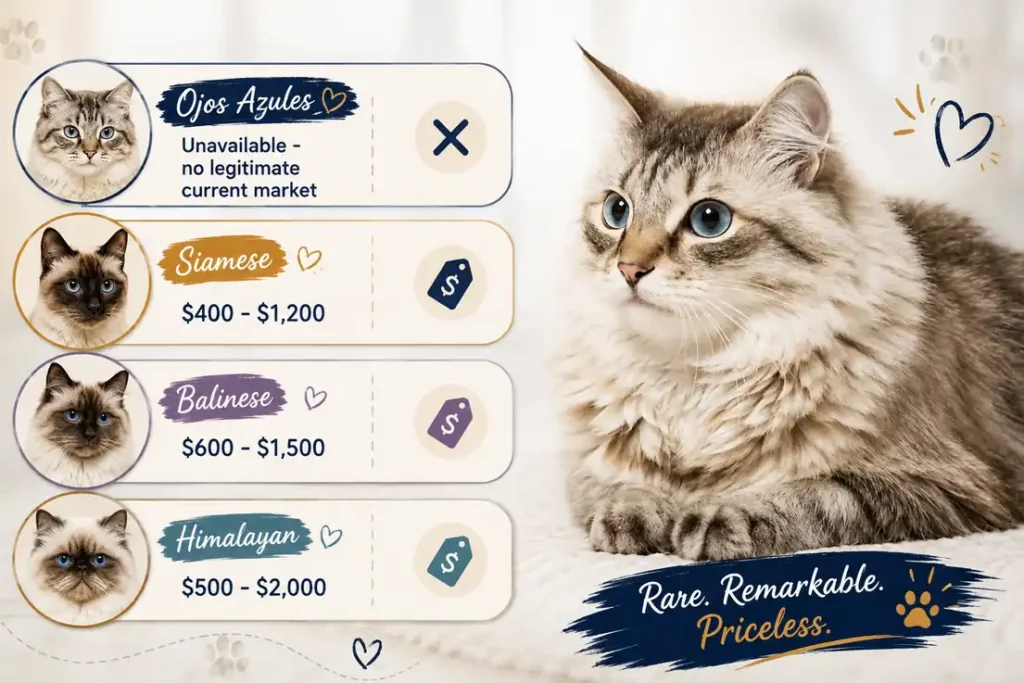
Today, any online listing advertising an “Ojos Azules for sale” at any price should be treated with real caution. Comparing costs against other rare or blue-eyed breeds can help put things in perspective.
| Breed | Typical Price Range (USD) |
| Ojos Azules | Unavailable – no legitimate current market |
| Siamese | $400 – $1,200 |
| Balinese | $600 – $1,500 |
| Himalayan | $500 – $2,000 |
Why Is the Ojos Azules Cat Cost So High?
Historically, the price reflected extreme scarcity rather than typical breed economics. With only about ten known cats in 1992 and a genetically risky breeding process, supply never came close to meeting curiosity-driven demand.
Interesting Facts About the Ojos Azules Cat
- The name “Ojos Azules” translates directly to “blue eyes” in Spanish.
- Cornflower, the founding cat, was a tortoiseshell, a color not normally linked to blue eyes.
- The breed’s gene works independently of coat color, unlike the Siamese colorpoint gene.
- White coats were discouraged in the breed standard to avoid confusion with deafness-linked white gene traits.
- TICA accepted both shorthaired and semi-longhaired varieties under the same standard.
- At its peak, fewer than a dozen verified Ojos Azules cats were known to exist worldwide.
Final Thoughts on the Ojos Azules Cat Extinct
The Ojos Azules cat’s story is equal parts fascinating and sobering. A single feral cat with an extraordinary genetic quirk sparked real excitement among breeders in the 1980s, yet within a few decades, health concerns quietly ended the experiment. Responsible breeders didn’t abandon the Ojos Azules cat because of a lack of interest. Instead, they chose to prioritize the cats’ health and welfare over preserving a rare and beautiful trait, which ultimately led to the breed’s extinction.
That decision offers a genuinely useful reminder for anyone drawn to unusual cat breeds today: striking looks should never come before an animal’s health. While you likely won’t ever meet a true Ojos Azules in person, its legacy still shapes conversations about ethical breeding practices across the cat fancier world.
FAQs About the Ojos Azules Cat Extinct
Is the Ojos Azules cat completely extinct?
Most experts consider it functionally extinct, since no verified active breeding programs currently exist anywhere in the world.
What breed replaced the Ojos Azules?
No breed directly replaced it, but the Balinese, Siamese, and Himalayan are popular alternatives for fans of striking blue eyes.
Why was Ojos Azules breeding considered unethical?
The responsible gene was lethal in double copies and caused cranial malformations in some single-copy carriers, raising serious welfare concerns.
Can Ojos Azules cats be found in shelters?
It’s extremely unlikely, since no verified population currently exists outside historical breeding records.
Did TICA ever fully recognize the Ojos Azules breed?
No, the breed only ever reached experimental and later registration-only status, never full championship recognition.