
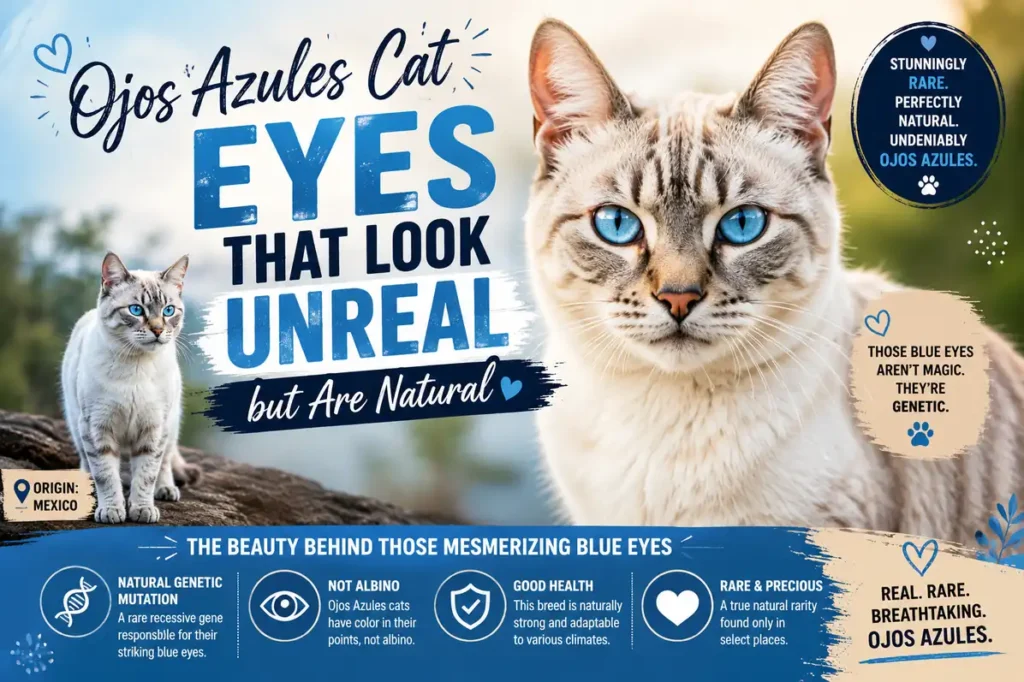
Ojos Azules cat eyes are deep blue and can appear with many coat colours, including patterns that do not usually produce blue eyes. The historic breed was first identified in New Mexico in the 1980s, and its eye colour came from a dominant genetic trait rather than the colourpoint genes seen in many blue-eyed cats. Ojos Azules cat eyes became important to geneticists because breeding two cats with the trait was linked to serious birth defects in kittens.
This risk kept the breed extremely rare and limited its breeding history. The eye colour can also appear as odd eyes, with one blue eye and one eye of a different colour. Blue eyes alone do not confirm that a cat is an Ojos Azules, because several other breeds can have them too.
What Makes Ojos Azules Cat Eyes So Unique?
Most cats with blue eyes, like Siamese or white Persians, only get that color because a gene is suppressing pigment across the whole body. Ojos Azules cat eyes work differently. The trait comes from an independent dominant gene, so it doesn’t touch fur color or pattern at all. That means you could theoretically see a solid black cat or a calico with startling blue eyes, something that rarely happens naturally elsewhere.
Breeders and geneticists found this so unusual that the trait got its own name in Spanish, meaning simply “blue eyes.” It’s a rare case where a single gene creates a visual contradiction that shouldn’t exist under typical feline color rules, and that novelty is still the main reason the breed draws attention today.
Find Out What Sets Ojos Azules Apart from Other Cats. Read more in Ojos Azules Cats With Eyes That Break Every Rule.
Blue Eyes Ojos Azules Cat: Why They’re Different
A blue-eyed Ojos Azules cat isn’t blue-eyed because of albinism, colorpoint restriction, or the dominant white gene that causes blue eyes in many other breeds. Instead, researchers trace it to a distinct autosomal dominant mutation first documented in a New Mexico feral cat. That difference matters because it changes the health risks involved. Siamese cats, for example, carry no elevated risk tied to their blue eyes.
Ojos Azules cats do, but only under specific breeding conditions. Understanding that distinction helps explain why breeders handle this trait so carefully, pairing blue-eyed cats only with non-blue-eyed partners rather than doubling up the gene.
What Colour Eyes Does an Ojos Azules Cat Have?
The table below gives a quick idea of the eye-color range accepted within the breed standard.
| Eye Shade | Description |
| Deep sapphire | The classic, most prized shade |
| Lavender-blue | A softer, paler blue tone |
| Cornflower blue | Named after the breed’s founding cat |
| Odd-eyed (heterochromia) | One blue eye, one green or amber |
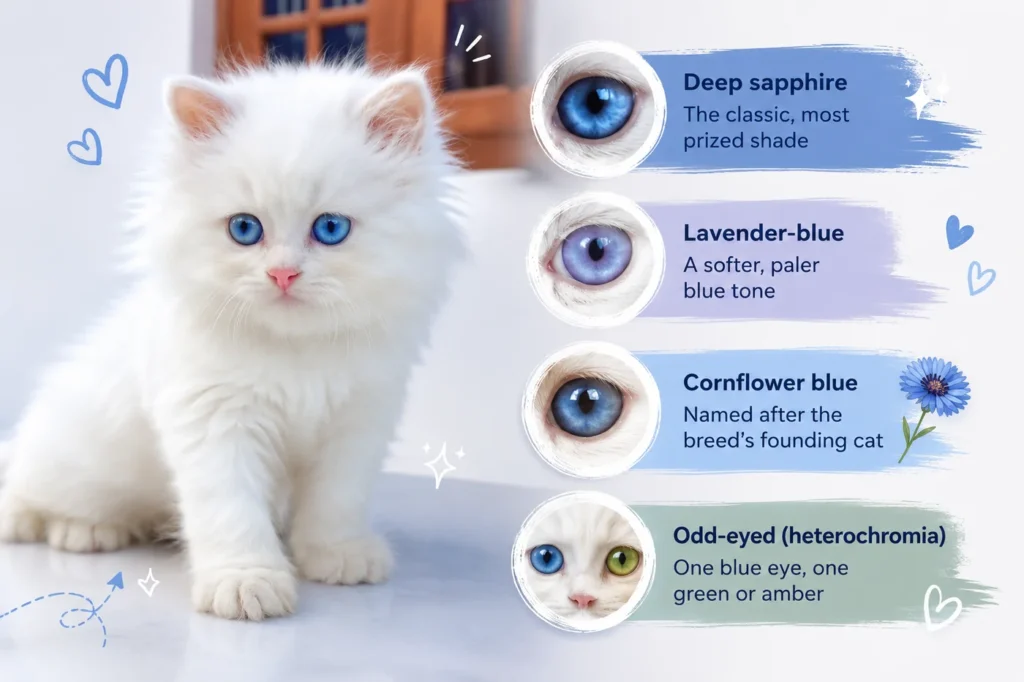
Ojos Azules cats display eye colors ranging from soft lavender-blue to deep sapphire, and breed standards accept every shade in between. Some also have odd-colored eyes, with one blue eye and one of a different color, a unique trait that the breed standard intentionally recognizes. That flexibility exists partly for genetic diversity and partly because forcing every cat toward one exact shade would shrink an already tiny gene pool even further.
Can Ojos Azules Cats Have Deep Blue Eyes?
Yes, deep sapphire is actually the most sought-after shade in the breed, and it’s the color most people picture when they hear the name. Lighter lavender tones and odd-eyed variations are equally valid under the standard, though.
Do All Ojos Azules Cats Have Blue Eyes?
No, and this surprises a lot of people. Because the gene is bred carefully to avoid two copies meeting in one kitten, roughly half of any litter from a heterozygous parent won’t inherit the trait at all. Those kittens are still genetically part of the lineage and often carry the same body type, but their eyes stay whatever color is typical for their coat.
Some breeders still count these cats as Ojos Azules for pedigree purposes, while others reserve the name strictly for cats that visibly show Ojos Azules cat eyes. It’s one more reason the breed stays so rare, since only a portion of each litter actually displays the signature look buyers are chasing.
Why Are Ojos Azules Cat Eyes Naturally Blue?
The short answer involves melanin, or rather the lack of it in a very specific location. Unlike Siamese-style blue eyes, which come from a body-wide pigment restriction, Ojos Azules cat eyes result from a localized effect that limits melanin only within the iris. In the 1980s, feline geneticist Solveig Pflueger identified and studied this gene, distinguishing it from the more familiar pigment-related mutations.
Because the effect stays confined to the eye, the rest of the coat can carry full, rich pigmentation. That’s the biological trick behind seeing sapphire eyes staring out from a jet-black or tortoiseshell face.
Eye Color Genetics in Ojos Azules Cats
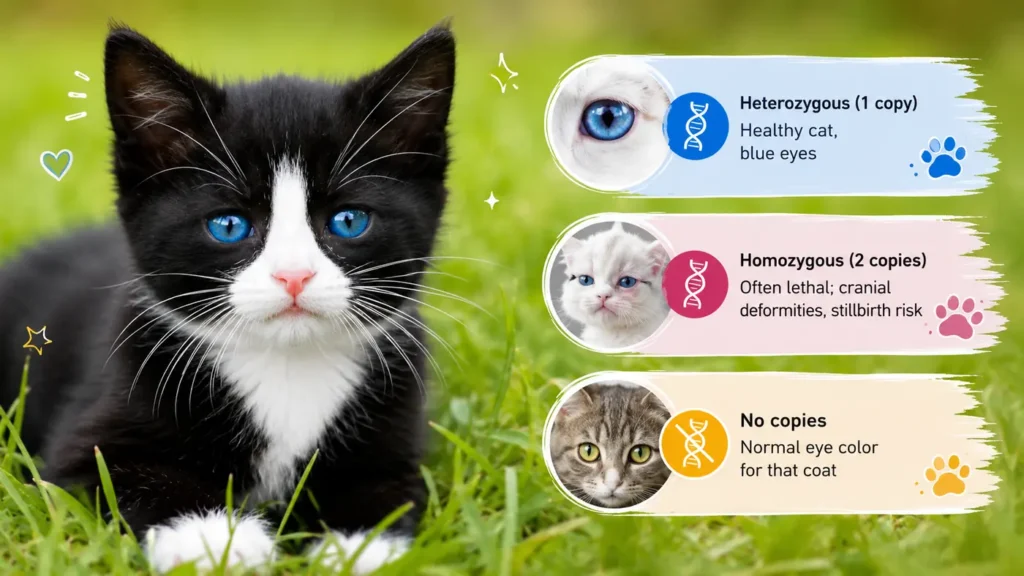
This table lays out the practical difference between carrying one copy of the gene versus two.
| Gene Copies | Result |
| Heterozygous (1 copy) | Healthy cat, blue eyes |
| Homozygous (2 copies) | Often lethal; cranial deformities, stillbirth risk |
| No copies | Normal eye color for that coat |
A single copy of the dominant mutation gives Ojos Azules cats their signature blue eyes while allowing them to remain perfectly healthy. Health problems arise only when breeders mate two blue-eyed cats together, which is why responsible breeders avoid this pairing. This single rule is the backbone of ethical Ojos Azules breeding programs.
Can an Ojos Azules Cat Have One Blue Eye?
Yes, and it’s actually a recognized part of the standard rather than a flaw. Odd-eyed Ojos Azules cats, with one blue eye and one green, gold, or amber eye, show up regularly in litters and are sometimes called cats with partial heterochromia. Breed founders kept this trait accepted on purpose, since restricting the standard to only fully blue-eyed cats would have narrowed the gene pool even more in an already small population. So if you come across a cat with mismatched eyes and unusual ear-set features, it may well be an Ojos Azules or a close descendant of the original lines.
Do Ojos Azules Kittens Keep Their Blue Eyes?
Yes, kittens that inherit the gene keep their blue eyes for life. This is different from most kittens, whose baby-blue eyes shift to their adult color around six to eight weeks. Ojos Azules cat eyes stay blue permanently because the trait isn’t tied to age-related pigment development like typical kitten eye color.
Are Ojos Azules Cat Eyes Linked to Health Problems?
This is the part every prospective owner should read carefully. A single copy of the Ojos Azules gene doesn’t cause deafness, making it different from the gene responsible for blue eyes in white cats. However, when a kitten inherits two copies of the gene, it can develop serious health problems, including cranial deformities, a shortened or curled tail, and in some cases, stillbirth.
Because of this, the International Cat Association (TICA) closely monitors breeding programs tied to this trait, and responsible breeders always pair a blue-eyed cat with a non-blue-eyed partner rather than risk two copies meeting in one kitten. Anyone considering an Ojos Azules kitten should ask directly about the parents’ genetic testing before buying.
Learn How Genetics Affects the Ojos Azules Breed. Read more in Ojos Azules Cats Health Problems That Come With Those Famous Blue Eyes.
How Ojos Azules Eyes Compare to Other Blue-Eyed Cats
Here’s how the Ojos Azules trait stacks up against the other well-known routes to blue eyes in cats.
| Breed/Type | Cause of Blue Eyes | Deafness Risk |
| Ojos Azules | Independent dominant gene | Not linked (heterozygous) |
| Siamese | Colorpoint restriction | Not elevated |
| White cats (W gene) | Dominant white, pigment suppression | 65–85% with both eyes blue |
| Odd-eyed white cats | Dominant white, partial suppression | Around 40% |
The contrast here is worth sitting with for a moment. According to the Cornell Feline Health Center, all-white cats with two blue eyes face a deafness rate of roughly 65 to 85 percent, and that risk drops to about 40 percent in odd-eyed white cats. Ojos Azules cat eyes don’t carry that same burden, because the underlying gene has nothing to do with the dominant white coat mutation responsible for the inner-ear damage in those other cats. That said, the breed trades one risk for another, since its own gene turns dangerous specifically in a homozygous pairing.
Caring for an Ojos Azules Cat’s Eye Health
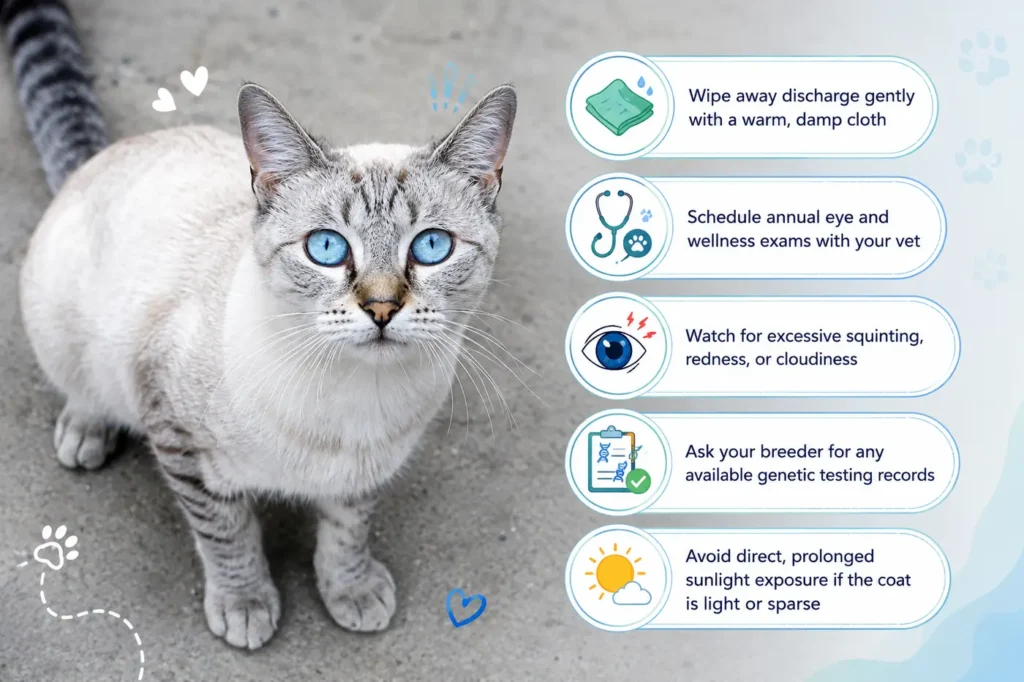
Day-to-day eye care for this breed isn’t drastically different from any other cat, but a few habits genuinely help. Regular vet checkups matter more here simply because the breed is so new that long-term data is still limited.
- Wipe away discharge gently with a warm, damp cloth
- Schedule annual eye and wellness exams with your vet
- Watch for excessive squinting, redness, or cloudiness
- Ask your breeder for any available genetic testing records
- Avoid direct, prolonged sunlight exposure if the coat is light or sparse
Diet also plays a supporting role, since a balanced, high-quality food helps maintain overall eye and coat health, though there’s no special “eye diet” required. If you ever notice sudden changes in how your cat’s eyes look or track movement, that’s worth a same-week vet visit rather than a wait-and-see approach.
Common Myths About Ojos Azules Cat Eyes
There’s a fair bit of misinformation floating around about this breed, mostly because it’s so rare that few people have met one in person.
- Myth: All blue-eyed cats are deaf. Not true. Deafness is tied to the white coat gene, not blue eyes generally.
- Myth: Ojos Azules cats only come in white. False. The whole point of the breed is blue eyes on any coat color.
- Myth: The breed is extinct. It’s extremely rare and was paused by some breeders, but small conservation efforts continue.
Myth Buster: Ojos Azules Cat Eyes Explained
The biggest myth is that blue eyes automatically mean a higher deafness risk. For Ojos Azules cat eyes specifically, that link doesn’t hold, since the gene behind the color has no connection to the dominant white mutation responsible for hearing loss in other blue-eyed cats.
Closing Thoughts: Beauty With Careful Boundaries
Ojos Azules cat eyes remain one of the most striking oddities in the feline world, proof that blue eyes don’t have to come at the cost of coat color or hearing. A single copy of the gene gives cats that rare sapphire gaze with no added health risk, but the breed’s fragile history is a reminder that this beauty needs careful, responsible breeding to stay safe. If you ever get the chance to meet one in person, it’s an experience worth having.
FAQs About Ojos Azules Cat Eyes
What causes Ojos Azules cat eyes?
An independent dominant gene limits melanin only in the iris, unlike Siamese or white-cat blue eyes, which come from body-wide pigment suppression.
Do all Ojos Azules cats have blue eyes?
No. Because breeders avoid pairing two blue-eyed cats, roughly half of each litter won’t inherit the trait and will have normal eye color instead.
Are Ojos Azules cat eyes linked to deafness?
No, not when the cat carries one copy of the gene. That’s different from blue-eyed white cats, where deafness risk is well documented.
Can an Ojos Azules cat have two different colored eyes?
Yes. Odd-eyed Ojos Azules cats, with one blue eye and one green, gold, or amber eye, are recognized under the breed standard.
Is it safe to breed two Ojos Azules cats together?
No. Pairing two blue-eyed cats can produce two copies of the gene, which has been linked to cranial deformities and stillbirths.
Do Ojos Azules kittens’ eyes change color as they grow?
No. Unlike most kittens, whose eyes shift color around six to eight weeks, Ojos Azules cat eyes stay blue permanently once the gene is present.