
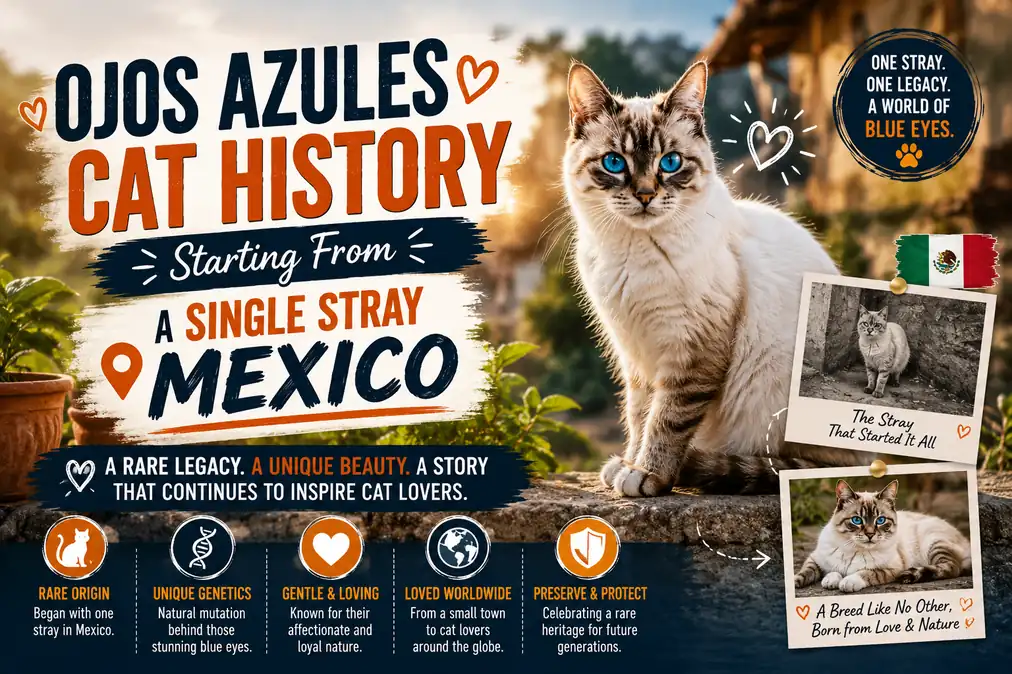
Ojos Azules cat history began in 1984, when a New Mexico rancher noticed a stray tortoiseshell cat with bright blue eyes living among a feral colony. This cat, later named Cornflower, did not carry the genes that usually cause blue eyes in cats, such as albinism or the Siamese pattern. Instead, she had a completely new dominant gene that turned her eyes a deep sapphire blue while leaving her coat color and pattern unchanged.
Researchers and breeders took notice, and by 1991, the International Cat Association (TICA) had accepted the Ojos Azules as an experimental breed based on this discovery. From that single wild cat, a small breeding program grew, and Ojos Azules cat history became a rare example of a breed built entirely around one spontaneous genetic mutation.
Introduction to Ojos Azules Cat History
Ojos Azules means “blue eyes” in Spanish, and that name explains almost everything about why the breed exists. Unlike Siamese cats, whose blue eyes come from a gene tied to point coloring, the Ojos Azules carries a completely different, dominant mutation that lets deep blue eyes appear on virtually any coat color. That alone made breeders and geneticists take notice in the 1980s. Because the breed’s numbers were always small, tracing this history means following one short, specific chain of cats and registry decisions.
Discover Why the Ojos Azules Cat Captured Global Attention. Read more in Ojos Azules Cats With Eyes That Break Every Rule.
Here is a quick snapshot of the breed before diving into the full story, which can help answer the most common at-a-glance questions people search for.
| Trait | Detail |
| Origin | Southwestern United States, New Mexico |
| Founding cat | Cornflower, a tortoiseshell female, 1984 |
| Coat | Short or long, soft and silky |
| Colors | Any color or pattern, always with deep blue eyes |
| Weight | About 9 to 12 pounds when fully grown |
| Lifespan | Roughly 10 to 12 years |
| Temperament | Affectionate, active, people-oriented |
| Registry status | TICA-registered in 1991, not actively promoted today |
The Origin of the Ojos Azules Cat
The story starts in feral cat colonies scattered around New Mexico during the early 1980s. Local cat fanciers noticed a handful of cats with unusually vivid blue eyes, a trait that didn’t match the white coats or point patterns usually linked to blue eyes. One tortoiseshell female stood out and quickly became the anchor of a new breeding project. Her coloring alone should have ruled out blue eyes entirely, which is exactly why breeders paid attention.
How Did the Ojos Azules Cat Breed Come About?
Ojos Azules cat history really begins with one deliberate test: breeding a blue-eyed female to males with ordinary eye colors. If the trait had been recessive, most kittens would have had normal eyes. Instead, every kitten in the litter inherited the striking blue eyes, telling breeders the gene was dominant. That single litter changed the direction of the entire project, since a dominant gene is far easier to multiply across a small founding population.
How Was the Ojos Azules Cat Breed Discovered?
The discovery wasn’t the result of a planned breeding program at all. It happened when someone noticed a feral cat with startlingly deep blue eyes and decided the trait was too striking to ignore. That kind of accidental discovery is actually fairly common in cat breed history, since unusual traits often show up in random, unmanaged populations first.
The First Known Ojos Azules Cat
Cornflower, the founding tortoiseshell, is the cat every Ojos Azules traces back to. She was pulled from a feral colony in New Mexico in 1984 and became the foundation female for the entire breed. Every cat that has ever qualified as a true Ojos Azules descends from her line and carries the same dominant blue-eye gene she passed down.
A Quick Timeline of Ojos Azules Cat History
Here’s a simple timeline that sums up how quickly this breed’s story unfolded.
| Year | Milestone |
| 1984 | Cornflower discovered in a New Mexico feral colony. |
| 1984–1990 | Early test breeding confirms a dominant blue-eye gene. |
| 1991 | TICA accepts Ojos Azules for registration |
| 1992 | Only about ten known cats exist worldwide. |
| 2000s | Genetic research links the gene to health risks. |
| 2004 | TICA finalizes the official breed standard |
| Today | No longer actively registering new cats |
The Unique Blue-Eye Gene Behind the Breed
The gene behind Ojos Azules cat history is officially called the dominant blue eye gene, and it behaves differently from the blue-eye genetics in Siamese or Ragdoll cats, where blue eyes are tied to point coloring and pigment loss. This gene works independently of coat color, which is why an Ojos Azules can be black, tabby, or almost any pattern and still have deep blue eyes.
Geneticist Solveig Pflueger, working with TICA, later found that cats inheriting two copies of the gene often developed cranial deformities and were sometimes stillborn. That discovery reshaped breeding strategy for the rest of the breed’s short history.
What Makes the Ojos Azules Cat’s Eyes So Rare?
The Ojos Azules cat’s eyes are rare because the dominant blue eye gene works independently of coat color, letting the trait appear on almost any color or pattern rather than being tied to white fur or point markings like other blue-eyed breeds.
Early Breeding Efforts
Once breeders confirmed the gene was dominant, the next challenge was finding enough cats to build a stable, diverse population. Because Cornflower was the only known source of the trait, every early kitten traced back to her, a tight bottleneck for any breed. Breeders outcrossed carefully with unrelated cats to widen the gene pool while preserving the blue-eye trait. Progress stayed slow by design, since rushing it with one founding cat would have raised the risk of health problems. By the early 1990s, the population had grown just enough to catch the attention of major registries.
Challenges in Developing the Ojos Azules Breed
The biggest challenge in Ojos Azules cat history turned out to be the gene itself. When two copies combine, the outcome is a lethal or semi-lethal defect, not simply more blue eyes. Affected kittens could be born with cranial deformities, curled tails, or excess white fur, and some pregnancies ended in stillbirth. Breeders had to test every mating carefully, always pairing a blue-eyed cat with one carrying no copies of the gene, which cut the available breeding combinations dramatically.
Recognition by Cat Registries
Despite its small numbers, Ojos Azules cat history includes a real registry milestone: acceptance by The International Cat Association (TICA) in 1991, covering both shorthaired and longhaired varieties. TICA published its formal breed standard on January 5, 2004. No other major registry, including the Cat Fanciers’ Association, ever added Ojos Azules to its recognized breed list, largely because the population never grew large or stable enough to meet typical registration thresholds. That single TICA registration remains the closest thing the breed has to formal recognition.
Does TICA Still Register New Ojos Azules Cats?
TICA is not currently accepting new registrations for the breed, since active, organized breeding of Ojos Azules cats has largely stopped due to the health risks tied to the gene.
Why the Ojos Azules Cat Became So Rare
Rarity was built into Ojos Azules cat history from day one, since the entire breed descended from one feral cat. Add in the health risks tied to the double-copy version of the gene, and breeders had every reason to move cautiously rather than expand quickly. By 1992, only about ten Ojos Azules cats were known to exist anywhere. That number never grew into anything resembling a mainstream population, and as awareness of the cranial-defect risk spread, several breeders stepped back from the project altogether.
Is the Ojos Azules Cat Breed Extinct?
The Ojos Azules cat breed is not officially declared extinct, but it is widely considered functionally extinct by cat breed sources, since active breeding has stopped and TICA is not currently registering new cats under the name.
The Current Status of the Ojos Azules Cat
Today, Ojos Azules cat history has essentially paused rather than ended. TICA still lists a historical breed standard, but the organization stopped promoting new registrations after the health risks tied to the gene became clear. Very few, if any, dedicated breeders continue working with the line, and the exact number of living Ojos Azules cats worldwide is unknown. Anyone hoping to find a purebred Ojos Azules kitten in 2026 should expect a long and difficult search.
Ojos Azules Cat Cost
Because the breed is so rare, pricing information is inconsistent and mostly anecdotal rather than based on an active market. Reported prices typically range from about $700 to $1,500 USD, though some listings mention lower or higher figures depending on the seller and how the cat’s ancestry is documented.
Given how few breeders exist, buyers should expect long waitlists and cats that may not have verifiable TICA paperwork at all. Because the genetics carry real health risks, a pre-purchase veterinary exam and, ideally, genetic testing are worth the extra expense.
Find Out If an Ojos Azules Cat Fits Your Budget. Read more in Ojos Azules Cat Price That Explains Why It’s So Rare.
Here’s a rough breakdown of what buyers and new owners can expect to pay, in USD.
| Category | Typical cost (USD) |
| Kitten from a breeder | $700 – $1,500 |
| Annual food and litter | $300 – $600 |
| Routine vet visits | $200 – $400 per year |
| Genetic or health testing | $100 – $300 |
Factors That Affect Ojos Azules Cat Cost
- Breeder reputation and how well-documented the lineage is
- Depth and clarity of the blue eye color
- Coat length and pattern, since long-haired lines are less common
- Geographic location and how far a buyer must travel
- Health testing and genetic screening already completed
Interesting Facts About Ojos Azules Cat History
- Cornflower, the founding cat, was a tortoiseshell, a coat pattern with no historical link to blue eyes.
- The breed’s name is simply Spanish for blue eyes.
- TICA accepted both short and long-haired varieties in 1991, but the formal standard wasn’t finalized until 2004.
- Unlike Siamese cats, Ojos Azules can have deep blue eyes with almost any coat color or pattern.
- Geneticist Solveig Pflueger played a key role in identifying the health risks tied to the double-copy gene.
- In 1992, only around ten Ojos Azules cats were known to exist worldwide.
- No major registry besides TICA has ever formally recognized the breed.
The Lasting Legacy of the Ojos Azules Cat
Ojos Azules cat history is a reminder that not every breed needs centuries to become fascinating. One feral cat, one unexpected litter, and a dominant gene were enough to create one of the rarest, most genetically unusual cats ever registered by a major association.
The same trait that made the breed so remarkable also made it fragile, and that tension between beauty and biology is really what defines its story. Whether or not organized breeding ever resumes, the history behind those deep blue eyes remains a genuinely unique chapter in the world of pedigreed cats.
Frequently Asked Questions About Ojos Azules Cat History
What is the history of the Ojos Azules cat?
It began in 1984, when a feral tortoiseshell named Cornflower was discovered in New Mexico with unusually deep blue eyes caused by a dominant genetic mutation.
Who discovered the first Ojos Azules cat?
Local cat fanciers in New Mexico discovered the first known Ojos Azules, a tortoiseshell female named Cornflower, living in a feral colony in 1984.
Why are Ojos Azules cats so rare?
The entire breed descends from one founding cat, and the gene responsible for their blue eyes causes serious health defects when inherited in double copy.
Is the Ojos Azules cat breed recognized by TICA?
Yes, TICA accepted the breed for registration in 1991 and published its official standard in 2004, though it is not actively promoting new registrations today.
Are Ojos Azules cats extinct?
The breed is not officially extinct, but it is widely considered functionally extinct, since organized breeding has largely stopped and very few active breeders remain.
How much does an Ojos Azules cat cost?
Reported prices generally range from about $700 to $1,500 USD, though exact pricing varies widely due to how rare the breed is.
What makes the Ojos Azules cat’s eyes different from other blue-eyed cats?
The Ojos Azules carries a dominant gene that works independently of coat color, unlike Siamese cats, whose blue eyes are tied to point coloring.
Can Ojos Azules cats be any color?
Yes, they can appear in almost any coat color or pattern, since the blue-eye gene isn’t linked to specific pigmentation like it is in other blue-eyed breeds.