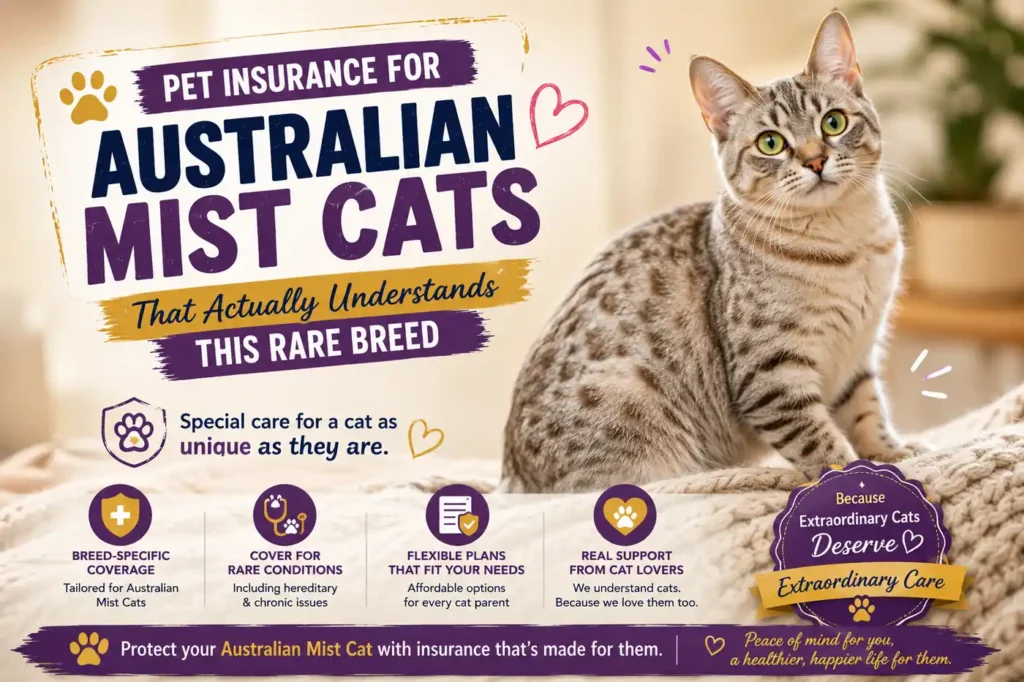
Yes, Pet Insurance for Australian Mist Cats can be worthwhile, especially when coverage begins before your cat develops or is diagnosed with a health condition. In 2026, cat insurance typically costs around $23–$46 per month, although your cat’s age, location, coverage limit, and reimbursement rate can affect the price.
Australian Mist cats are generally healthy, but they can still develop conditions such as heart problems and joint issues. The right insurance policy can help cover eligible veterinary costs for unexpected illnesses, injuries, surgery, hospitalization, and ongoing treatment.
Buying coverage while your Australian Mist is young and healthy can also give you more options. Once a condition appears in your cat’s medical history, insurers may classify it as pre-existing and exclude it from future coverage.
Australian Mist Cat Pet Insurance Needs
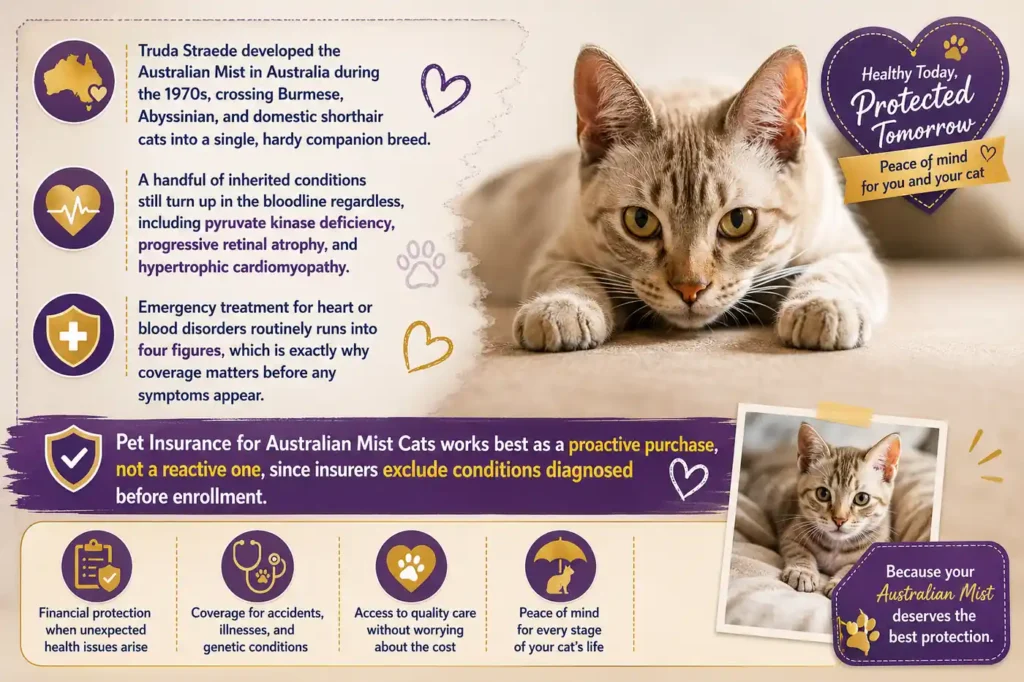
Truda Straede developed the Australian Mist in Australia during the 1970s, crossing Burmese, Abyssinian, and domestic shorthair cats into a single, hardy companion breed. Hybrid vigor from that mixed ancestry means fewer hereditary problems than many purebred lines carry, according to breed data published by TICA (The International Cat Association). A handful of inherited conditions still turn up in the bloodline regardless, including pyruvate kinase deficiency, progressive retinal atrophy, and hypertrophic cardiomyopathy.
Emergency treatment for heart or blood disorders routinely runs into four figures, which is exactly why coverage matters before any symptoms appear. Pet Insurance for Australian Mist Cats works best as a proactive purchase, not a reactive one, since insurers exclude conditions diagnosed before enrollment. Waiting until a cat reaches senior status narrows every option and raises the monthly price along the way. Lifespan runs 12 to 18 years for a well-cared-for Australian Mist, and a policy purchased early can stay in force for well over a decade.
Pet Insurance Coverage for Australian Mist Cats
Accident and illness plans form the backbone of most cat insurance policies, paying out after unexpected injuries and newly diagnosed diseases alike. Coverage typically extends to surgery, hospitalization, diagnostic imaging, and prescription medication, provided the condition surfaces after the policy’s waiting period ends. Chronic illnesses such as kidney disease or hyperthyroidism stay covered for the rest of a cat’s life as long as the policy remains active without a lapse.
Genetic conditions common to the breed, including pyruvate kinase deficiency and progressive retinal atrophy, fall under standard illness coverage when a cat is enrolled before any signs appear. Optional wellness add-ons extend coverage further, reimbursing vaccinations, annual exams, and parasite prevention that standard plans leave out.
| Provider | Accident & Illness | Reimbursement | Deductible | Best For |
| Provider A | ✓ | 70–90% | $250–$500 | Overall |
| Provider B | ✓ | 70–90% | Variable | Older cats |
| Provider C | ✓ | 70–90% | Variable | Flexible plans |
What Does Accident and Illness Coverage Include?
Accident and illness coverage reimburses treatment for unexpected injuries and diagnosed diseases, covering surgery, hospitalization, diagnostic testing, and prescription medication. Most insurers pay back 70% to 90% of the vet bill once the annual deductible is met. Coverage for chronic conditions continues for life, provided the policy stays active without a break in payments.
Pet Insurance for Australian Mist Cats: What’s Not Covered
Pre-existing conditions sit at the top of every exclusion list, meaning any illness or injury diagnosed before a policy’s start date, or during its waiting period, stays permanently uninsured with that provider. Reading the policy wording before symptoms appear, not after, is the only way to know what’s genuinely excluded.
- Cosmetic procedures, elective declawing, and breeding-related costs fall outside coverage across nearly every major insurer on the market.
- Routine or preventive care, including annual checkups, vaccinations, and flea treatment, requires a separate wellness add-on since standard accident and illness plans leave it out.
- Bilateral exclusions can apply too: if a cat is treated for one knee injury before enrollment, insurers sometimes exclude the opposite knee from future claims as a related pre-existing risk.
Australian Mist Cat Pet Insurance Costs
Monthly premiums for cat insurance in the United States average between $23 and $46 depending on age, coverage limit, and location, based on 2026 industry data from NAPHIA (North American Pet Health Insurance Association). Pet Insurance for Australian Mist Cats tends to track the broader cat insurance market rather than command a breed-specific premium, since the breed isn’t classified as high-risk. Kittens under one year old typically insure for the lowest rates, often close to $23 a month, because insurers treat early kittenhood as a single, low-risk pricing tier.
Premiums climb gradually through middle age before rising more sharply after age eight, when claim frequency increases across nearly every cat breed. State-level cost differences add another layer, with regions carrying higher veterinary costs, such as California and New York, pushing premiums above the national average.
The table below breaks down how average monthly premiums shift as a cat ages, based on data compiled from 2026 industry pricing reports.
| Cat’s Age | Average Monthly Premium (USD) |
| Under 1 year | $23 |
| 1-2 years | $22-$23 |
| 7 years | $34 |
| 8 years | $38 |
| 9 years | $41 |
| 10 years | $46 |
Health Conditions Covered by Australian Mist Cat Insurance
Pyruvate kinase deficiency tops the list of inherited risks, a genetic disorder that breaks down red blood cells and causes chronic anemia if left unmanaged. DNA testing identifies carriers before breeding, and GCCF (Governing Council of the Cat Fancy) has written mandatory screening into its official breeding policy for the breed.
- Progressive retinal atrophy follows close behind, an inherited eye condition that gradually degrades vision and, in some cases, leads to blindness.
- Hypertrophic cardiomyopathy, the most common heart disease across all cat breeds, can cause sudden heart failure and requires lifelong monitoring once diagnosed.
- Gingivitis and periodontal disease appear more often in Australian Mists than in some breeds, a legacy of their Burmese ancestry.
- Insurers cover every condition on this list under a standard accident and illness plan, on the condition that enrollment happens before any symptoms or diagnosis occur.
Here’s how the breed’s most-discussed health conditions typically line up against standard insurance coverage.
| Condition | What It Is | Insurance Coverage Note |
| Pyruvate Kinase Deficiency (PKD) | Genetic red blood cell disorder causing anemia | Covered pre-diagnosis; DNA testing available for breeders |
| Progressive Retinal Atrophy (PRA) | Inherited disorder causing gradual vision loss | Covered pre-diagnosis; excluded once symptoms appear |
| Hypertrophic Cardiomyopathy (HCM) | Most common feline heart disease | Covered if enrolled before diagnosis or murmur is noted |
| Gingivitis / Periodontal Disease | Dental inflammation common in Burmese-descended breeds | Usually covered under illness plans; some insurers cap dental payouts |
Choosing the Best Pet Insurance for an Australian Mist Cat
Side-by-side comparison beats chasing the lowest advertised premium, since four numbers determine what a policy actually pays out: the annual coverage limit, the deductible, the reimbursement percentage, and any per-condition caps. Unlimited annual coverage costs more upfront but removes the risk of hitting a payout ceiling mid-treatment for a chronic condition like kidney disease.
Reimbursement rates between 80% and 90% strike a reasonable balance for most budgets, leaving a manageable share of each bill for the owner to cover out of pocket. Waiting periods matter just as much as the premium, since accident coverage often begins within 48 hours while illness coverage can take 14 days or longer to activate.
The comparison below lines up the three main plan types side by side, using national 2026 average pricing.
| Plan Type | What’s Covered | Typical Monthly Cost (USD) |
| Accident-Only | Injuries from accidents (fractures, swallowed objects, poisoning) | $9-$16 |
| Accident & Illness | Accidents plus diagnosed illnesses, including PKD, HCM, and cancer | $23-$46 |
| Wellness Add-On | Vaccinations, annual exams, parasite prevention | +$10-$25 on top of a base plan |
How Should I Compare Cat Insurance Plans?
Comparing cat insurance plans works best by lining up the annual limit, deductible, reimbursement percentage, and monthly premium side by side rather than focusing on price alone. A cheap premium paired with a high deductible frequently costs more during an actual claim than a slightly pricier plan with stronger reimbursement terms. Checking for breed-specific exclusions and waiting periods before signing avoids unpleasant surprises later.
Best Age to Insure an Australian Mist Cat
Enrolling between 8 and 12 weeks old locks in the lowest possible premium and avoids any dispute over pre-existing conditions, since kittens rarely carry a diagnosed health history yet. Breeders and shelters typically release Australian Mist kittens around 12 weeks, making that window the natural, practical starting point for a policy.
- Pet Insurance for Australian Mist Cats becomes more restrictive with every year a condition goes undiagnosed
- Insurers treat any symptom noted in past vet records as pre-existing
- Senior cats past age ten remain insurable in most cases
- Coverage often excludes age-related conditions like arthritis or kidney decline that show up in prior records
- Starting early, in short, keeps more conditions eligible for coverage down the road
Is Pet Insurance for Australian Mist Cats Worth the Investment?
This kind of coverage earns back its cost the moment a major illness or injury strikes, since treatment for conditions like HCM or PKD-related anemia can exceed $2,000 per incident. Paying $25 to $40 a month across a cat’s healthy years typically costs less than one uninsured emergency room visit. For most owners, that trade-off makes coverage a practical rather than optional purchase.
What This Means for Your Wallet and Your Cat
Australian Mist cats bring a calm, people-oriented temperament and a signature spotted or marbled coat, alongside a short list of inherited health risks worth insuring against early. Coverage under a solid accident and illness plan pays for surgery, hospitalization, and ongoing treatment once accidents or new illnesses appear.
Exclusions matter just as much as coverage, since pre-existing conditions, cosmetic procedures, and routine care stay off the reimbursement list no matter the provider chosen. Average monthly premiums in 2026 run between $23 and $46 depending on age, per NAPHIA industry data. Pyruvate kinase deficiency, progressive retinal atrophy, and hypertrophic cardiomyopathy top the list of conditions insurers will cover only when a policy starts before diagnosis.
Comparing annual limits, deductibles, and reimbursement rates side by side beats chasing the cheapest premium alone. Enrolling between 8 and 12 weeks old locks in the lowest rates and sidesteps pre-existing condition disputes later on. A modest monthly premium for feline coverage remains one of the more practical financial decisions an Australian Mist owner can make this year.
Australian Mist Cat Pet Insurance FAQs
What does pet insurance cost for an Australian Mist cat in 2026?
Monthly premiums generally range from $23 to $46 depending on age and coverage limit, based on 2026 NAPHIA pricing data.
Are pre-existing conditions ever covered?
No major insurer covers a condition diagnosed before the policy’s start date or during its waiting period.
What’s the best age to start a policy?
Between 8 and 12 weeks old, before any health issue can appear on a vet record.
Does insurance cover genetic conditions like pyruvate kinase deficiency?
Yes, as long as enrollment happens before any symptoms or diagnosis appear.
Is wellness coverage included automatically?
No, routine care like vaccinations and annual exams requires a separate add-on, typically $10 to $25 a month.
Can switching insurers protect coverage for an ongoing condition?
Rarely, since new insurers usually classify any previously diagnosed condition as pre-existing.