
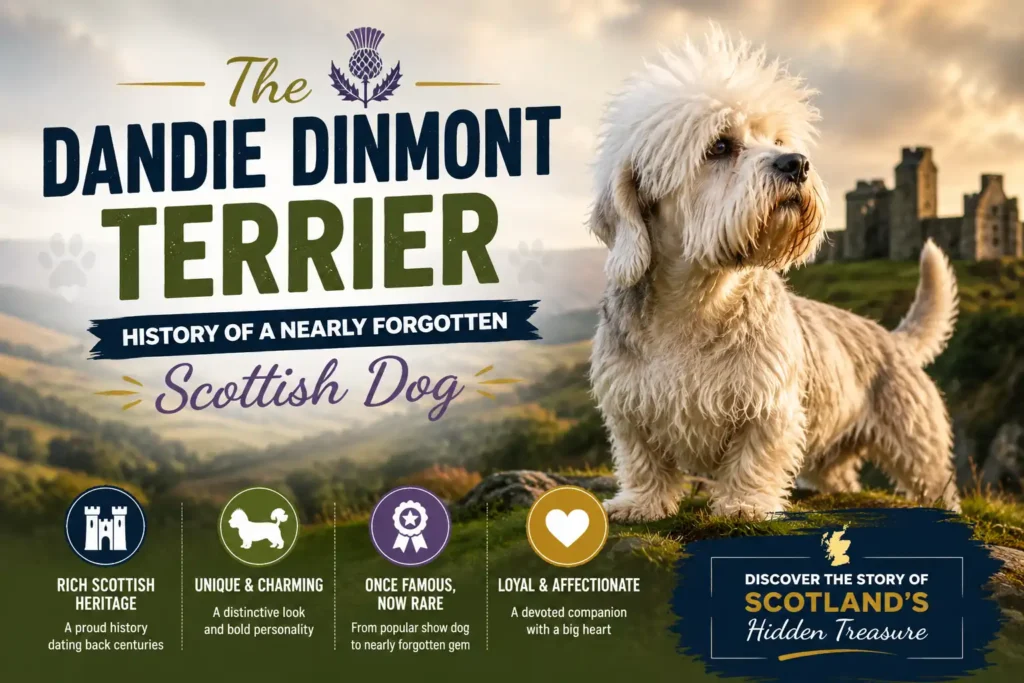
Dandie dinmont terrier history begins in the early 1700s, in the rugged border area between Scotland and England. This small, long-bodied dog is the only breed in the world named after a fictional character, which makes its story unlike any other. Farmers, Romani travellers, and border tinkers bred a low, short-legged terrier known simply as the Mustard and Pepper Terrier, named for its two coat colours.
These dogs were tough, brave, and unusually quiet for a terrier. Their job was serious: they hunted badgers, otters, foxes, and other small animals in narrow underground dens. Understanding dandie dinmont terrier history means understanding this working past first, because everything about the breed’s shape and character was built for that purpose.
Key Milestones in Dandie Dinmont Terrier History
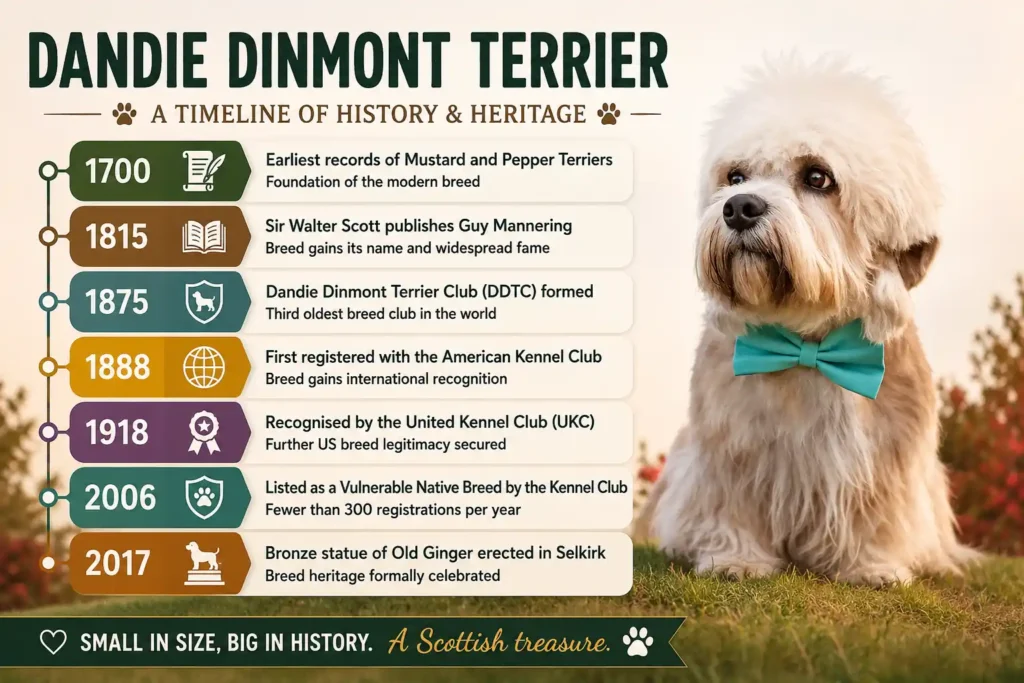
Here is a summary of the most important dates in Dandie Dinmont Terrier history that shaped the breed into what it is today.
| Year | Milestone | Significance |
| 1700 | Earliest records of Mustard and Pepper Terriers | Foundation of the modern breed |
| 1815 | Sir Walter Scott publishes Guy Mannering | Breed gains its name and widespread fame |
| 1875 | Dandie Dinmont Terrier Club (DDTC) formed | Third oldest breed club in the world |
| 1888 | First registered with the American Kennel Club | Breed gains international recognition |
| 1918 | Recognised by the United Kennel Club (UKC) | Further US breed legitimacy secured |
| 2006 | Listed as a Vulnerable Native Breed by the Kennel Club | Fewer than 300 registrations per year |
| 2017 | Bronze statue of Old Ginger erected in Selkirk | Breed heritage formally celebrated |
The Border Country That Shaped the Breed
The Cheviot Hills, straddling Northumberland and the Scottish Borders, are wild, windy, and historically remote. This landscape shaped the Dandie Dinmont Terrier physically and temperamentally. The dogs needed short, powerful legs to pursue prey underground. They needed a muscular neck and strong jaw to take on badgers, which are far tougher than they look. And they needed the famously stubborn terrier spirit to never, ever give up.
The Dandie Dinmont Terrier Club (DDTC), formed in 1875 at the Fleece Hotel in Selkirk, is considered the third oldest breed club for any dog in the world. That alone tells you how seriously early breeders took preserving this breed’s heritage.
Why the Breed Was Originally Bred
These terriers were working dogs first and foremost. Farmers along the Scottish-English border needed reliable hunters to control vermin and protect livestock. Romani travellers also prized them for poaching small game and even entered them into early badger-baiting contests. What made them stand out from other terriers was a combination of qualities that rarely come together: bold enough to take on an otter or badger underground, yet calm enough to live quietly in a farmhouse.
Their double coat, a mix of hard and soft hairs, kept water out during riverbank hunts. Their compact, low build let them squeeze into narrow dens. And that distinctive silky topknot on the head? That’s a breed signature, not a fashion accessory. It likely helped protect the dog’s eyes during rough underground work.
Dandie Dinmont Terrier Breed Facts at a Glance
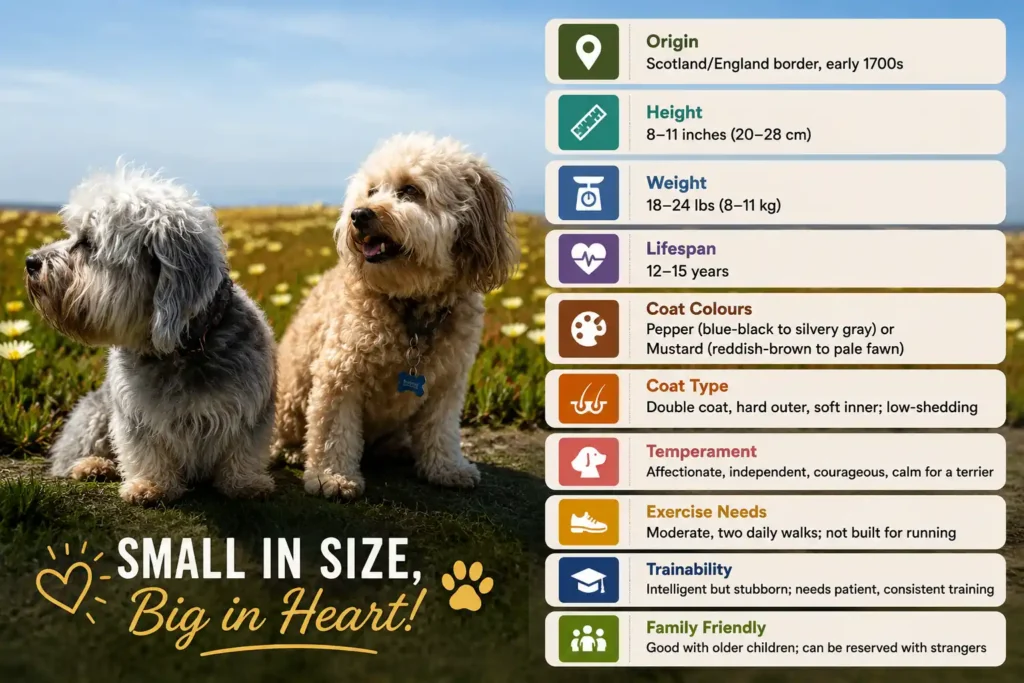
The following table outlines the key physical and temperament traits of the Dandie Dinmont Terrier as recognised by current breed standards.
| Characteristic | Detail |
| Origin | Scotland/England border, early 1700s |
| Height | 8–11 inches (20–28 cm) |
| Weight | 18–24 lbs (8–11 kg) |
| Lifespan | 12–15 years |
| Coat Colours | Pepper (blue-black to silvery gray) or Mustard (reddish-brown to pale fawn) |
| Coat Type | Double coat, hard outer, soft inner; low-shedding |
| Temperament | Affectionate, independent, courageous, calm for a terrier |
| Exercise Needs | Moderate, two daily walks; not built for running |
| Trainability | Intelligent but stubborn; needs patient, consistent training |
| Family Friendly | Good with older children; can be reserved with strangers |
The Story Behind the Name “Dandie Dinmont”
In 1815, Sir Walter Scott published Guy Mannering, a novel that sold out on its very first day. One character in the book, a rough-but-kindly tenant farmer named Dandie Dinmont, kept a pack of six beloved terriers all named Pepper or Mustard. Scott partly based the character on James Davidson, a well-known border farmer who kept and bred these distinctive terriers.
After the novel came out, people quickly connected Davidson to the fictional Dandie Dinmont, and his dogs became famous overnight. Lords and ladies wrote to his Hindlee farm asking to buy pairs of the low-set, topknotted terriers. The character’s name stuck, and within a generation, people officially recognized these dogs as Dandie Dinmont Terriers, the only dog breed in recorded history named after a fictional character.
What Is the Origin of the Dandie Dinmont Terrier?
The Dandie Dinmont Terrier originated in the border region between Scotland and England in the early 1700s. Farmers and Romani travellers originally bred Mustard and Pepper Terriers to hunt badgers, otters, and foxes. The breed gained its current name after Sir Walter Scott’s 1815 novel Guy Mannering featured a character who owned a pack of these distinctive terriers.
Early Breeders and the Breed’s Development
James Davidson shaped the modern Dandie Dinmont Terrier and is widely recognized for his lasting influence. He developed his dogs from terrier lines maintained by several Border families, including the Allans of Holystone in Northumberland, who had bred these terriers since at least the early 1700s. Davidson kept meticulous records of his breeding, unusual for the time, which is part of why he gets so much credit.
One particularly important dog in the breed’s development was Old Ginger, acknowledged as a founding father of the modern bloodline. Old Ginger was the offspring of Old Pepper, a dog of unknown parentage found in a poacher’s trap in 1839, and a bitch named Vixen. In 2017, Dandie enthusiasts erected a life-size bronze statue of Old Ginger at The Haining in Selkirk, where he was born.
How the Dandie Dinmont Terrier Gained Recognition
Dog enthusiasts founded The Kennel Club (UK) in 1873, followed by the Dandie Dinmont Terrier Club in 1875, making it one of the world’s oldest formal breed organizations. Judges evaluated Dandie Dinmont Terriers as their own category for the first time at a Manchester dog show in 1861, but they found none worthy of first place that year.
Recognition in the United States came in 1888, when the breed was first registered with the American Kennel Club. The United Kennel Club followed with recognition in 1918. During their transatlantic journey to America, Dandies reportedly earned their keep on ships by hunting rats, staying true to their working terrier roots until the very end.
When Was the Dandie Dinmont Terrier Recognised by the AKC?
The Dandie Dinmont Terrier was first registered with the American Kennel Club (AKC) in 1888. The United Kennel Club (UKC) followed with its own recognition of the breed in 1918. The UK founded the Dandie Dinmont Terrier Club in 1875, making it the world’s third-oldest breed club.
The Breed’s Journey Beyond Scotland
The Dandie Dinmont Terrier’s fame spread quickly after Scott’s novel popularised them. By the mid-1800s, even European royalty had taken notice. King Louis Philippe of France famously kept Dandies, and celebrated artists like Sir Edwin Landseer and Richard Ansdell featured the breed in their paintings. The topknotted terrier had gone from working Scottish borderland to the walls of grand European homes in just a few decades.
Their relatively calm temperament, unusually quiet and dignified for a terrier, made them attractive to city dwellers as well as country landowners. They adapted well to apartment living when given enough daily exercise, which helped expand their reach well beyond the Borders.
Changes in the Breed Over the Years
By the mid-1800s, some breeders introduced outside blood to refine the Dandie’s distinctive features. Many experts believe breeders introduced Dachshund blood into the breed, which may explain its unusually elongated spine. A writer using the pseudonym “Stonehenge” first proposed this theory in the 1880s, and it has remained a topic of debate ever since. Many breeders at the time denied it.
Whatever the exact crosses, the modern Dandie Dinmont Terrier also played a role in shaping other breeds. There’s strong evidence of early involvement in the development of the Bedlington Terrier, another distinctive-looking British terrier with a similarly shaped silhouette.
Why the Dandie Dinmont Terrier Became Rare
World War II was devastating for the breed. Food rationing and labor shortages forced many British kennels to close, led owners to euthanize countless dogs, and brought breeding programs to a halt. After the war, only a handful of dedicated kennels, including the Bellmead Kennels, worked to re-establish the population.
Breeders registered just 90 Dandie Dinmont Terrier puppies with The Kennel Club in 2003, compared with 9,823 West Highland White Terriers that breeders registered the same year. The low numbers led The Kennel Club to add the breed to its Vulnerable Native Breed list in 2006, a status reserved for UK breeds with fewer than 300 annual registrations. Even in 2024, the breed remained one of the rarest, ranking 180th out of 201 breeds recognized by the AKC.
Find out why Dandie Dinmont Terriers are so rare today. Read more in Is a Dandie Dinmont Terrier Right for You? Complete Breed Guide & Owner Insights.
Dandie Dinmont Terrier vs Other Rare Terrier Breeds
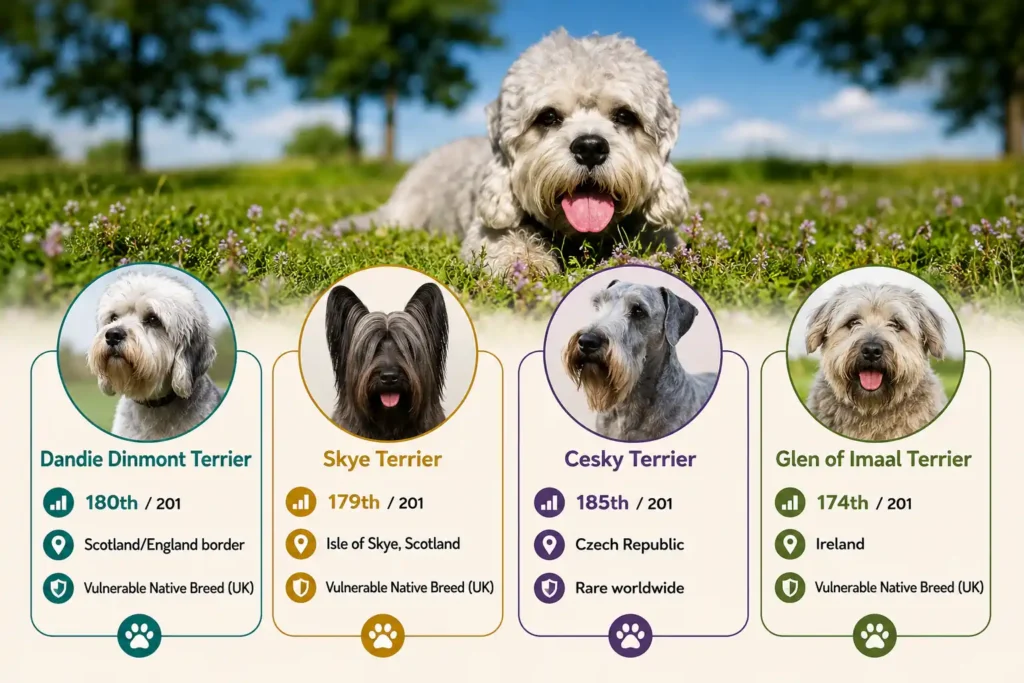
This comparison highlights how the Dandie Dinmont Terrier sits among other rare terrier breeds in terms of global recognition and registration numbers.
| Breed | AKC Ranking (2024) | Origin | Status |
| Dandie Dinmont Terrier | 180th / 201 | Scotland/England border | Vulnerable Native Breed (UK) |
| Skye Terrier | 179th / 201 | Isle of Skye, Scotland | Vulnerable Native Breed (UK) |
| Cesky Terrier | 185th / 201 | Czech Republic | Rare worldwide |
| Glen of Imaal Terrier | 174th / 201 | Ireland | Vulnerable Native Breed (UK) |
The Breed’s Historical Legacy Today
Today the Dandie Dinmont Terrier carries a remarkable historical legacy. It remains the only dog breed named after a fictional character. Its breed club is one of the oldest in the world. And despite near-extinction, it has survived thanks to passionate breeders in the UK, United States, and parts of Europe who consider preserving this breed a genuine responsibility.
If you’re considering welcoming a Dandie into your life, understanding this breed’s history helps you appreciate what you’re getting: not just a curious-looking small dog, but a 300-year-old piece of living Scottish heritage.
Why Is the Dandie Dinmont Terrier So Rare Today?
The Dandie Dinmont Terrier is rare today due to a combination of World War II breeding disruptions, changing farming lifestyles, and limited global awareness of the breed. In 2006, the Kennel Club in the UK officially listed it as a Vulnerable Native Breed, given that registrations had fallen below 300 per year.
In 2003, only 90 puppies were registered in the UK across the entire year. Conservation efforts by dedicated breed clubs in the UK and the US continue to support the breed’s survival.
Frequently Asked Questions About Dandie Dinmont Terrier History
How old is the Dandie Dinmont Terrier as a breed?
The Dandie Dinmont Terrier has been around since at least the early 1700s, giving the breed a history of more than 300 years. In 1815, Sir Walter Scott’s novel Guy Mannering gave the breed its now-famous name, Dandie Dinmont.
Who is credited with developing the modern Dandie Dinmont Terrier?
Scottish border farmer James Davidson laid the foundation for the modern breed. He carefully documented his breeding program and raised the famous “Immortal Six” terriers, which became the backbone of today’s bloodline.
Is the Dandie Dinmont Terrier good with children?
Yes, Dandies are generally good with older children. They are affectionate and calm for a terrier, though they can be stubborn. Supervision is recommended with very young children due to the dog’s small size.
What health issues do Dandie Dinmont Terriers have?
The main health concerns are intervertebral disc disease (IVDD) due to their elongated spine, and a higher-than-average rate of certain cancers. Maintaining a healthy weight is particularly important for this breed to reduce spinal stress.
What makes the Dandie Dinmont Terrier unique in dog history?
Sir Walter Scott named the Dandie Dinmont Terrier after the fictional character Dandie Dinmont in his 1815 novel Guy Mannering, making it the only dog breed in the world to take its name from a fictional character. In 1875, enthusiasts founded the Dandie Dinmont Terrier Club in its honor, and it remains the third-oldest breed club in the world.