
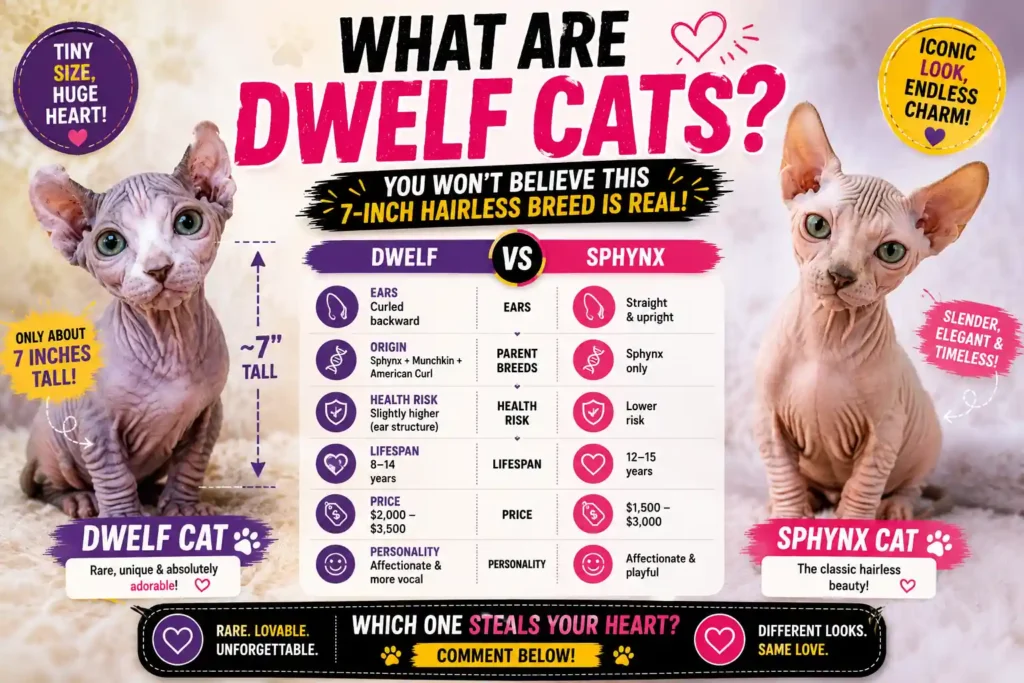
Dwelf cats are a rare and unusual breed of small, hairless cats known for their curled ears and short legs. If you are asking, “What are Dwelf cats?”, the simple answer is this: they are a mix of three breeds, the Sphynx, the Munchkin, and the American Curl, which gives them their bare skin, tiny dwarf-like body, and folded-back ears.
These cats grow only 6 to 9 inches tall, but they are full of energy and love to be close to their owners, almost like a small dog. Because they are so rare, Dwelf cats often cost between $1,500 and $2,500 in 2026, making them one of the most expensive designer cat breeds today. So when people ask what Dwelf cats are, the short version is: a tiny, wrinkly, affectionate cat with a very big personality.
What Are Dwelf Cats?
So, what are Dwelf cats exactly? They’re a hybrid breed created by crossing three established cats: the Sphynx (hairless), the Munchkin (short legs), and the American Curl (curled-back ears). The result is a compact, dog-like companion with a face that looks part pixie, part bat, and entirely charming.
The name itself blends “dwarf” and “elf.” Breeders in the United States first developed the Dwelf in the early 2000s, and it was initially noted by the now-defunct Dwarf Cat Association before gaining a spot on the Rare and Exotic Feline Registry.
This is still considered a new and experimental breed. The International Cat Association (TICA) currently lists it under an experimental category, which means standards are still evolving, and no two Dwelf kittens look exactly alike as a result.
Everything You Need to Know Before Choosing a Dwelf. Read more in People Are Losing Their Minds (and $3,000) Over the Dwelf Cat.
Why Was the Dwelf Cat Bred?
Unlike working breeds developed for a job, the Dwelf was bred purely for looks and personality, a small, hairless, curly-eared cat with a big, affectionate temperament, rather than a mouser or show-ring specialist.
Selective breeding took real patience. Each parent breed brings its own gene: hairlessness from the Sphynx, short legs from the Munchkin, folded-back ears from the Curl, and combining all three consistently is genuinely tricky.
Responsible catteries also screen for hereditary health issues along the way, since stacking three sets of unusual genes onto one small body raises the odds of complications. That’s why the Dwelf has stayed a niche, pricey breed rather than a mainstream one.
Dwelf Characteristics
Here’s a quick snapshot of the core Dwelf characteristics before we go section by section. The table below covers the essentials most future owners want to know first, and it’s worth bookmarking if you’re comparing this breed against other hairless or dwarf cats.
| Trait | Details |
| Origin | United States, early 2000s |
| Parent Breeds | Sphynx, Munchkin, American Curl |
| Size | 6–9 inches tall |
| Weight | 4–9 lbs (males heavier, females lighter) |
| Lifespan | 9–13 years on average |
| Coat | Mostly hairless; occasional fine peach fuzz |
| Colors | Suede, pink, or black skin, with possible markings |
| Registry Status | Experimental (TICA) |
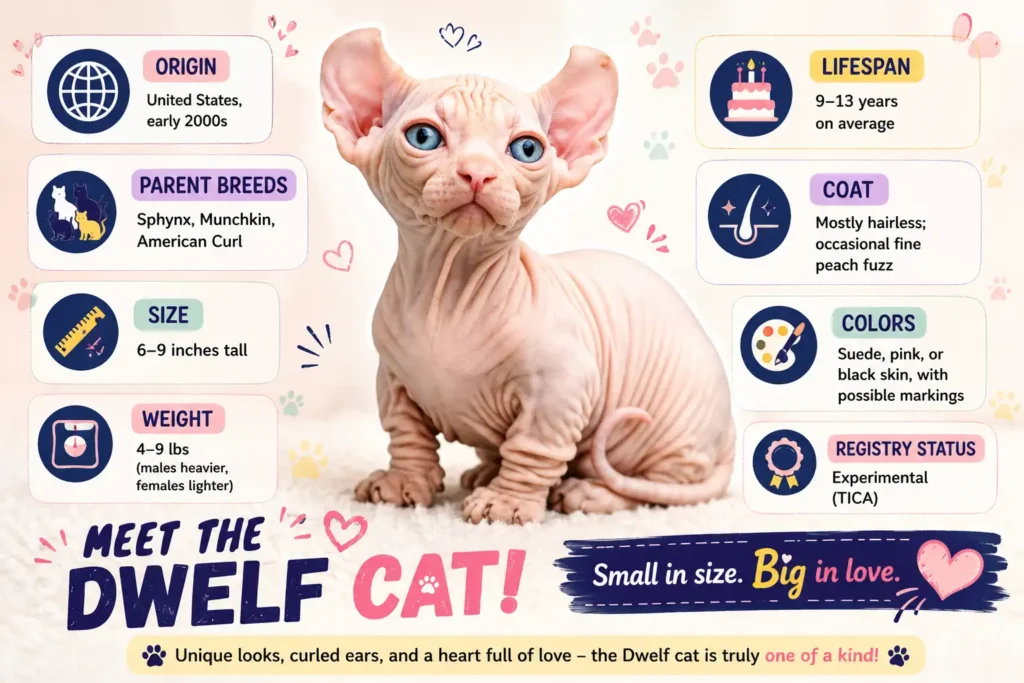
Beyond the numbers, Dwelf cats have a muscular, medium-boned body with a rounded belly and a whip-like tail. Their large curled ears and prominent cheekbones give them that unmistakable pixie-meets-bat expression.
Dwelf Cat Has Short Legs: Here’s Why
The short legs come straight from the Munchkin side of the family tree. It’s caused by a naturally occurring genetic mutation that shortens the long bones of the legs, similar to how it works in dachshunds or corgis.
Even with stubby legs, the Dwelf isn’t slow or clumsy. Its legs are powerful and well developed, and reputable breeders select against any leg length that would hinder normal movement, jumping, or play.
That said, the trait isn’t without controversy. Some veterinary organizations have raised concerns about breeding for dwarfism-related genes in cats, since it can affect the spine over time, a fair point to raise with any breeder beforehand.
Do Dwelf Cats Have Hair?
For the most part, no, Dwelf cats are predominantly hairless, just like their Sphynx parent. Some individuals do carry a light dusting of short, downy fuzz, especially around the ears, nose, and paws, but it’s nowhere close to a normal coat.
Because there’s so little fur in the way, their skin wrinkles are on full display across the legs, shoulders, and forehead, and the pattern of those wrinkles is genuinely unique to each cat.
That bare skin means Dwelf cats need real sun protection and warmth. They’re prone to sunburn outdoors and get cold quickly indoors, so cat sweaters and heated beds aren’t cute extras; they’re practically necessary, along with more frequent bathing to manage oil buildup on exposed skin.
Quick Answer: What Are Dwelf Cats in One Sentence?
A Dwelf cat is a small, mostly hairless hybrid breed with short Munchkin legs and curled American Curl ears, created for its unusual appearance and affectionate, dog-like personality.
How Intelligent Are Dwelf Cats?
Very. Dwelf cats are considered one of the sharper hybrid breeds, largely thanks to the Sphynx’s reputation for problem-solving and curiosity. They pick up routines fast and often figure out doors, latches, and toy puzzles quicker than owners expect.
This intelligence makes them fairly trainable, too. Many Dwelf cats can learn leash walking, simple tricks, and even obstacle courses with consistent, reward-based training, and they usually master litter box habits with minimal fuss.
On the flip side, that same intelligence means boredom sets in fast. Puzzle feeders, interactive toys, and daily play sessions are basically required to keep a Dwelf mentally satisfied; a bored one can turn to mischief.
What Is the Difference Between an Elf and a Dwelf Cat?
These two breeds get confused constantly, and it makes sense; they share a parent breed and a similar look. The main difference comes down to leg length, and it all traces back to genetics.
An easy way to compare them side by side is shown below, since the leg length difference is really the defining factor between the two.
| Feature | Elf Cat | Dwelf Cat |
| Parent Breeds | Sphynx + American Curl | Sphynx + Munchkin + American Curl |
| Leg Length | Normal, standard length | Short, Munchkin-style legs |
| Coat | Hairless | Hairless |
| Ears | Curled | Curled |
| Body Shape | Taller, more standard proportions | Compact, low-to-the-ground |
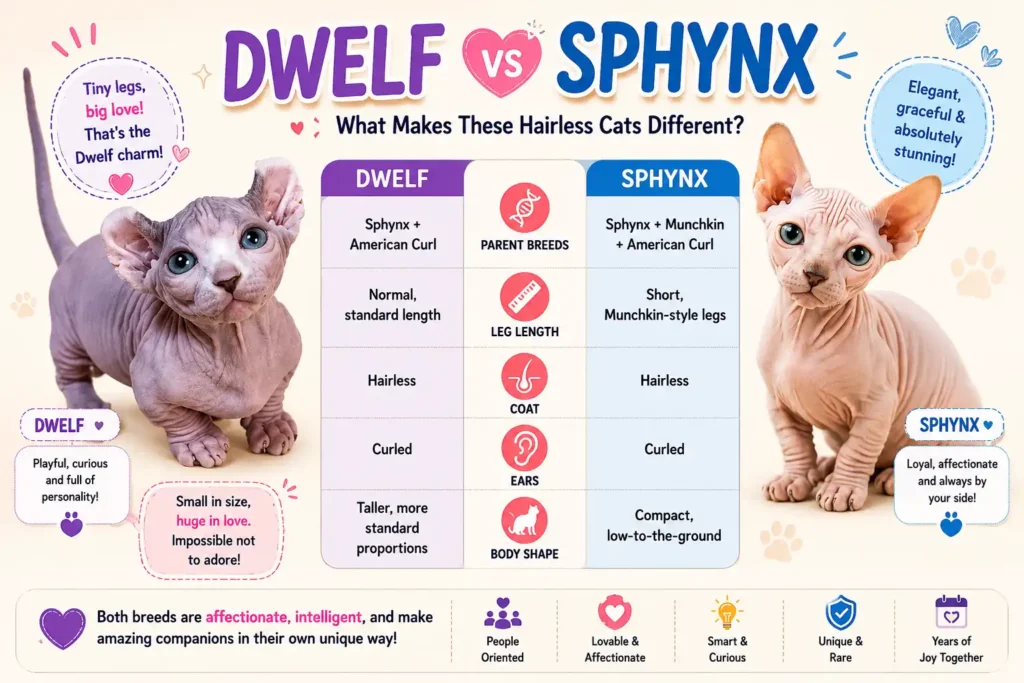
In short, an Elf cat is a Dwelf without the dwarfism gene. If you love the hairless, curly-eared look but want standard leg proportions, the Elf is the closer match.
Are Dwelf Cats Friendly With Families and Other Pets?
Generally, yes, Dwelf cats are known for dog-like devotion, and they tend to follow their favorite person from room to room rather than keeping their distance the way some cat breeds do.
They usually do well with children, as long as kids are taught to handle them gently given their small, delicate frames, and their playful nature makes them a good match for active households.
Dwelf cats also tend to get along with other pets, including dogs, provided introductions are gradual and supervised. The main caveat: this breed doesn’t handle long stretches of solitude well, so homes where someone is around most of the day are a much better fit.
Are Dwelf Cats Rare?
Yes, genuinely rare. Because so few catteries specialize in this three-breed cross, and because breeding for hairlessness, short legs, and curled ears simultaneously is difficult to do responsibly, litters are uncommon, and waitlists are common.
This scarcity is exactly why people keep asking what Dwelf cats are worth and where to find one. You’re unlikely to spot one at a typical shelter, though breed-specific hairless-cat rescues occasionally have one available.
Prices generally run from about $1,500 to $2,500 per kitten in 2026, though well-documented lineage or unusual coloring can push that figure higher with established breeders.
How Big Do Dwelf Cats Get?
Not very; that’s rather the point. Most adult Dwelf cats top out around 6 to 9 inches tall, which is dramatically shorter than an average domestic cat. The table below breaks down typical weight ranges by sex.
| Sex | Typical Weight | Typical Height |
| Male | 6–9 lbs | 6–9 inches |
| Female | 5–7 lbs | 6–8 inches |
Keep in mind that designer breeds like this one can vary more than standardized breeds, since the genetics are still being refined, so a given kitten could end up smaller or larger than these averages suggest.
Do Dwelf Cats Have Any Health Concerns?
This is the section to read carefully. Combining three breeds’ genetics into one small body raises real health considerations, and the Cornell Feline Health Center notes that hairless, dwarf-legged cats can be more prone to certain inherited conditions than standard breeds.
Common concerns include spinal or joint issues linked to the Munchkin’s leg-shortening gene, along with Sphynx-related conditions such as hypertrophic cardiomyopathy (a heart muscle disease) and skin sensitivity, including sunburn and infection risk. Even minor weight gain can strain their small joints faster than in a standard-sized cat.
Buying from a breeder who screens for hereditary heart and joint conditions, and who can show health testing records, matters enormously with this breed. Regular veterinary checkups, including cardiac screening, are worth prioritizing from kittenhood on.
Quick Answer: What Health Problems Do Dwelf Cats Have?
The most common concerns include spinal or joint strain from the short-leg gene, heart conditions like hypertrophic cardiomyopathy, and skin issues such as sunburn, due to their hairless coat.
How Much Care Does a Dwelf Cat Need?
More than the hairless look might suggest. Weekly bathing helps manage oil buildup on bare skin, and sunscreen or protective clothing helps near windows or outdoors. Diet matters too; following AAFCO (Association of American Feed Control Officials) portion guidance helps avoid the joint strain that comes with even small amounts of excess weight.
Ear cleaning deserves extra attention too, since curled ears trap more debris and moisture than standard upright ears, raising infection risk if left unchecked. Daily interactive play matters just as much, since a bored Dwelf gets into trouble fast.
Indoor-only living is strongly recommended given their sensitivity to sun, cold, and outdoor hazards, so investing in enriching indoor spaces, cat trees, window perches, and puzzle feeders pays off long-term.
Should You Get a Dwelf Cat?
So, after all that, should you get a Dwelf cat? It depends on your lifestyle. This breed suits people who are home often and enjoy an affectionate, dog-like companion, but it’s a tougher fit for frequent travelers or anyone unprepared for higher vet bills given its genetic health considerations.
- Pros: affectionate, intelligent, trainable, great with families, unique appearance
- Cons: expensive, rare, needs warmth and sun protection, potential genetic health risks, dislikes being left alone
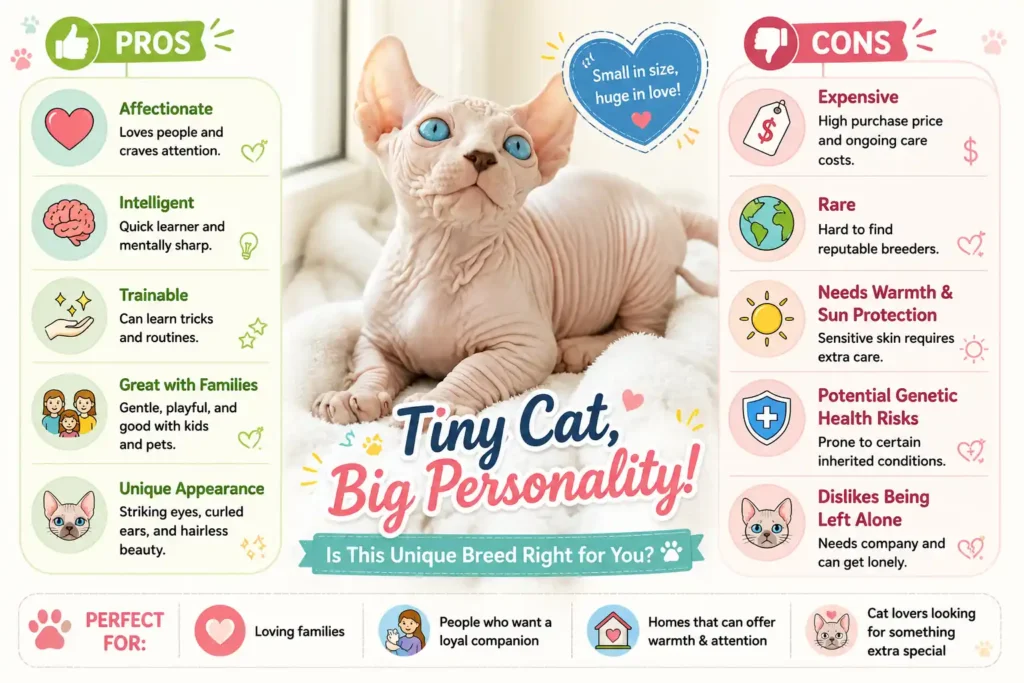
If you’ve weighed the pros and cons and still find yourself drawn in, reaching out to a reputable, health-testing breeder or a hairless-cat rescue is the responsible next step.
Quick Facts About Dwelf Cats
- Created from the Sphynx, Munchkin, and American Curl breeds in the early 2000s
- Stands just 6–9 inches tall as an adult
- Weighs between 4 and 9 lbs depending on sex
- Lives an average of 9–13 years
- Recognized as an experimental breed by TICA
- Kittens typically cost $1,500–$2,500 in 2026
- Known for a dog-like, highly social temperament
Quick Answer: How Much Do Dwelf Cats Cost?
Dwelf kittens generally cost between $1,500 and $2,500 from reputable breeders in 2026, though pricing can vary based on lineage, coloring, and breeder location.
Frequently Asked Questions
Are Dwelf cats good indoor pets?
Yes, they should be kept strictly indoors, since their bare skin makes them vulnerable to sunburn, cold, and outdoor injuries.
Can Dwelf cats jump despite having short legs?
They can, though usually not as high as standard-legged cats, thanks to strong, muscular legs.
Do Dwelf cats get cold easily?
Very easily. With little fur for insulation, they often need sweaters or heated beds in cooler months.
Are Dwelf cats high maintenance?
Somewhat. Weekly baths, sun protection, ear cleaning, and daily mental stimulation add up to more hands-on care than many breeds.
How long do Dwelf cats live?
Most live between 9 and 13 years with good veterinary care, proper diet, and a healthy weight.
Are Dwelf cats hypoallergenic?
Not entirely, though they may cause fewer reactions in some allergy sufferers, since allergens live in skin and saliva, not just fur.
Why are Dwelf cats so expensive?
They’re rare and difficult to breed responsibly, combining three separate genetic traits while screening for health issues.