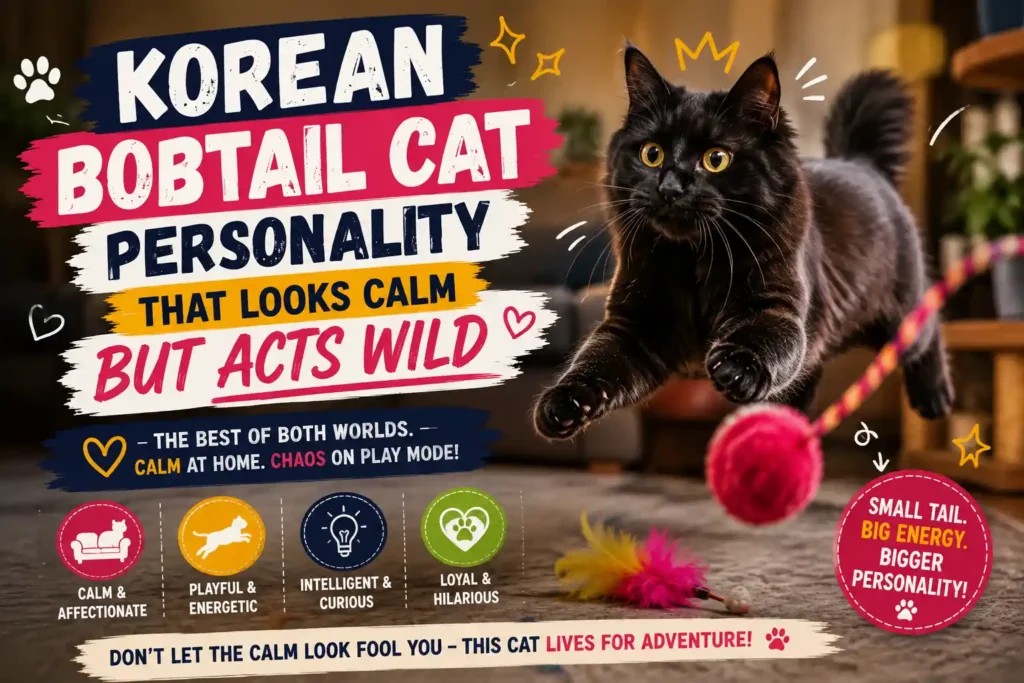
Korean Bobtail cat personality is friendly, playful, and full of energy from day one. This rare cat loves people so much that it follows them around the house instead of hiding away like many other breeds. A key part of the Korean Bobtail cat’s personality is its voice; instead of a normal meow, it makes soft chirps and trills to “talk” to its owner throughout the day.
These cats are also very smart, so they learn routines fast and enjoy simple games like fetch. They stay playful and active well into old age, often for 15 years or more, which makes them feel like a true family member rather than just a pet. If you want a cat that greets you at the door, sits close to you on the couch, and hates being left alone for long hours, this breed fits that need perfectly.
What Is the Korean Bobtail Cat Like?
Picture a medium-sized cat with a lean, muscular body, almond-shaped eyes, and a tail that’s more of a suggestion than a full-length feature. That’s the Korean Bobtail in a nutshell. The breed traces back to Korea, where short-tailed cats have been documented for centuries, often kept around farms and homes to help control rodents.
Unlike its better-known cousin, the Japanese Bobtail, this breed still hasn’t been standardized by major registries such as The International Cat Association (TICA), which is a big reason it stays so rare outside its home region. Physically compact but mentally anything but, this cat packs a lot of personality into a small frame.
Explore the History, Personality, and Care of This Unique Breed. Read more in Korean Bobtail Cat That Looks Rare but Isn’t Officially Recognized.
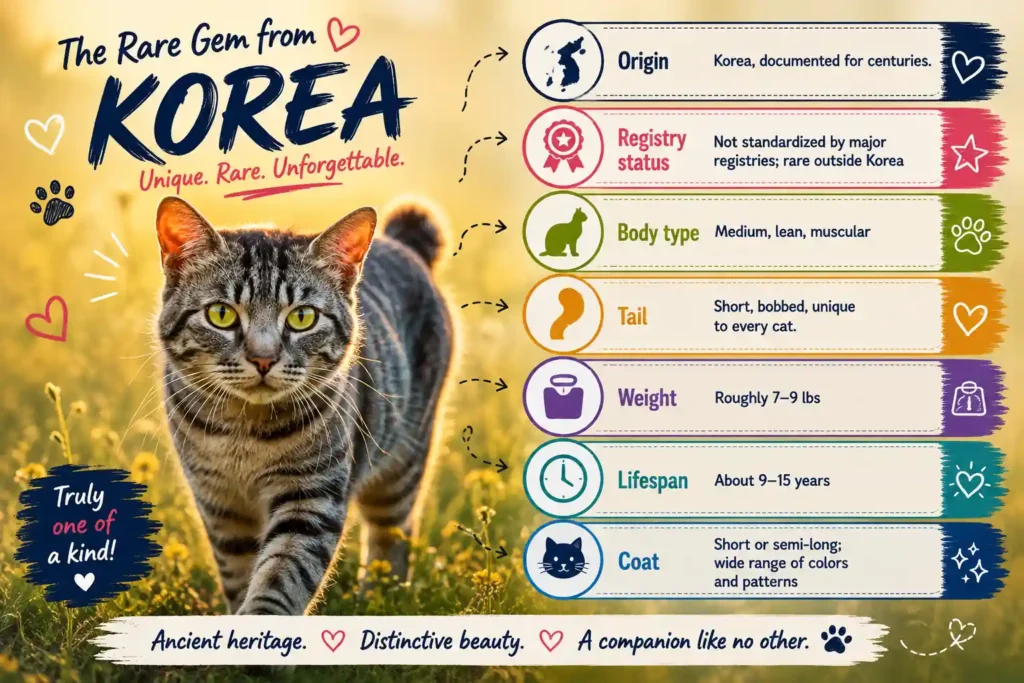
Here’s a quick snapshot of what to expect from this breed’s build and background.
| Trait | Detail |
| Origin | Korea, documented for centuries. |
| Registry status | Not standardized by major registries; rare outside Korea |
| Body type | Medium, lean, muscular |
| Tail | Short, bobbed, unique to every cat. |
| Weight | Roughly 7–9 lbs |
| Lifespan | About 9–15 years |
| Coat | Short or semi-long; wide range of colors and patterns |
Korean Bobtail Cat Personality at a Glance
In short, the Korean Bobtail cat personality is affectionate, vocal, and highly interactive. This breed acts less like a typical cat and more like a chatty, loyal shadow that wants in on everything you’re doing, whether that’s cooking dinner or answering the phone.
Korean Bobtail Cat Personality
At its core, the Korean Bobtail cat personality revolves around connection. These cats bond tightly with their households and genuinely seem to enjoy being included, not just tolerated. They’re curious to a fault, often investigating grocery bags, open drawers, and suitcases before you’ve even finished unpacking. Meanwhile, that short tail does a lot of talking on its own, flicking and twitching to show mood the way a longer tail would. Owners often describe the breed as “dog-like” because of how eagerly it greets people at the door.
Korean Bobtail Cat Temperament
Temperament-wise, this breed leans confident rather than shy. New visitors are usually met with curiosity instead of hiding under the bed, and most Korean Bobtails settle into new routines quickly. That said, confidence doesn’t mean low-maintenance. This cat still needs consistent attention, play, and mental stimulation to stay balanced. Skip that, and boredom can turn into mischief fairly fast, since idle paws and a sharp mind aren’t a great combination.
The table below breaks the temperament down trait by trait, since “friendly” alone doesn’t capture the full picture.
| Temperament Trait | What It Looks Like |
| Affection | Seeks physical closeness; follows owners room to room. |
| Vocalization | Soft chirps and trills, occasional meows |
| Energy | High, especially through kittenhood and young adulthood |
| Sociability | Warms up quickly to guests, dogs, and other cats |
| Independence | Low; doesn’t do well left alone for long stretches. |
Are Korean Bobtail Cats Affectionate?
Yes, and noticeably so. This isn’t a breed that offers affection on its own schedule and disappears the rest of the day. Korean Bobtails tend to seek out laps, shoulders, and any warm surface a person happens to be occupying. They’re also quick to show preference for certain family members, though they rarely ignore anyone completely. Because of this closeness, sudden changes in routine, like a new work schedule, can genuinely unsettle them, so consistency goes a long way.
Are Korean Bobtail Cats Friendly With Children?
Generally, yes. Their playful streak and patience make them a solid match for households with kids who understand basic cat etiquette, like not pulling on that short tail. They tend to enjoy interactive games, which lines up well with how children naturally like to play. As with any breed, though, early and gentle introductions matter, and supervision with very young children is still the safer approach until both sides learn each other’s boundaries.
Do Korean Bobtail Cats Get Along With Other Pets?
For the most part, yes, especially with dogs that share a similarly playful temperament. Korean Bobtails are social by nature, and multi-pet households often report smoother introductions than expected, provided everyone gets a slow, supervised meeting period. Other cats are usually welcomed too, particularly if introduced while the Korean Bobtail is still young. Smaller pets like birds or rodents are a different story, since natural prey drive doesn’t disappear just because a cat is friendly overall.
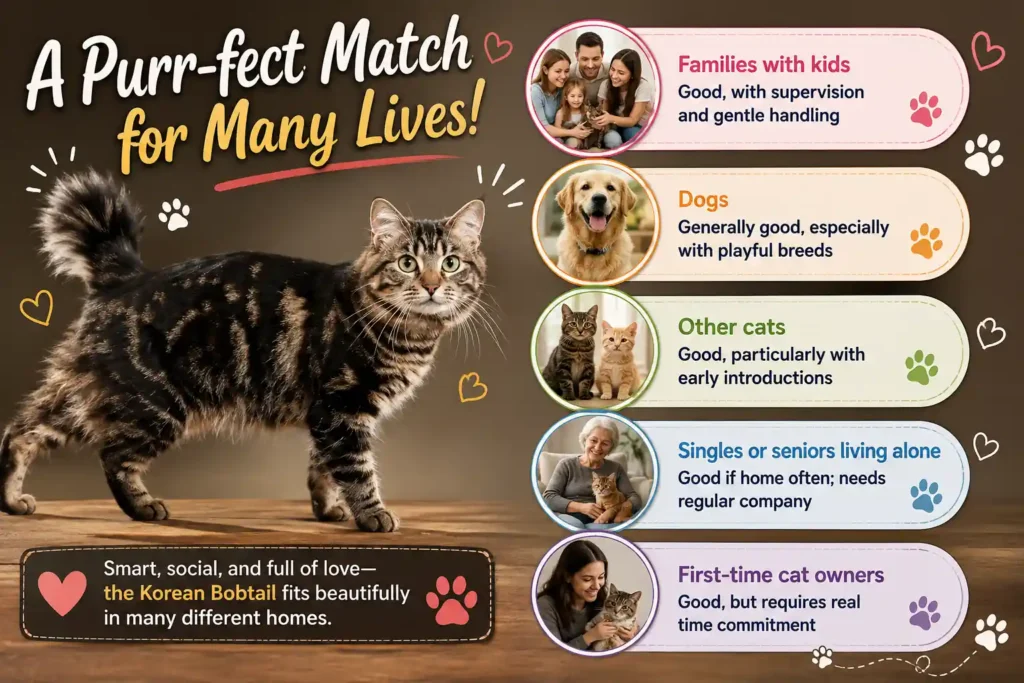
Here’s how this breed typically fits into different household setups.
| Household Type | Compatibility |
| Families with kids | Good, with supervision and gentle handling |
| Dogs | Generally good, especially with playful breeds |
| Other cats | Good, particularly with early introductions |
| Singles or seniors living alone | Good if home often; needs regular company |
| First-time cat owners | Good, but requires real time commitment |
Quick Answer: Is a Korean Bobtail Good With Kids and Other Pets?
Generally, yes. Korean Bobtails tend to be patient with children, playful with dogs, and sociable with other cats, as long as introductions happen gradually and supervision is in place early on.
How Intelligent Are Korean Bobtail Cats?
Quite intelligent, and food-motivated enough to make training realistic. Many owners find their Korean Bobtail can learn to open cabinet doors, fetch small toys, or figure out puzzle feeders faster than expected. That sharpness cuts both ways, though. A bored, understimulated Korean Bobtail is more likely to get into things it shouldn’t, so puzzle toys and rotating playtime aren’t optional extras here; they’re closer to a requirement.
Energy Level and Playfulness
Energy stays high well past kittenhood, which surprises some new owners who expect cats to mellow out by age two or three. Korean Bobtails often keep chasing toys, climbing cat trees, and inventing their own games into full adulthood. A tall scratching post, a few interactive wand toys, and short daily play sessions usually keep this energy pointed somewhere useful instead of toward the couch.
Do Korean Bobtail Cats Like to Be Alone?
Not really, no. This breed tends to struggle more than most with long stretches of solitude, and separation-related stress is a genuine concern for people who work long hours away from home.
The American Association of Feline Practitioners (AAFP) recommends environmental enrichment, like window perches, puzzle feeders, and rotating toys, for cats that spend extended time alone, and that guidance applies especially well here. A second pet or a consistent midday check-in can make a real difference for this particular breed.
Are Korean Bobtail Cats Vocal?
Yes, though not always in the way people expect. Rather than constant loud meowing, most Korean Bobtails communicate through soft chirps, trills, and short chatty bursts, especially when greeting someone or asking for attention. It’s a distinctive sound, closer to a bird’s chirp than a typical cat’s meow, and many owners actually list it as one of their favorite quirks. Still, if you’re sensitive to noise at night, it’s worth knowing this breed isn’t the strong, silent type.
Can Korean Bobtail Cats Be Trained Easily?
Yes, more easily than a lot of people assume. Short, reward-based sessions using treats or a clicker tend to work well, since this breed responds strongly to food motivation and repetition. Litter training is usually straightforward from kittenhood, and many owners successfully teach basic tricks like sit, high-five, or coming when called. Patience still matters here, since intelligence sometimes means a cat decides a trick simply isn’t worth its time that day.
Find Out Why Korean Bobtails Are Quick Learners. Read more in Korean Bobtail Cat Training That Feels More Like Training a Dog.
Quick Answer: How Trainable Is the Korean Bobtail Cat Personality?
Very trainable, overall. The Korean Bobtail cat personality combines intelligence, food motivation, and a genuine desire to interact with people, all of which make short, positive-reinforcement training sessions unusually effective for a cat breed.
Common Behavioral Traits of Korean Bobtail Cats
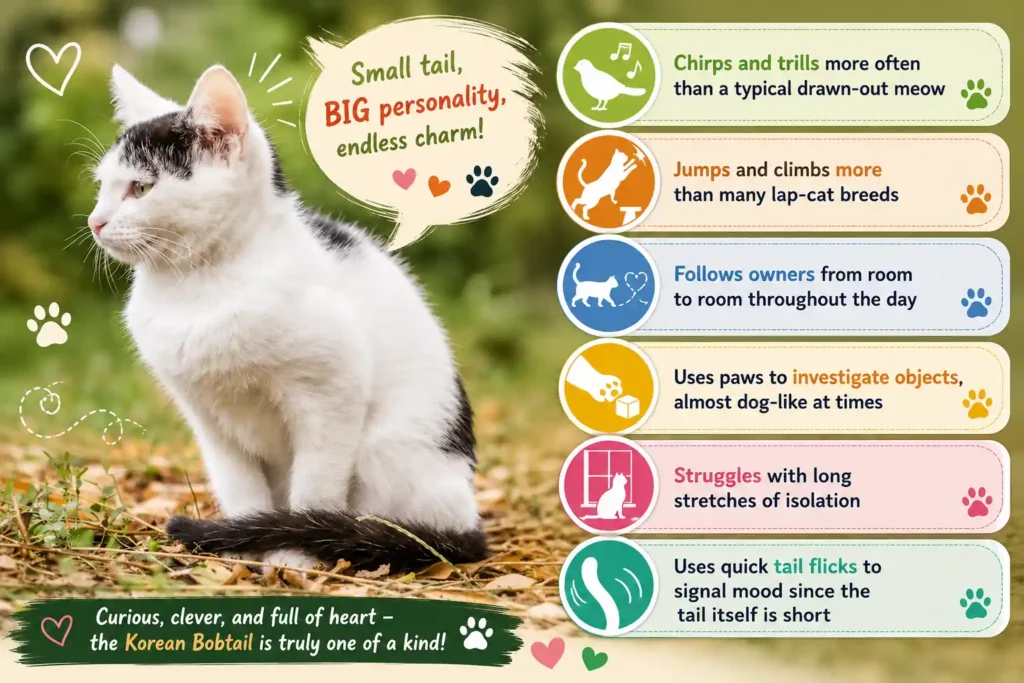
A few patterns show up again and again in owner reports and breed descriptions, and they’re worth knowing before adoption day.
- Chirps and trills more often than a typical drawn-out meow
- Jumps and climbs more than many lap-cat breeds
- Follows owners from room to room throughout the day
- Uses paws to investigate objects, almost dog-like at times
- Struggles with long stretches of isolation
- Uses quick tail flicks to signal mood since the tail itself is short
Pros and Cons of the Korean Bobtail Cat Personality
No breed is a perfect fit for everyone, and the Korean Bobtail cat personality comes with real trade-offs worth weighing honestly.
- Pro: Deeply affectionate and people-focused
- Pro: Intelligent and genuinely trainable
- Pro: Playful well into adulthood
- Pro: Usually great with kids and other pets
- Con: Doesn’t tolerate being left alone for long
- Con: Can be quite vocal, including at inconvenient hours
- Con: Rare and often difficult to find through a reputable breeder
Is the Korean Bobtail Cat Right for Your Lifestyle?
This breed suits people who are genuinely home often, enjoy an interactive pet, and don’t mind a bit of background chatter throughout the day. Apartment living works fine, since the Korean Bobtail cares more about company than square footage. On the other hand, anyone chasing a low-key, independent cat that’s content being ignored for ten hours a day should probably look elsewhere. Fit matters more than looks with this particular breed.
- Good for: attentive owners, families, multi-pet homes
- Less ideal for: frequent travelers, very quiet households, hands-off owners
In Short: A Cat That Won’t Let You Be Alone
Korean Bobtail cat personality isn’t subtle, and that’s exactly the appeal for the right household. This is a breed that talks back, follows you around, and treats companionship as non-negotiable, all wrapped up in a compact, rare, and genuinely striking little cat. If you can offer time, play, and company, you’ll likely get one of the most engaged, dog-like feline personalities out there in return.
FAQ
Is the Korean Bobtail cat friendly?
Yes. Korean Bobtails are typically outgoing and social, greeting familiar people and new guests with curiosity rather than hiding away.
Are Korean Bobtail cats good family pets?
Generally, yes. Their playful, affectionate nature and patience with children make them a solid choice for most family households.
Are Korean Bobtail cats aggressive?
No, aggression isn’t a typical trait. They can get pushy about wanting attention, but that’s closer to persistence than aggression.
Do Korean Bobtail cats need a lot of attention?
Yes. This breed bonds closely with its household and doesn’t handle long periods of isolation well, so daily interaction matters.
What makes the Korean Bobtail cat temperament unique?
The mix of dog-like devotion, chirpy vocalizations, and sustained playfulness into adulthood sets this breed’s temperament apart from most cats.