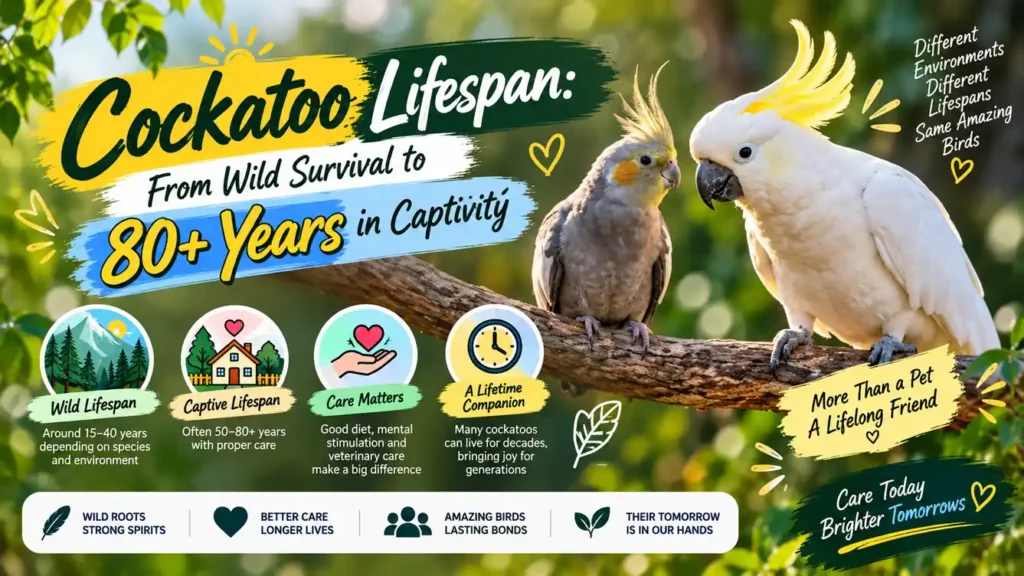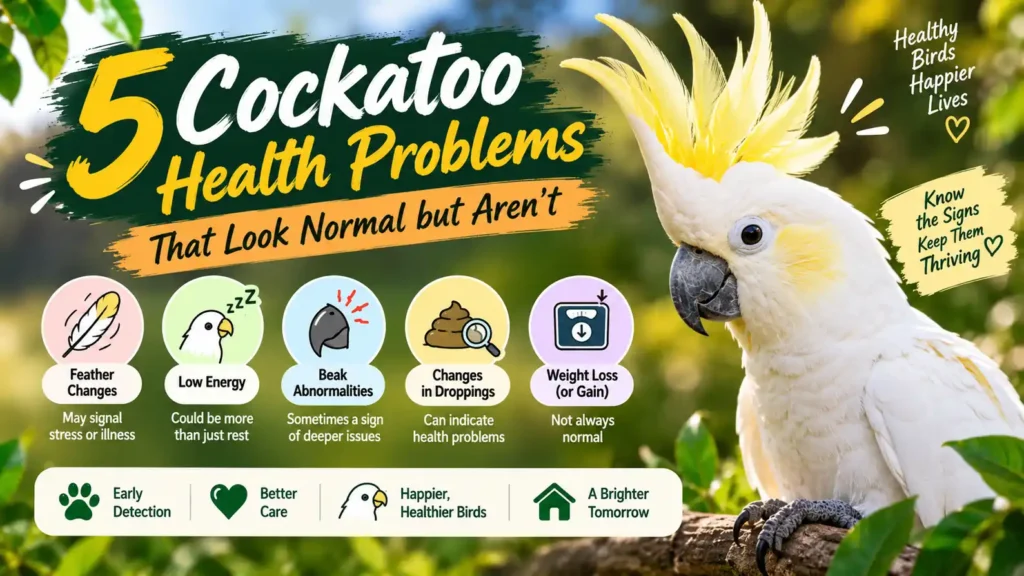
Types of cockatoos differ widely in size, color, and price, so choosing the right bird starts with knowing what makes each species unique. The Galah stands out as one of the more affordable types of cockatoos, often priced near $700, while the Palm Cockatoo sits at the top end, sometimes costing over $40,000 due to its rarity and slow breeding rate. Between these two extremes, species like the Goffin’s, Umbrella, and Moluccan Cockatoo offer different combinations of size, noise level, and lifespan, with many living 40 to 60 years or more in captivity.
Location also plays a role, since wild populations spread across Australia, Indonesia, the Philippines, and New Guinea, each adapted to different climates and diets. Before buying, it helps to compare temperament, care needs, and long-term cost, since a cockatoo is not a short-term pet but a companion that can stay in your life for decades.
The table below matches common species to experience level and household type.
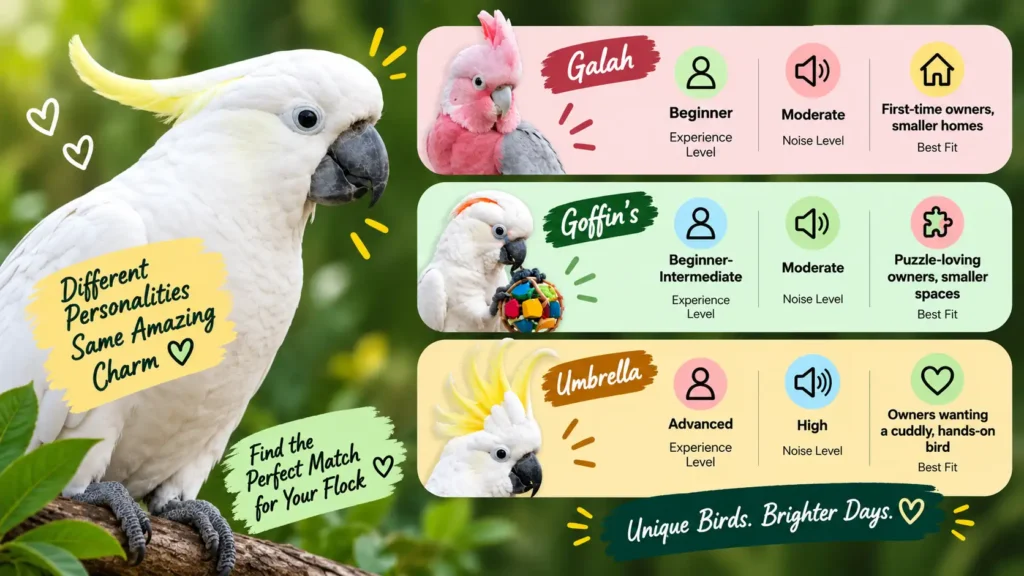
| Species | Experience Level | Noise Level | Best Fit |
| Galah | Beginner | Moderate | First-time owners, smaller homes |
| Goffin’s | Beginner-Intermediate | Moderate | Puzzle-loving owners, smaller spaces |
| Umbrella | Advanced | High | Owners wanting a cuddly, hands-on bird |
| Sulphur-Crested | Advanced | Very High | Social households, detached housing |
| Moluccan | Advanced | Very High | Experienced owners, rural or detached homes |
| Major Mitchell’s | Intermediate-Advanced | Moderate | Collectors seeking a calmer temperament |
| Palm Cockatoo | Expert/Aviculturist | Moderate-High | Serious collectors, large aviaries |
How Many Types of Cockatoos Are There?
Twenty-one species make up the cockatoo family, scientifically known as Cacatuidae, and their conservation status is tracked by the International Union for Conservation of Nature (IUCN). Eleven of these species live only in Australia, three are shared between Australia and New Guinea, and seven inhabit Indonesia, the Philippines, the Solomon Islands, and other parts of Oceania. Size varies enormously across the family: the cockatiel, technically the smallest cockatoo, weighs under 100 grams, while the Palm Cockatoo can top 1,200 grams.
Feather colors run from snow white to jet black, though nearly every species shares a movable crest that lifts when the bird gets excited, startled, or simply wants attention. Not every species makes a good household pet, since several remain protected, rare, or too specialized in diet and habitat for captivity. The table below breaks down where each regional group is typically found.
| Region | Approx. Species | Well-Known Examples |
| Australia only | 11 | Sulphur-Crested, Galah, Major Mitchell’s |
| Australia & New Guinea | 3 | Palm Cockatoo, Triton Cockatoo |
| Indonesia, Philippines & Oceania | 7 | Umbrella, Moluccan, Goffin’s |
Popular Types of Cockatoos
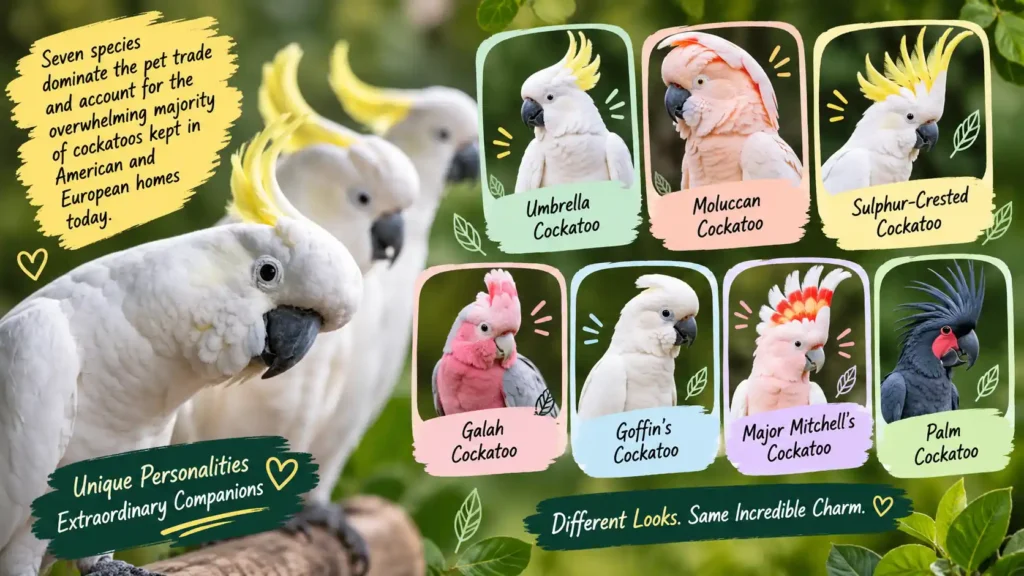
Seven species dominate the pet trade and account for the overwhelming majority of cockatoos kept in American and European homes today. Each of these birds brings a different mix of size, volume, and neediness to the table, so the right choice really depends on an owner’s tolerance for noise and hands-on attention.
Price alone spans a huge range, from a few hundred dollars for a Galah to tens of thousands for a Palm Cockatoo, and that gap usually reflects rarity and breeding difficulty rather than personality. Every species below carries real conservation and welfare considerations worth weighing before purchase, using size, lifespan, and price figures drawn from current 2026 breeder listings and species databases.
Umbrella Cockatoo
Snow-white plumage and a crest that unfurls into a full circle make the Umbrella Cockatoo (Cacatua alba) instantly recognizable. Native to the North Maluku islands of Indonesia, this bird measures 17 to 19 inches long and weighs 500 to 700 grams. Lifespan regularly reaches 40 to 60 years, and one Florida rescue bird named Duster reportedly lived to nearly 100. An Endangered rating from the IUCN reflects ongoing pressure from pet-trade trapping and habitat loss.
Expect to pay $1,000 to $3,000 for a captive-bred Umbrella. Affection runs deep with this species, sometimes too deep: Umbrellas bond intensely with one person and can turn destructive, loud, or prone to feather plucking when left without enough attention.
Moluccan Cockatoo
Salmon-pink undertones beneath a mostly white coat give the Moluccan Cockatoo (Cacatua moluccensis) its nickname, the salmon-crested cockatoo. Native to the Seram archipelago in eastern Indonesia, this bird ranks among the largest white cockatoos, reaching up to 20 inches and 850 grams. Import into the United States has been banned under the Wild Bird Conservation Act, so nearly every bird available today comes from domestic breeding programs, priced between $1,000 and $2,000.
An IUCN Endangered listing applies to wild populations. Volume defines this species more than anything else: Moluccans produce some of the loudest calls in the parrot world, often compared to a jet engine, which makes apartment living a poor fit.
Sulphur-Crested Cockatoo
Bright yellow crest feathers atop a pure white body identify the Sulphur-Crested Cockatoo (Cacatua galerita) at a glance. Wild populations across Australia, New Guinea, and nearby islands remain healthy enough that the IUCN rates the species as Least Concern, unlike several Indonesian relatives. Adults measure 18 to 22 inches, and captive lifespan regularly hits 40 to 70 years, with a few documented individuals reportedly surpassing 100.
Pricing typically runs $1,500 to $4,000 depending on subspecies, which include the Triton and Eleonora cockatoos. A 2009 study on a Sulphur-Crested named Snowball found the bird could synchronize movement to a musical beat, a rare skill outside primates. Daily interaction matters enormously for this highly social, vocal companion, which struggles badly in isolation.
Galah Cockatoo
Pink chest feathers paired with soft grey wings make the Galah, also called the Rose-breasted Cockatoo (Eolophus roseicapilla), one of the easiest species to identify at a glance. Measuring just 12 to 15 inches, this Australian native ranks among the smaller cockatoos and typically costs $700 to $2,200, making it one of the more affordable entry points into cockatoo ownership.
Lifespan runs 40 to 60 years, occasionally longer. Wild populations remain abundant across Australia, and no significant conservation concern applies to the species. Quieter behavior and stronger food motivation for training set the Galah apart from an Umbrella or Moluccan, making it a realistic option for a first-time owner who still commits to daily interaction.
Goffin’s Cockatoo
Small size paired with big problem-solving skills defines the Goffin’s Cockatoo (Cacatua goffiniana), also known as the Tanimbar Corella. Native to Indonesia’s Tanimbar Islands, this bird measures around 12 inches, making it the smallest member of the genus Cacatua. Habitat loss and illegal trapping earned the species a Near Threatened rating from the IUCN. Researchers from Oxford, the Max Planck Institute, and the University of Vienna documented Goffin’s cockatoos solving multi-step mechanical puzzles, showing object permanence skills that rival a four-year-old child’s.
Price typically falls between $1,000 and $2,000, and lifespan can reach 40 to 60 years with good care. Compact size and manageable volume make this species a popular choice for owners chasing cockatoo intelligence without cockatoo-sized noise.
Major Mitchell’s Cockatoo
Salmon-pink and white feathers topped with a dramatic red-and-yellow crest make the Major Mitchell’s Cockatoo (Cacatua leadbeateri), also called the Pink Cockatoo, one of the most photogenic cockatoo species available. Native to arid inland Australia, this species appears far less often in the pet trade than the others on this list, which pushes prices to $5,000 to $6,500.
The IUCN rates the species Least Concern globally, though Australian state agencies list several regional populations as vulnerable due to habitat loss. Longevity runs remarkably high: a Major Mitchell’s named Cookie lived 82 years and 88 days at Brookfield Zoo, a Guinness World Record for the species. A calmer temperament than an Umbrella or Moluccan still comes with real needs, including daily mental stimulation and a large, secure cage.
Palm Cockatoo
Charcoal-black feathers, bare red cheek patches, and a beak strong enough to crack macadamia nuts whole set the Palm Cockatoo (Probosciger aterrimus) apart from every other species on this list. Found in the rainforests of Cape York, Australia, and New Guinea, this bird holds the title of largest cockatoo species, reaching up to 24 inches and 1,200 grams. Males use sticks as drumsticks, striking hollow trees in a rhythmic display that researchers classify as genuine tool use.
Breeding success in captivity remains rare, which drives prices from around $15,000 well past $40,000 for a single bird. A Near Threatened status applies to the species, with mining and deforestation cited as primary pressures across its native range, and its trade is regulated under CITES Appendix I, the international agreement governing wildlife trade. Very few private owners ever keep this species, and most examples live in zoos or specialized aviaries.
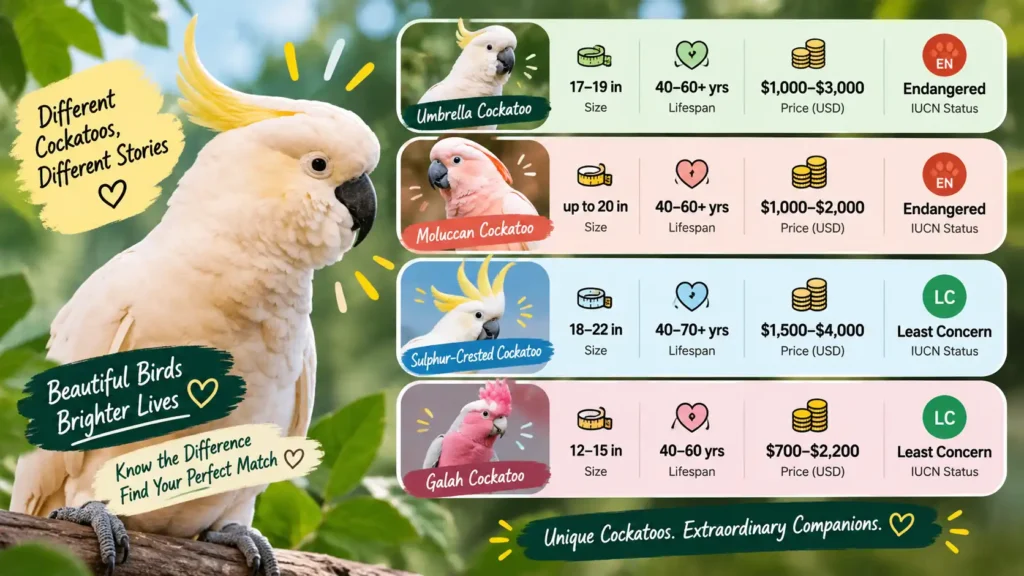
| Species | Size | Lifespan | Price (USD) | IUCN Status |
| Umbrella Cockatoo | 17-19 in | 40-60+ yrs | $1,000-$3,000 | Endangered |
| Moluccan Cockatoo | up to 20 in | 40-60+ yrs | $1,000-$2,000 | Endangered |
| Sulphur-Crested Cockatoo | 18-22 in | 40-70+ yrs | $1,500-$4,000 | Least Concern |
| Galah Cockatoo | 12-15 in | 40-60 yrs | $700-$2,200 | Least Concern |
| Goffin’s Cockatoo | ~12 in | 40-60 yrs | $1,000-$2,000 | Near Threatened |
| Major Mitchell’s Cockatoo | ~14 in | 50-80+ yrs | $5,000-$6,500 | Least Concern |
| Palm Cockatoo | up to 24 in | 40-60+ yrs | $15,000-$40,000+ | Near Threatened |
How to Choose the Right Cockatoo Species?
Matching a cockatoo to a household comes down to three practical factors: available space, tolerance for volume, and hands-on time. Living situation matters immediately, since apartment dwellers rarely do well with a Moluccan or Sulphur-Crested, both capable of calls that carry through walls and across streets. Budget plays a bigger role than most first-time buyers expect, since purchase price is only the entry cost; a large cockatoo can also run $50 to $150 a month in food, toys, and enrichment items.
Learn About the Personality, Care, and Traits of Cockatoos. Read more in Cockatoo Parrot Diet, Temperament, and the Commitment Few Expect.
Experience level narrows the list further, since a Galah or Goffin’s forgives beginner mistakes far more easily than an Umbrella or Palm Cockatoo. Veterinary access deserves a check before bringing any of these types of cockatoos home, since not every general vet treats avian patients, and annual exams from an avian-certified vet catch problems like psittacine beak and feather disease early. Rescue groups affiliated with the World Parrot Trust often have adult cockatoos already available, sidestepping both the breeder waitlist and the highest price tags.
- Confirm cage size and daily out-of-cage space before buying, not after
- Locate an avian-certified vet within reasonable driving distance
- Budget $50-$150 a month for food, toys, and enrichment
- Ask breeders for IUCN or CITES paperwork on any protected species
Types of Cockatoos FAQs
What is the most popular type of cockatoo?
The Sulphur-Crested Cockatoo ranks as the most popular and widely recognized cockatoo species worldwide, thanks to its bright yellow crest, strong talking ability, and broad presence across Australia, New Guinea, and the pet trade. Its Least Concern IUCN status also keeps supply steadier than endangered species like the Umbrella or Moluccan Cockatoo.
Which cockatoo is best for beginners?
The Galah, also called the Rose-breasted Cockatoo, ranks as the best beginner choice among all types of cockatoos. Its smaller size, a lower price around $700 to $2,200, and a calmer temperament than larger species make it far more forgiving of first-time owner mistakes. Goffin’s Cockatoo works as a strong second choice for beginners drawn to a smaller, puzzle-loving bird.
What is the smallest cockatoo species?
The cockatiel (Nymphicus hollandicus) counts as the smallest member of the cockatoo family, weighing under 100 grams and measuring around 12 to 13 inches including its tail. Among the larger-bodied species most people picture as cockatoos, the Goffin’s Cockatoo takes the title of smallest at roughly 12 inches long.
What is the largest cockatoo species?
The Palm Cockatoo holds the record as the largest cockatoo species, reaching up to 24 inches long and weighing as much as 1,200 grams. An oversized beak, the largest of any parrot besides the hyacinth macaw, combined with jet-black feathers, makes it unmistakable next to any other species on this list.