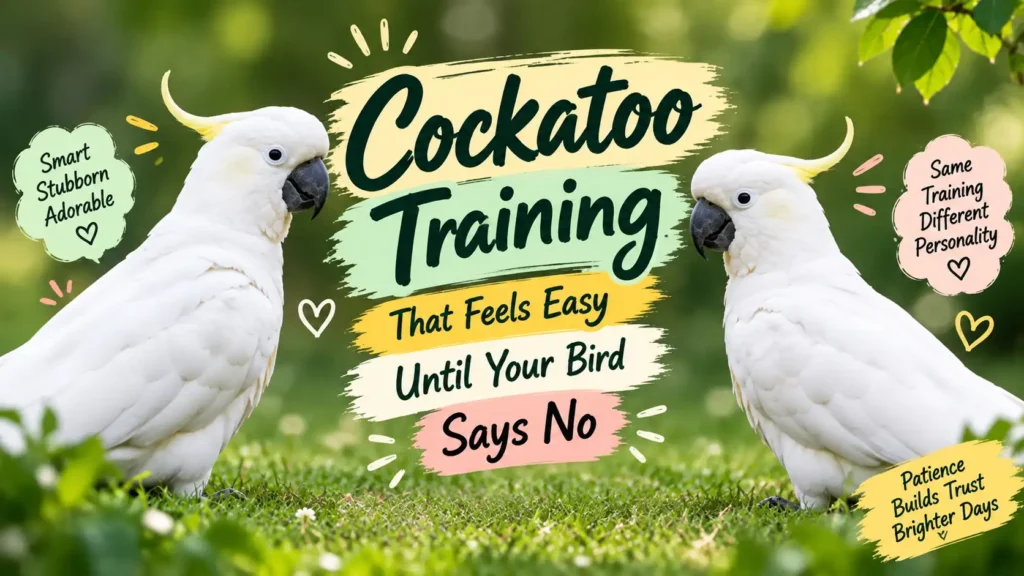
Cockatoo training works best when it starts the moment a new bird enters the home, before fear or bad habits take root. The process relies on positive reinforcement: rewarding calm behavior with treats, praise, or attention, while ignoring or redirecting aggressive reactions like biting or lunging. Short daily sessions of ten to fifteen minutes build trust far more effectively than long, forced interactions, since cockatoos learn quickest when they feel safe and in control.
Basic cockatoo training usually begins with simple step-up commands, using a consistent word and hand position so the bird knows exactly what to expect every time. Patience matters more than speed here, because a cockatoo that feels pressured will often regress instead of progress. Within two to three weeks of steady practice, most owners see real changes: fewer bites, calmer body language, and a bird that responds to cues instead of reacting out of fear.
How Do You Start Cockatoo Training?
Short, structured sessions form the foundation of every successful approach to training a cockatoo. Five to ten minutes of focused practice, repeated two to three times daily, produces faster results than one long session and prevents frustration on both sides. Cockatoo training works because it pairs desired behavior with immediate rewards, creating a clear cause-and-effect pattern the bird can predict. Trust-building always comes before formal commands, since a bird that doesn’t feel safe rarely engages with treats or praise.
Quiet, distraction-free environments help a nervous or new bird focus during early sessions. Progress typically follows a slow-then-fast pattern, with the first two weeks feeling frustratingly slow before behaviors start clicking into place.
Curious About Cockatoos? Find Out More About These Amazing Birds. Read more in Cockatoo Parrot Diet, Temperament, and the Commitment Few Expect.
When Should You Start Training a Cockatoo?
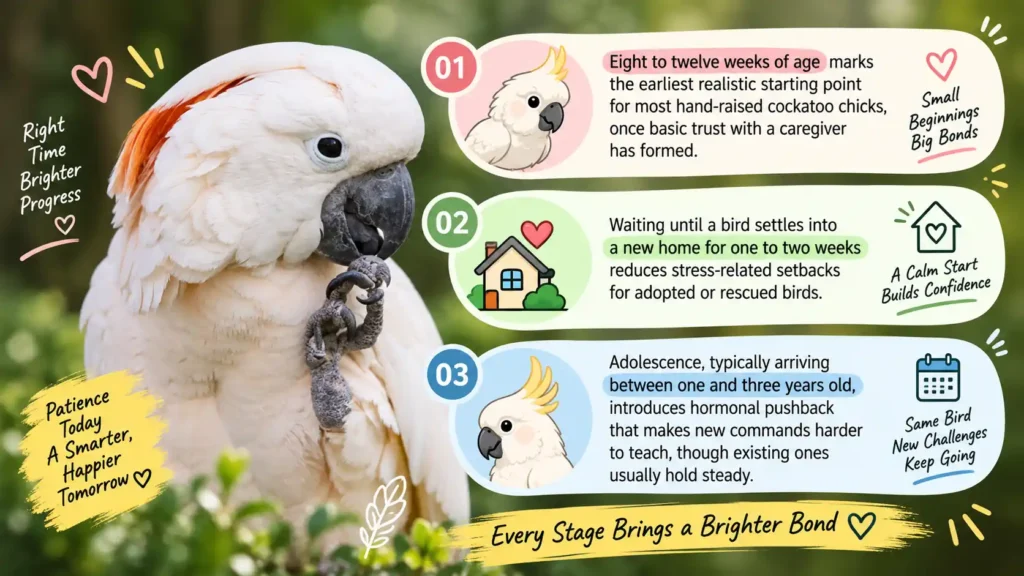
Eight to twelve weeks of age marks the earliest realistic starting point for most hand-raised cockatoo chicks, once basic trust with a caregiver has formed. Waiting until a bird settles into a new home for one to two weeks reduces stress-related setbacks for adopted or rescued birds. Adolescence, typically arriving between one and three years old, introduces hormonal pushback that makes new commands harder to teach, though existing ones usually hold steady. Cockatoo training started early tends to prevent many biting and screaming habits before they become ingrained patterns. Adult and senior birds, even those rescued after decades without structure, can still learn new behaviors with patient, consistent repetition.
Age matters less than consistency, according to guidance from the Association of Avian Veterinarians (AAV), which recommends starting positive reinforcement as soon as a bird shows comfort with a caregiver.
The table below breaks down age-appropriate training priorities for cockatoos at each life stage, a useful quick reference before starting any formal sessions.
| Age Stage | Typical Behavior | Training Priority | Realistic Goal |
| 8-16 Weeks (Chick) | Curious, dependent, low fear | Hand-taming, gentle touch | Comfortable hand contact |
| 4 Months-1 Year (Juvenile) | Playful, testing boundaries | Step-up command, basic recall | Reliable step-up on cue |
| 1-3 Years (Adolescent) | Hormonal, biting spikes | Boundary reinforcement | Reduced biting frequency |
| 3-7 Years (Adult) | Settled, bonded | Advanced commands, talking | Expanded vocabulary and tricks |
| 7+ Years (Senior) | Set routines, cautious with change | Maintenance, enrichment | Sustained good behavior |
How to Tame a Cockatoo
Slow, predictable movements near the cage build the first layer of trust with a nervous or previously mishandled bird. Hand-feeding favorite treats through the cage bars often marks the first successful contact point. Approaching from the side rather than straight-on reduces the perceived threat, since direct eye contact and frontal approaches mimic predator behavior in the wild.
Sessions should end on a calm note, even if that means stopping after a single successful interaction. Taming timelines vary enormously by individual history, ranging from a few days for a confident hand-raised bird to several months for a previously mishandled cockatoo. Patience during this stage prevents the fear-based biting and lunging that undermines every later training goal.
Basic Cockatoo Training Techniques
Two techniques form the backbone of nearly every successful program: step-up training and positive reinforcement. Both methods rely on predictable cues, immediate rewards, and short repeated sessions rather than punishment or force. Clicker training, borrowed from dog and marine mammal training programs, works well for cockatoos that respond strongly to sound-based cues. Target training, teaching a bird to touch a stick or fingertip on command, builds a foundation for more advanced tricks later.
Certified trainers affiliated with the International Association of Animal Behavior Consultants (IAABC) generally recommend combining two or three methods rather than relying on just one. Choosing the right mix depends heavily on the individual bird’s personality, food motivation, and prior handling history.
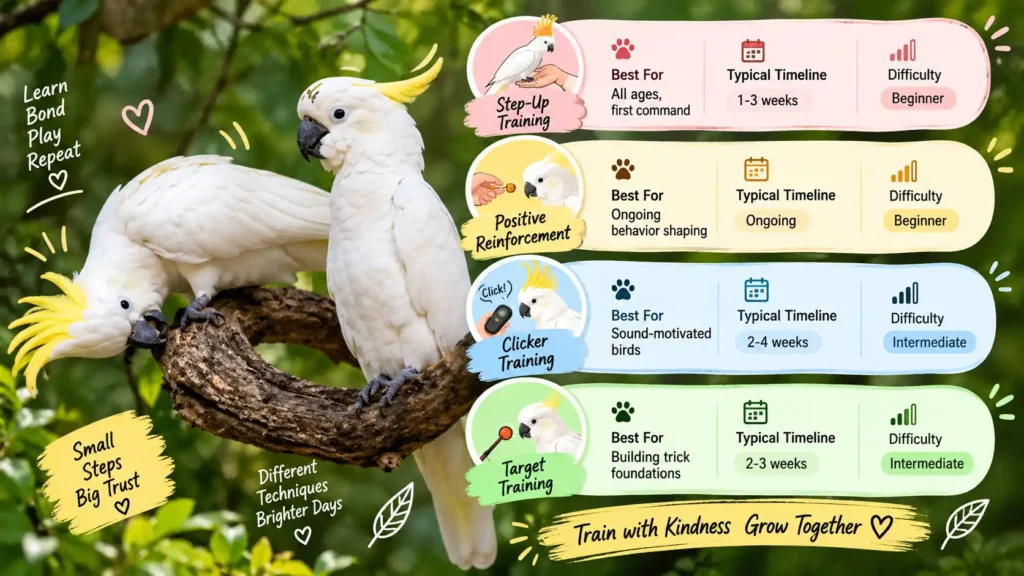
The comparison below outlines the core techniques covered in this guide, helping new owners choose a starting point that matches their bird’s personality.
| Technique | Best For | Typical Timeline | Difficulty |
| Step-Up Training | All ages, first command | 1-3 weeks | Beginner |
| Positive Reinforcement | Ongoing behavior shaping | Ongoing | Beginner |
| Clicker Training | Sound-motivated birds | 2-4 weeks | Intermediate |
| Target Training | Building trick foundations | 2-3 weeks | Intermediate |
Step-Up Training
Extending a finger or perch just above the bird’s feet, paired with the verbal cue “up,” forms the entire technique behind this foundational command. Gentle upward pressure against the lower belly typically prompts the bird to step forward naturally, without any pulling or forcing involved. Reward delivery, ideally a small treat or verbal praise, should happen within one to two seconds of a successful step for the association to stick.
Repetition across five to ten short attempts per session, several times a day, produces a reliable response within one to three weeks for most birds. Refusal signals stress more often than stubbornness, so backing off and trying again later usually works better than repeated pressure. Step-down training should follow immediately after step-up becomes reliable, giving the bird a full, controllable routine.
Positive Reinforcement
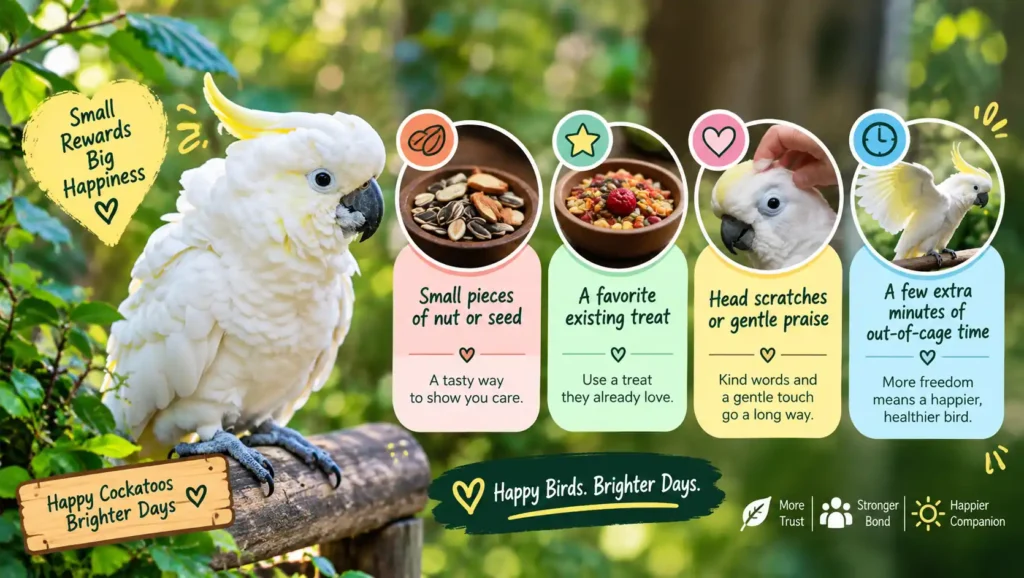
Rewarding desired behavior immediately after it happens, rather than punishing unwanted behavior, defines positive reinforcement at its core. Treats, favorite foods, verbal praise, and head scratches all work as effective rewards, though food-based rewards tend to produce the fastest results. Timing matters enormously, since rewards delivered more than a few seconds late fail to connect clearly with the triggering behavior in the bird’s mind. Punishment-based methods, including yelling, cage-covering, or physical correction, consistently backfire according to avian behaviorists, often increasing fear-based biting and mistrust. Consistency across every household member handling the bird prevents mixed signals that slow progress considerably.
- Small pieces of nut or seed
- A favorite existing treat
- Head scratches or gentle praise
- A few extra minutes of out-of-cage time
Weaning off constant treats toward intermittent rewards, once a behavior becomes reliable, keeps the bird motivated long-term without over-reliance on food.
How to Train a Cockatoo Not to Bite?
Fear, hormonal surges, overstimulation, and poor body-language reading account for the vast majority of cockatoo bites, according to avian behavior specialists. Reading warning signs allows an owner to remove a hand before a bite occurs rather than reacting after the fact.
- Pinned or rapidly narrowing eyes
- Raised crest feathers
- Stiff, upright body posture
- Beak opening without vocalizing
Redirecting toward an appropriate chew toy the moment beak pressure increases teaches the bird an acceptable outlet without punishment. Yelling or pulling away sharply after a bite often reinforces it, since dramatic reactions can register as exciting to the bird. Hormonal seasons, typically spring and early summer, require extra patience and less physical affection to avoid triggering possessive responses. Professional avian behaviorists typically charge $50 to $150 USD per session for hands-on help with entrenched biting cases. Veterinary checkups rule out pain or illness whenever biting starts suddenly in a previously gentle bird.
How to Train a Cockatoo to Talk?
Repetition of short, clear words during calm, one-on-one interaction time builds the foundation for speech development in a talking-capable cockatoo. Not every species mimics human speech reliably, with Umbrella and Sulphur-Crested cockatoos showing more consistent talking ability than Goffin’s or Galahs. Association matters more than volume, so pairing a word with a specific action, like saying “up” during step-up practice, speeds recognition and recall.
Daily short sessions, five to ten minutes long, outperform occasional long sessions for building vocabulary over time. Some individual birds never develop reliable speech regardless of effort, since talking ability varies by temperament as much as species. Realistic expectations matter here, since even talented talkers usually need several months of consistent exposure before producing recognizable words.
Common Mistakes to Avoid When Training a Cockatoo
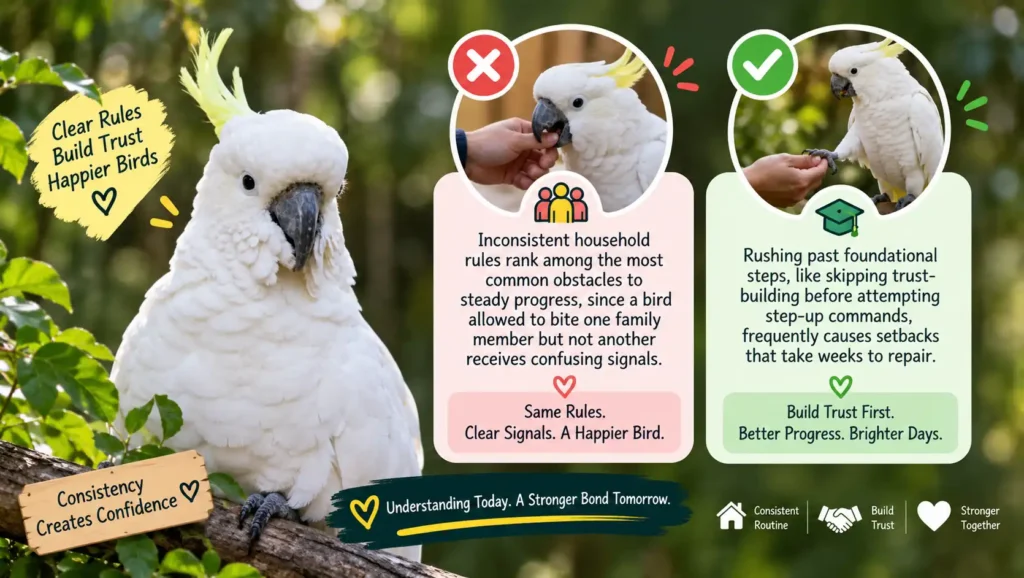
Inconsistent household rules rank among the most common obstacles to steady progress, since a bird allowed to bite one family member but not another receives confusing signals. Rushing past foundational steps, like skipping trust-building before attempting step-up commands, frequently causes setbacks that take weeks to repair.
Overusing treats without transitioning to intermittent rewards can create a bird that only performs commands when food is visible. Punishment-based corrections, including physical discipline or prolonged isolation, damage trust and often increase problem behaviors instead of resolving them. Skipping daily practice for several days at a time slows progress considerably compared to short, consistent sessions.
The table below highlights the most frequent mistakes reported by owners, along with the underlying cause and a more effective approach.
| Mistake | Why It Backfires | Better Approach |
| Inconsistent rules across family members | Confuses the bird’s expectations | Align rules for every caregiver |
| Skipping trust-building | Leads to fear-based biting later | Build trust before formal commands |
| Overusing food rewards | Creates food-only compliance | Shift to intermittent rewards over time |
| Punishing unwanted behavior | Increases fear and aggression | Redirect and reward alternatives instead |
| Irregular practice schedule | Slows or reverses progress | Keep sessions short but daily |
The Bottom Line on Cockatoo Training
Cockatoo training ultimately comes down to consistency, patience, and reading a bird’s individual signals rather than following a rigid script. Starting age matters less than most owners assume, since even senior or previously neglected birds respond to steady, reward-based methods. Taming a nervous bird takes slow, predictable interaction, while step-up and positive reinforcement form the two pillars of nearly every successful technique.
Biting almost always traces back to fear or hormones rather than genuine aggression, and reading warning signs prevents most incidents before they happen. Talking ability varies by individual and species, rewarding realistic expectations over rushed results. Avoiding common mistakes, like inconsistent household rules or skipping trust-building, saves months of frustration for everyone involved. Every stage of this process rewards patience over force, producing a calmer, more confident companion.
Frequently Asked Questions
Are Cockatoos Easy to Train?
Cockatoos rank among the more trainable parrot species thanks to high intelligence and strong food motivation, though their emotional sensitivity means harsh corrections backfire quickly. Basic commands like step-up typically develop within one to three weeks using consistent, reward-based methods, while advanced tricks or speech take considerably longer.
How Long Does Cockatoo Training Take?
Basic commands, including step-up and simple recall, generally take one to three weeks of daily short sessions to become reliable. Advanced tricks, consistent speech, or resolving established biting habits often take two to six months depending on the bird’s history and practice consistency.
Can an Older Cockatoo Be Trained?
Older or previously neglected cockatoos can absolutely learn new behaviors, contrary to common assumptions about a “window closing” after adolescence. Progress often takes longer, sometimes several months instead of weeks, especially when unlearning fear-based reactions from prior mishandling, but consistent positive reinforcement produces real results at any age, according to rescue and sanctuary reports compiled by the World Parrot Trust.