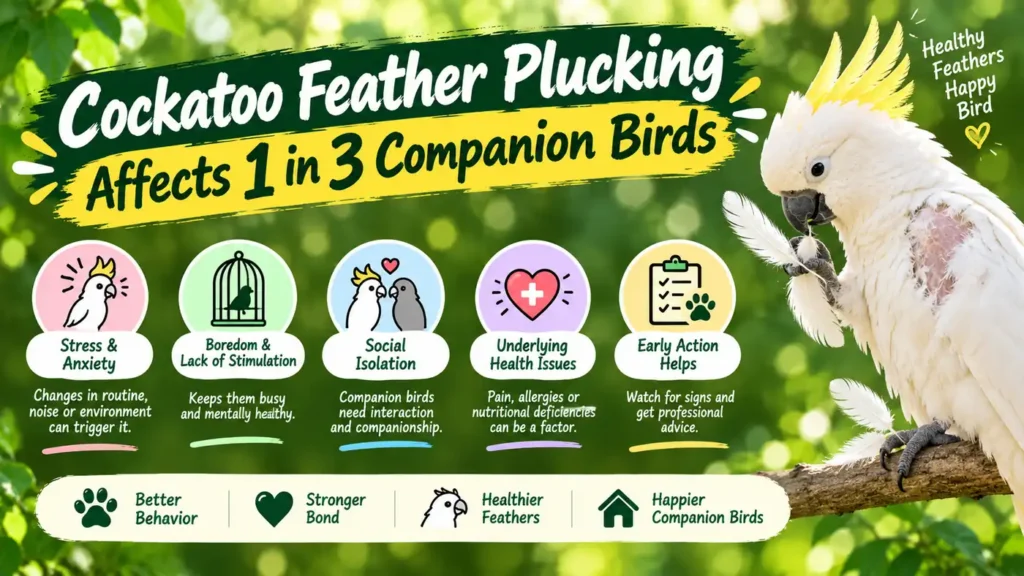
Cockatoo feather plucking happens when a bird repeatedly bites, pulls, or chews its own feathers, leaving bald spots on the chest, wings, or legs. This is not just a bad habit, it is usually a sign of an underlying problem such as skin infection, poor diet, low humidity, hormonal stress, or boredom from not enough mental activity.
Cockatoos are highly social and sensitive birds, so even small changes like a new pet, less attention, or a shift in daily routine can start the behavior within days. If left untreated, the habit can continue even after the original cause is fixed, so quick action at the first sign of unusual preening is important.
What Is Feather Plucking in Cockatoos?
Feather-destructive behavior covers a range of self-directed actions, chewing, barbering, or fully pulling feathers, that damage plumage beyond normal preening. Cockatoos typically target the chest, under-wing, flank, and inner thigh, areas their beak can reach with ease. Normal preening keeps feathers aligned and free of debris, while destructive plucking strips feathers down to stubble or bare skin.
Veterinary literature notes that the boundary between the two can blur, since mild over-preening often escalates gradually into a fixed pattern. Plumage serves temperature regulation, flight, and social signaling, so ongoing feather loss carries real physical consequences beyond appearance. Left unaddressed, the behavior tends to progress rather than resolve on its own.
Feather-Destructive Behavior, Defined in One Line
Feather-destructive behavior in cockatoos means a bird pulling, chewing, or barbering its own feathers past the point of normal grooming, typically driven by an underlying medical issue, psychological stress, or both, and it calls for a veterinary evaluation rather than a wait-and-see approach.
Thinking About a Cockatoo? Discover What You Should Know. Read more in Cockatoo Parrot Diet, Temperament, and the Commitment Few Expect.
Why Do Cockatoos Pluck Their Feathers?
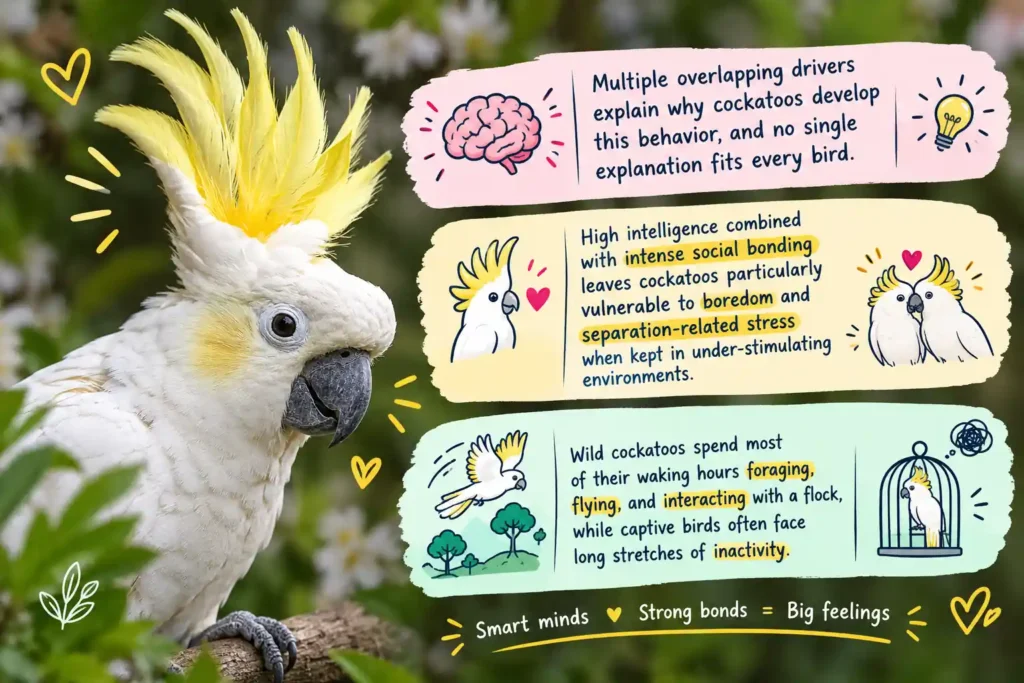
Multiple overlapping drivers explain why cockatoos develop this behavior, and no single explanation fits every bird. High intelligence combined with intense social bonding leaves cockatoos particularly vulnerable to boredom and separation-related stress when kept in under-stimulating environments. Wild cockatoos spend most of their waking hours foraging, flying, and interacting with a flock, while captive birds often face long stretches of inactivity.
Hormonal cycles tied to breeding season can also trigger plucking, especially in birds that receive frequent stroking along the back or wings. Skin irritation from allergies, low humidity, or parasites frequently sits underneath what first looks like a purely behavioral problem. A single triggering event, such as a house move or a new pet, sometimes starts a pattern that outlasts the original stressor. Survey data consistently ranks cockatoos above cockatiels, conures, and parakeets for reported plucking rates, reflecting their unusually strong pair-bonding instincts.
Causes of Feather Plucking in Cockatoos
Veterinary evaluations generally sort the causes into two broad groups, and the table below breaks down the most frequently documented triggers in each category.
| Medical Causes | Behavioral Causes |
| Bacterial, fungal, or viral skin infections | Boredom and understimulation |
| Internal disease such as liver, kidney, or PDD | Separation anxiety or loneliness |
| Nutritional deficiencies from a seed-heavy diet | Hormonal or sexual frustration |
| External or internal parasites | Environmental stress: noise, smoke, sudden change |
| Allergies and chronically low humidity | Inconsistent daily routine |
Cockatoo feather plucking rarely traces back to one isolated cause, and vets often find two or three factors compounding at once. Association of Avian Veterinarians (AAV) guidance recommends ruling out every medical possibility before labeling a case purely behavioral, since treating assumed boredom while ignoring an infection delays real recovery. Bloodwork, fecal testing, and skin scrapings form the standard first step in most diagnostic workups. Genetics may play a role too, since certain lines within popular breeds such as umbrella and Moluccan cockatoos show markedly higher plucking rates than average.
Top Causes at a Glance
Common triggers behind feather-destructive behavior include skin or internal infections, nutritional gaps, parasites, hormonal cycles, boredom, separation anxiety, and sudden environmental stress. Medical and behavioral causes frequently overlap in the same bird, which is why avian veterinarians recommend a full diagnostic workup before assuming the problem is purely psychological.
Signs of Feather Plucking in Cockatoos
Severity varies widely from bird to bird, and the checklist below outlines what to watch for at each stage.
| Sign | What It Looks Like | Recommended Action |
| Fraying or chewed tips | Feather edges look ragged, not smooth | Monitor closely |
| Bald patches | Bare skin visible on chest, wings, or legs | Schedule a vet visit |
| Broken blood feathers | Bleeding or dark, damaged shafts | Seek same-day care |
| Skin lesions or scabs | Redness, swelling, or open sores | Urgent veterinary care |
| Behavioral changes | Increased screaming, reduced appetite, restlessness | Schedule a vet visit |
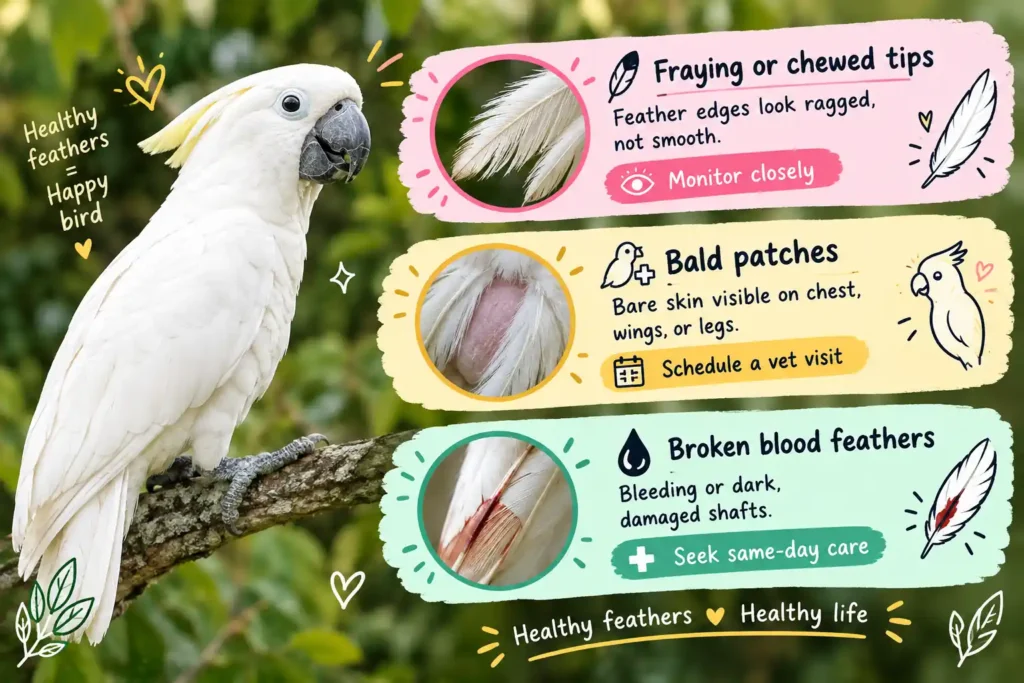
Cockatoos rarely announce distress directly, so subtle shifts in posture, appetite, or vocalization often appear before feathers do. Bald patches on the chest and under the wings tend to develop first, since these areas sit within easy reach of the beak.
Bleeding wounds or exposed skin represent a veterinary emergency rather than a wait-and-see situation, because infection risk rises quickly on damaged skin. Careful owners often notice the earliest signs simply by handling their bird regularly enough to feel new stubble beneath the feathers. Tracking changes with a simple photo log every few weeks makes gradual feather loss far easier to catch than relying on memory alone.
How to Stop Cockatoo Feather Plucking
Veterinary evaluation always comes first, since stopping the behavior long-term depends on identifying whatever is driving it. Blood panels, fecal exams, and skin or feather cultures typically rule out infection, parasites, and organ disease within the first one or two visits. Environmental changes such as adding foraging toys, increasing out-of-cage time, and establishing a consistent daily routine often reduce mild, boredom-driven plucking within a few weeks.
Sexual or hormonal triggers respond well to reduced petting along the back and wings, along with adjusted light exposure to dampen breeding cycles. Positive reinforcement, meaning rewarding calm, feather-intact behavior with a favorite treat or activity, works better than scolding, which tends to increase stress and worsen the habit. Consistency across every household member matters more than any single technique, since mixed signals slow progress considerably. A practical starting checklist looks like this:
- Book a full avian veterinary exam before trying anything else
- Add two or three foraging toys and rotate them weekly
- Increase supervised out-of-cage time to one or two hours daily
- Reduce back-and-wing petting to lower hormonal stimulation
- Reward calm, feather-intact behavior immediately with a favorite treat
Treatment for Feather Plucking in Cockatoos
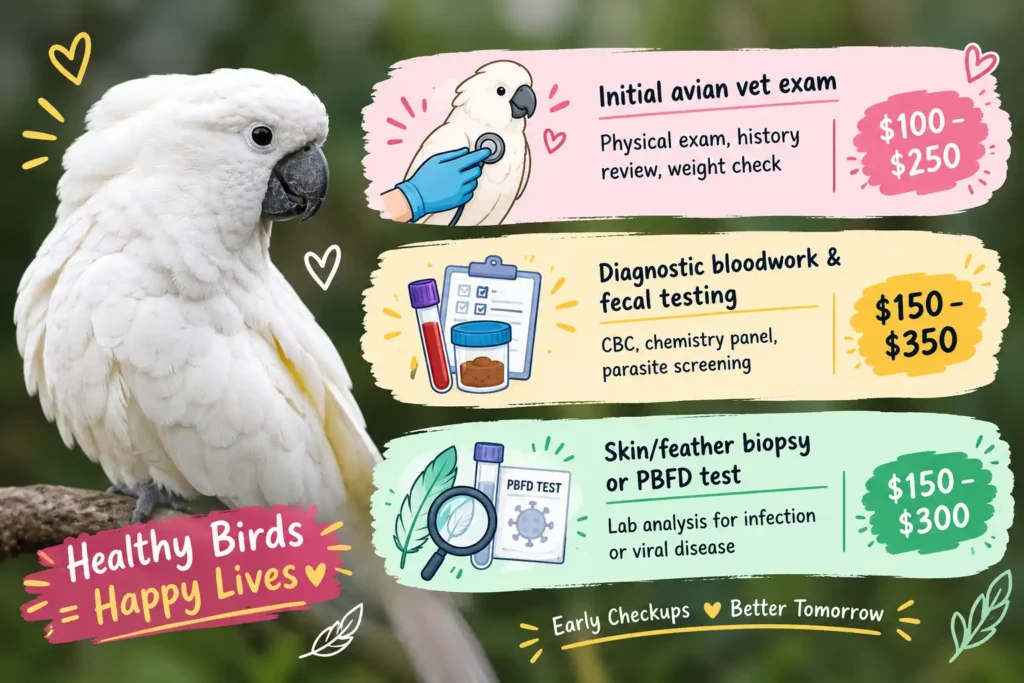
Cost and approach both depend on the underlying cause, and the table below summarizes what treatment typically involves at each stage.
| Approach | What It Involves | Typical Cost (USD) |
| Initial avian vet exam | Physical exam, history review, weight check | $100–$250 |
| Diagnostic bloodwork & fecal testing | CBC, chemistry panel, parasite screening | $150–$350 |
| Skin/feather biopsy or PBFD test | Lab analysis for infection or viral disease | $150–$300 |
| Behavioral therapy follow-up | Enrichment plan, revisits with an avian vet | $80–$160/visit |
| Prescribed medication | Antibiotics, antifungals, or short-term anti-anxiety medication | Varies by drug |
Cockatoo feather plucking treatment plans are never one-size-fits-all, and a bird with an infection needs a very different protocol than one dealing with pure separation anxiety. American Veterinary Medical Association (AVMA) resources caution against self-medicating a plucking bird, since several common human, cat, and dog medications are toxic to parrots even in small doses.
Protective collars or vests sometimes help interrupt the physical habit while medical or behavioral treatment takes effect, though vets typically treat these as a temporary bridge rather than a fix. Feathers that have been damaged, rather than pulled from the follicle, can take several months to regrow through the normal molt cycle. Avian-inclusive pet insurance can offset some of these costs, though many standard policies still exclude birds.
How to Prevent Feather Plucking in Cockatoos
Prevention works best when enrichment becomes part of a bird’s daily routine rather than an occasional treat. Foraging toys that require effort to access food mimic natural wild behavior and keep the beak and mind occupied for meaningful stretches of the day. A varied, pellet-based diet with fresh vegetables reduces nutritional deficiencies linked to poor feather condition, while excessive seed-only diets raise long-term risk.
Full-spectrum lighting and regular access to natural sunlight or a bird-safe UVB source support healthy skin and feather growth. Routine wellness exams, ideally scheduled once or twice a year, catch medical triggers before they escalate into full-blown plucking. Consistent sleep schedules of ten to twelve hours in a dark, quiet space also lower stress hormones linked to the behavior.
Prevention Checklist in Brief
Preventing feather-destructive behavior relies on five habits: rotating foraging toys weekly, offering a pellet-based diet with fresh produce, scheduling annual avian wellness exams, maintaining ten-plus hours of uninterrupted sleep, and limiting back-and-wing petting that can trigger hormonal plucking.
Protecting Your Cockatoo’s Feathers Long-Term
Feather-destructive behavior in cockatoos ranges from mild over-preening to severe, bleeding self-trauma, and knowing the difference matters for a bird’s health. Overlapping causes, hormones, boredom, infection, parasites, poor diet, stress, and loneliness, explain why cockatoos pluck more than most other companion birds. A full vet workup is the only reliable way to tell medical and behavioral causes apart. Early signs range from frayed tips to bald patches and open wounds, each needing a different level of urgency.
Stopping the habit means treating the root cause first, then adding routine and enrichment to reinforce calm behavior. Costs vary from around $100 for a basic exam to several hundred for full bloodwork. Prevention, foraging toys, a balanced diet, wellness exams, and good sleep offer the best long-term protection. Owners who combine prompt vet care with daily enrichment give their cockatoo the best chance at a full, feather-covered recovery.
Feather Plucking in Cockatoos: FAQs
Why is my cockatoo plucking its feathers?
Plucking often comes from both medical and behavioral causes, infections, poor diet, hormones, or boredom and stress. A vet exam is the best way to find the real cause.
Is feather plucking normal in cockatoos?
Losing a stray feather while preening is normal. Repeatedly pulling healthy feathers is not, even though it’s common in cockatoos.
Can cockatoo feathers grow back?
Usually yes. Chewed feathers regrow at the next molt. Feathers pulled from the follicle take longer and may not always return.
How Do You Stop Cockatoo Feather Plucking?
Get a vet check first to rule out illness. Then add enrichment, a steady routine, and patience; recovery can take months.