

A Blue and Gold Macaw Wingspan typically measures about 41 to 45 inches (104 to 114 cm) from wingtip to wingtip, making this large parrot wider than a standard interior doorway when fully stretched. That size matters when choosing a cage, arranging a room, and providing enough safe space for daily wing exercise.
Photos can make the species look impressive, but seeing a Blue and Gold Macaw fully stretch its wings can be surprising for first-time owners. Knowing its wingspan, body length, weight, and space requirements can help you choose suitable housing and avoid common setup mistakes.
Blue and Gold Macaw Wingspan in Inches and Centimeters
Zoo and wildlife references put the adult wingspan between 41 and 45 inches, which equals about 104 to 114 cm. Small differences appear between sources because birds vary by age, region, and individual build. Measurement runs from one wingtip to the other with both wings fully open.
Long, narrow wings suit macaws that travel far through forest and river areas to find food. Wing width affects daily life in three practical ways:
- Cage bars: a flap inside a narrow cage can bend flight feathers against the metal
- Room layout: a fully open wing needs clear space, and lamps, shelves, and fans often sit in the way
- Safety margin: planning around the wider 45-inch figure leaves a buffer for larger birds
A simple conversion chart makes the wingspan easier to picture next to other body measurements.
| Measurement | Imperial | Metric |
| Wingspan (adult) | 41 to 45 in | 104 to 114 cm |
| Body length with tail | 32 to 36 in | 81 to 91 cm |
| Weight | About 2 to 3 lb | About 0.9 to 1.4 kg |
What Is the Blue and Gold Macaw Wingspan?
The typical adult wingspan measures 41 to 45 inches (104 to 114 cm) from wingtip to wingtip. Most healthy adults fall inside that range, although individual birds can measure slightly more or less. Any cage, perch, or play stand should be planned around the wider end of the range.
Blue and Gold Macaw Size, Length and Weight
Adults reach 32 to 36 inches (81 to 91 cm) from beak to tail tip, and the tail alone accounts for nearly 20 inches of that length. Weight usually falls around 2 to 3 pounds (0.9 to 1.4 kg). Long tail feathers make cage depth and height just as important as width.
Body weight can shift with diet, activity, and health, so two habits help:
- Regular weighing: a small gram scale gives an early warning that something has changed
- Vet contact: sudden loss or gain deserves a call to an avian vet rather than guesswork at home
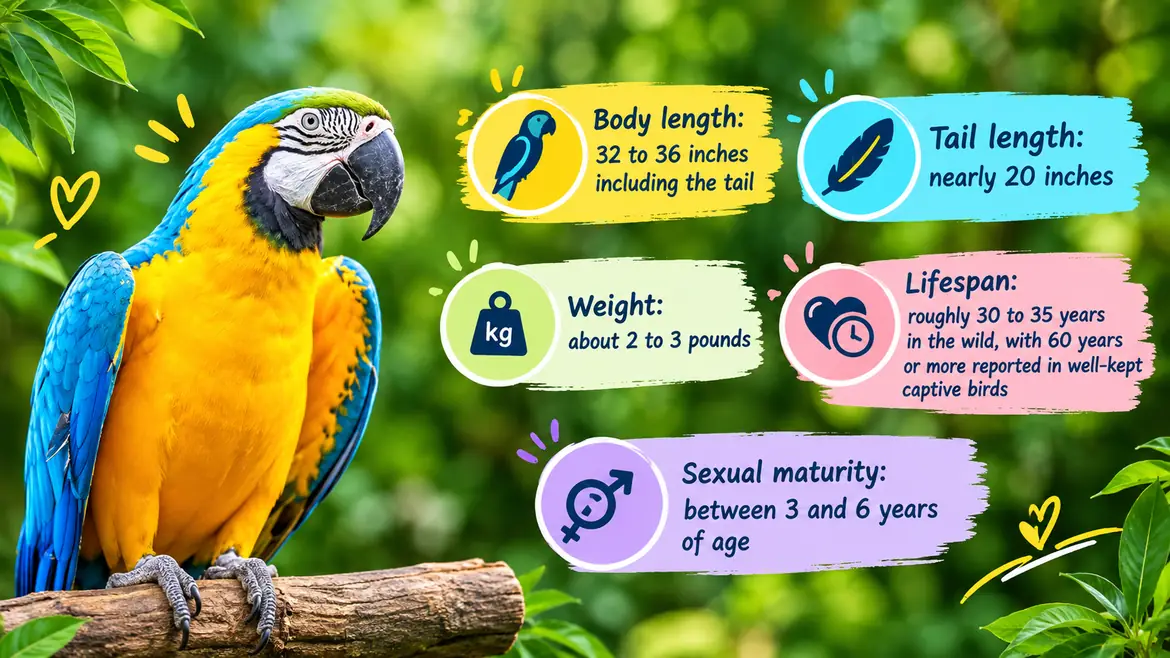
Quick facts help when comparing size, age, and long-term commitment.
- Body length: 32 to 36 inches including the tail
- Tail length: nearly 20 inches
- Weight: about 2 to 3 pounds
- Lifespan: roughly 30 to 35 years in the wild, with 60 years or more reported in well-kept captive birds
- Sexual maturity: between 3 and 6 years of age
How Big Is a Blue and Gold Macaw?
A blue and gold macaw is a large parrot measuring 32 to 36 inches (81 to 91 cm) long, with a 41 to 45 inch wingspan and a weight of about 2 to 3 pounds. Nearly 20 inches of that length is tail, so the bird looks larger than its weight suggests.
Wingspan Compared With Other Popular Macaws
Blue and Gold Macaw Wingspan sits in the middle of the large macaw range. Blue-throated macaws measure about 90 cm across, while scarlet and green-winged macaws often list slightly wider. Hyacinth macaws, the largest of all, reach 48 inches or more.
Figures from zoo and reference sources show how the main large species compare, though exact ranges differ slightly between publications.
| Macaw | Wingspan | Body length |
| Blue and gold | 41 to 45 in (104 to 114 cm) | 32 to 36 in |
| Scarlet | 44 to 47 in (112 to 120 cm) | 29 to 37 in |
| Green-winged | 41 to 49 in | 35 to 37 in |
| Hyacinth | 48 to 56 in (120 to 140 cm) | About 39 to 40 in |
Overlap between species shapes housing advice in several ways:
- Grouping: many cage guides place blue and gold, military, and green-winged macaws in one size class
- Extra room: hyacinth macaws need noticeably more space because of extra width and a longer tail
- Real measurements: ranges above are approximate, so an individual bird’s actual size should guide the final cage choice
Blue and Gold Macaw Cage Size and Space Needs
Blue and Gold Macaw Wingspan is the starting point for every housing decision, because a bird should stretch and flap without hitting bars. Retail and care guides commonly cite a minimum of 36 inches wide, 48 inches deep, and 60 inches tall for large macaws. Bar spacing of about 1 to 1.5 inches is also widely listed.
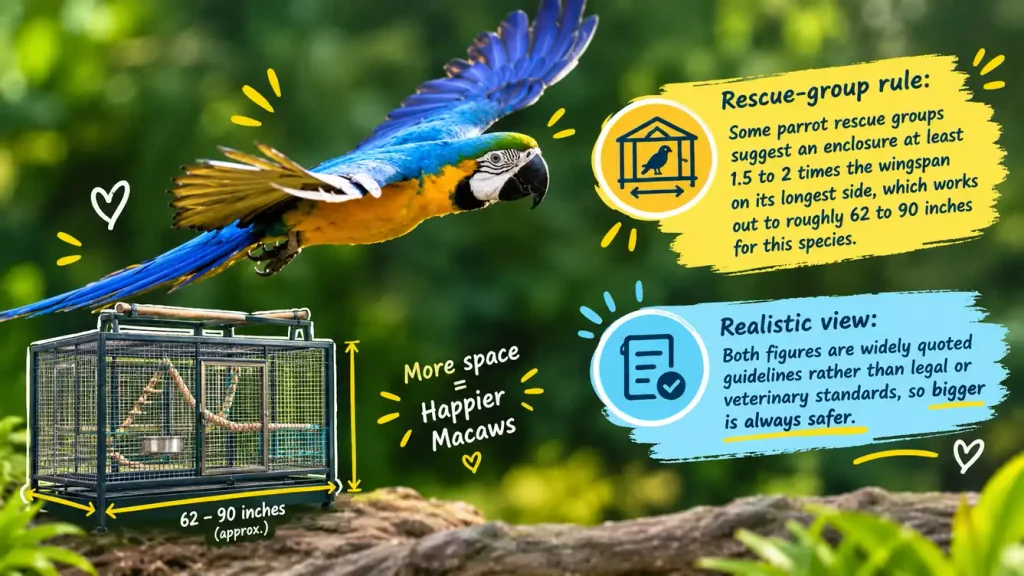
Two further points add context to those numbers:
- Rescue-group rule: some parrot rescue groups suggest an enclosure at least 1.5 to 2 times the wingspan on its longest side, which works out to roughly 62 to 90 inches for this species
- Realistic view: both figures are widely quoted guidelines rather than legal or veterinary standards, so bigger is always safer
A compact checklist keeps the main housing figures in one place.
| Housing detail | Common guideline |
| Retail minimum | 36 in W × 48 in D × 60 in H (about 91 × 122 × 152 cm) |
| Rescue-group rule of thumb | 1.5 to 2 times wingspan on the longest side (about 62 to 90 in, or 157 to 229 cm) |
| Bar spacing | About 1 to 1.5 in (2.5 to 3.8 cm) |
| Cage material | Strong, chew-resistant metal with a non-toxic finish |
| Extra space | Play stand or bird-safe room for daily supervised time. |
Cage space cannot replace time outside the cage. Daily supervised time on a play stand or in a bird-safe room gives the wings real exercise. Placement and safety tips make the setup work better:
- Keep the cage away from kitchen fumes, because nonstick cookware (PTFE) fumes can seriously harm birds
- Add perches of different widths to protect foot health
- Offer sturdy, chewable toys, since macaw beaks quickly destroy weak materials
- Switch off ceiling fans and close windows before out-of-cage time
What Size Cage Does a Blue and Gold Macaw Need?
A common minimum is 36 inches wide, 48 inches deep, and 60 inches tall, with bar spacing near 1 to 1.5 inches. Larger is better, since the bird must stretch its wings and keep its tail clear of the floor and walls. Daily time outside the cage remains essential.
Care, Health and Ownership Notes for a Large Macaw
Blue and Gold Macaw Wingspan also raises household safety issues, since wide wings can strike ceiling fans, windows, and hot cooking areas. Diet matters too. Wild birds feed on seeds, fruits, nuts, and berries, while captive birds can develop nutritional gaps if the menu stays narrow or repetitive.
Health basics deserve attention from the first week:
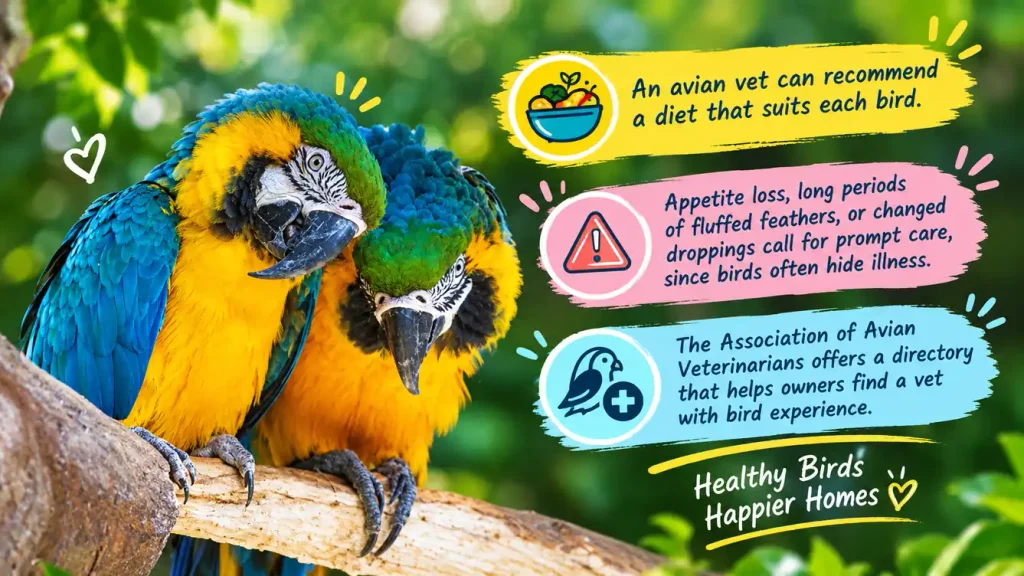
- Feeding plan: an avian vet can recommend a diet that suits each bird
- Warning signs: appetite loss, long periods of fluffed feathers, or changed droppings call for prompt care, since birds often hide illness
- Finding help: the Association of Avian Veterinarians offers a directory that helps owners find a vet with bird experience
Responsible buying matters as well. The International Union for Conservation of Nature lists the species as Least Concern, yet the Cornell Lab of Ornithology notes that numbers are declining across much of its range because of hunting and the collection of young birds for the pet trade. Choosing a legal, reputable source supports healthier birds and protects wild populations.
Points worth checking before bringing one home:
- Space: room for a large cage plus daily safe out-of-cage time
- Noise: loud, carrying calls are typical of large macaws, which matters in shared buildings
- Lifespan: a long-lived bird may outlive its owner, so a long-term plan is needed
- Cost: purchase price varies by seller and region, and food, vet care, and a big cage add ongoing expenses
- Rules: laws on owning, selling, and moving parrots differ by country and state, so local rules come first
Macaw Size and Care: What to Check Before You Decide
Wingspan is the number that shapes everything else, and adult birds measure about 41 to 45 inches, or 104 to 114 cm, from tip to tip. Size, length, and weight fill in the rest of the picture, with 32 to 36 inches of body length and roughly 2 to 3 pounds. Comparisons with scarlet, green-winged, and hyacinth macaws place the species in the middle of the large group. Cage size guidelines start near 36 by 48 by 60 inches, although larger space is safer.
Daily time outside the cage matters just as much as the enclosure itself. Care, health, and ownership points such as diet, fan safety, avian vet access, lifespan, and legal sourcing complete the decision. Careful planning now protects a bird that may live for decades. Measure the space, check the rules, and choose a bird only when the home can truly fit it.
Frequently Asked Questions
How many feet is a blue and gold macaw’s wingspan?
An adult wingspan of 41 to 45 inches equals roughly 3.4 to 3.75 feet, or about 104 to 114 cm.
How long does a blue and gold macaw live?
Wild birds live roughly 30 to 35 years, while well-kept captive birds have been reported to reach 60 years or more.
Is a blue and gold macaw bigger than a scarlet macaw?
Both species are close in size. Blue and gold macaws measure 32 to 36 inches long, while scarlet macaws range from about 29 to 37 inches, and sources differ slightly on exact wingspan.
Can a blue and gold macaw live in an apartment?
Possibly, but only when the home fits a large cage, allows daily time outside it, and tolerates loud calls. Space and noise are the main limits, so an honest check before buying is wise.
Are blue and gold macaws endangered?
The species is listed as Least Concern, although numbers are declining across much of its range because of hunting and the collection of young birds for the pet trade.