

Senegal Parrot Lifespan averages 25 to 30 years when the bird gets a balanced diet, regular exercise, and routine vet checkups. Genetics play a role too, but daily habits matter more than luck in most cases. Wild Senegal parrots often live shorter lives because of predators, disease, and food shortages, while pet birds benefit from steady meals and a safe home. Studies on this species remain limited, so exact numbers vary between sources, yet the general range stays consistent across avian vet reports.
Owners who understand the Senegal Parrot Lifespan can plan better for the bird’s long-term needs, from housing size to social interaction. A parrot bought as a young adult may still be part of the family decades later, well into a person’s own retirement years. This long commitment is why breeders and vets urge new owners to research care requirements fully before bringing one home.
How Long Do Senegal Parrots Live? A Look at Senegal Parrot Lifespan
Most sources place the typical range between 20 and 30 years with good care. Individual birds can fall outside that window because genetics, early nutrition, and housing all leave a mark. Claims of 40 or 50 years circulate online, yet such cases are rarely documented, so planning around 25 to 30 years is the honest approach.
Compared with macaws and cockatoos, which can outlive their owners, Senegals sit in the middle. Adopting one still means a commitment that may span house moves, career changes, and family milestones.
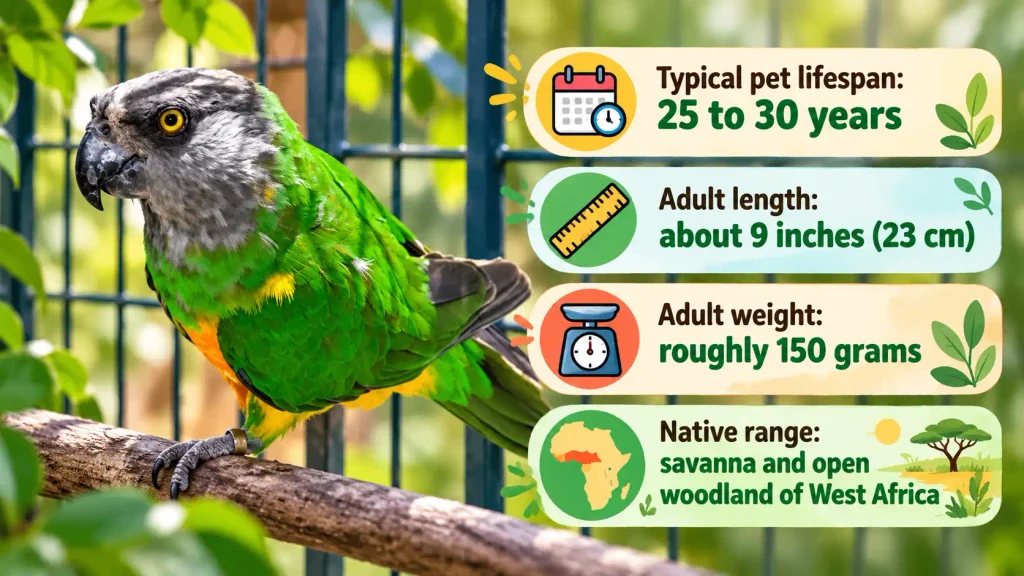
Quick facts help set the scene:
- Typical pet lifespan: 25 to 30 years
- Adult length: about 9 inches (23 cm)
- Adult weight: roughly 150 grams
- Native range: savanna and open woodland of West Africa
What Is the Average Lifespan of a Senegal Parrot?
The average lifespan of a Senegal parrot in captivity is about 25 to 30 years, although some references list 20 to 25 years. Wild birds appear to live shorter lives because of predators, food shortages, and disease, but exact wild figures are poorly documented.
Senegal Parrot Life Expectancy
Life expectancy describes what a typical bird can reasonably reach, not what any single bird will get. Few long-term studies follow individual Senegal parrots from hatching to death, which explains why figures differ. The World Parrot Trust, a nonprofit focused on parrot welfare and conservation, lists longevity at 20 to 25 years, while many aviculture sources report 25 to 30.
The table below compares the ranges most often cited and shows how reliable each one is.
| Setting | Commonly cited range | Reliability |
| Well-kept pet | 25 to 30 years | Widely repeated |
| Conservative reference | 20 to 25 years | Cautious species-level figure |
| Exceptional captive bird | Up to 50 years | Mostly anecdotal |
| Wild bird | About 10 to 25 years | Estimates vary; data is thin |
Because these ranges overlap, planning for 25 years while hoping for more is sensible. Quality of life matters as much as age, so a few routines belong in every plan:
- Weekly weight checks
- Yearly avian vet exams
- Daily enrichment and social time
Senegal Parrot Lifespan in Captivity
Captive birds gain steady food, shelter, and veterinary care, which explains why pets usually outlive wild relatives. Fresh food and clean water every day, protection from predators and harsh weather, faster treatment when illness appears, and daily social contact and enrichment all give pet birds a real edge over their wild counterparts. But captivity still carries risks that owners must manage carefully. Boredom and too little social contact can wear down a bird’s mental health over time, while obesity from fatty seeds and treats remains one of the most common diet-related problems avian vets see.
Airborne toxins, including fumes from nonstick cookware, pose a hidden danger since a parrot’s respiratory system is far more sensitive than a human’s. Cages too small for climbing and wing stretching add physical strain that shortens both comfort and lifespan. Owners who balance these advantages against the risks give their Senegal parrot the best chance at a long, healthy life.
Senegal Parrot Lifespan in the Wild
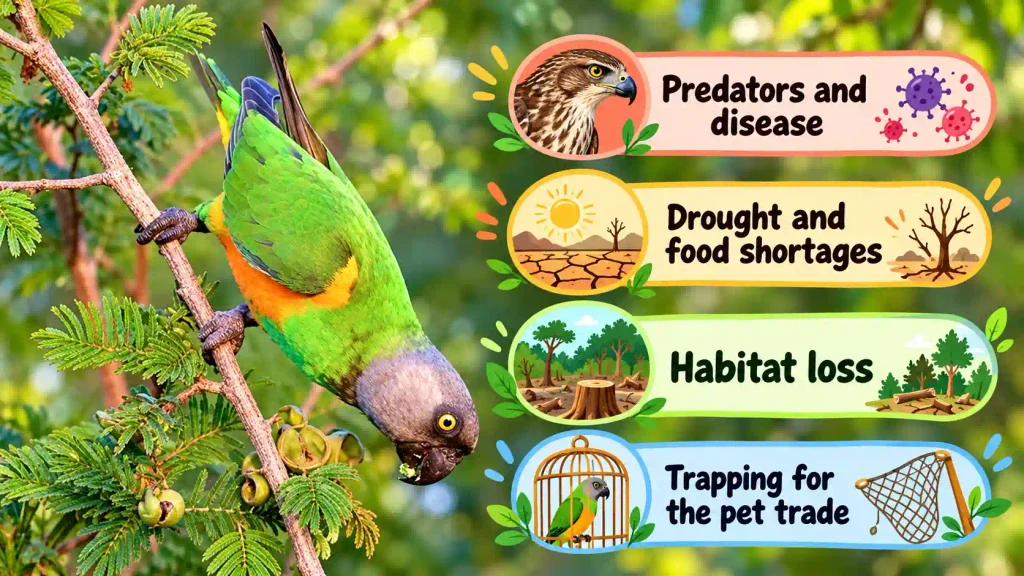
Wild Senegal parrots live across the savanna and open woodland of West Africa, nesting in tree cavities and eating fruit, seeds, and flowers. Published estimates of wild lifespan range from about 10 to 25 years, but solid field data are thin. Main threats include:
- Predators and disease
- Drought and food shortages
- Habitat loss
- Trapping for the pet trade
The International Union for Conservation of Nature classifies the species as Least Concern, although the population trend appears to be decreasing. Wild-caught birds rarely settle well as pets, so captive-bred birds are the more responsible choice.
How to Increase Senegal Parrot Lifespan
Small daily habits add up over 25 years. Avian vets generally recommend formulated pellets as the base diet, with fresh vegetables, some fruit, and limited seeds or nuts as treats, because all-seed diets tend to cause vitamin gaps and weight gain.
- Rotate leafy greens, carrots, peppers, and cooked sweet potato through the week.
- Change water daily and wash food bowls every day.
- Offer foraging toys, chewable wood, and daily time outside the cage in a bird-safe room.
- Provide 10 to 12 hours of dark, quiet sleep each night.
- Weigh the bird weekly on a gram scale, since weight loss can be an early warning.
- Keep smoke, aerosol sprays, scented candles, and nonstick cookware away from the bird.
- Avoid avocado, onion, chocolate, caffeine, and alcohol completely.
- Choose a cage big enough for full wing stretches, with perches of different thicknesses.
- Rotate toys weekly to keep the mind busy.
- Practice gentle handling and training daily to build trust.
- Book a baseline avian exam soon after adoption, then repeat it yearly.
Finding a vet with real bird experience matters, because parrots hide illness until they are quite sick. The Association of Avian Veterinarians maintains a directory of member vets, and many avian vets suggest checkups once or twice a year.
What Is the Simplest Way to Help a Senegal Parrot Live Longer?
Feed a pellet-based diet with fresh vegetables, allow 10 to 12 hours of sleep, offer daily enrichment, remove household toxins, and book yearly avian vet exams. Consistent routines protect health better than any single trick or supplement.
What Affects Senegal Parrot Lifespan?
Genetics set the starting point, but daily surroundings decide how far a bird actually goes. Weak spots in one area often stress another, so a balanced routine works best. The table below pairs each major factor with the habits that help and the ones that hurt.
| Factor | Helps | Hurts |
| Diet | Pellets, vegetables, measured treats | All-seed meals, avocado, chocolate, alcohol |
| Sleep | 10 to 12 dark, quiet hours | Late nights and constant noise |
| Housing | Roomy cage, varied perches | Cramped cage, dirty perches |
| Mental health | Play, foraging, social time | Isolation and boredom |
| Air quality | Fresh, smoke-free rooms | Nonstick fumes, sprays, smoke |
| Vet care | Yearly exams, prompt treatment | Delayed care, inexperienced vet |
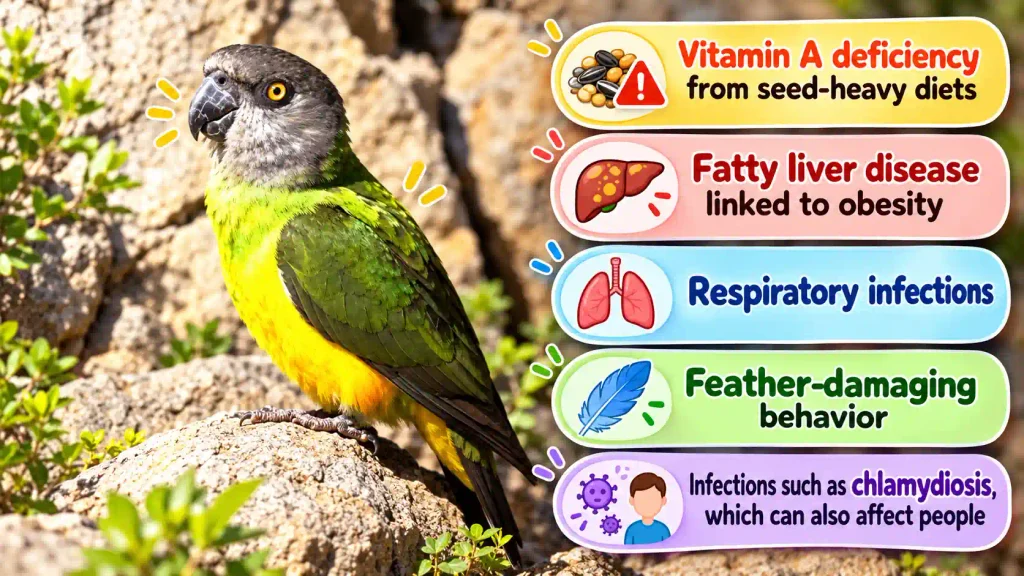
Common health problems in pet parrots include:
- Vitamin A deficiency from seed-heavy diets
- Fatty liver disease linked to obesity
- Respiratory infections
- Feather-damaging behavior
- Infections such as chlamydiosis, which can also affect people
Captive birds gain steady food, shelter, and veterinary care, which explains why pets usually outlive wild relatives. Fresh food, clean water, protection from predators and harsh weather, and faster treatment when illness appears all give pet birds a real edge. Still, captivity carries risks owners must manage: boredom from too little social contact, obesity from fatty seeds and treats, airborne toxins like nonstick cookware fumes, and cages too small for climbing and wing stretching. Balancing these advantages against the risks gives a Senegal parrot the best chance at a long, healthy life.
Old Senegal Parrot
Senegal parrots generally count as seniors after about 20 years, although aging varies from bird to bird. Arthritis, weight changes, and organ problems become more common with age, so closer monitoring pays off. Typical signs of aging include:
- Less climbing and flying, with more resting
- Stiff feet or trouble gripping perches
- Duller or more ragged feathers
- Changes in appetite or droppings
- Weight loss despite normal eating
Small adjustments make life easier for an older bird:
- Lower the perches and add wide, flat resting spots
- Keep the room warm and free of drafts
- Offer softer foods if chewing seems difficult
- Place food and water at easy perch height
- Schedule vet checkups twice a year, or as advised
Mental activity still matters at this stage, so gentle play and familiar routines keep an older bird engaged without tiring it.
At What Age Is a Senegal Parrot Considered Old?
A Senegal parrot is generally considered old at around 20 years, since that is when a typical pet enters the later part of its expected life. Some birds show senior signs earlier or later, so an avian vet exam gives the clearest picture.
Senegal Parrot Age
Age shapes both buying decisions and care plans. Key milestones include:
- Leaving the nest at about 9 weeks
- Independence around 12 weeks
- Sexual maturity between roughly 2 and 4 years, when hormones can bring nipping, screaming, or moodiness
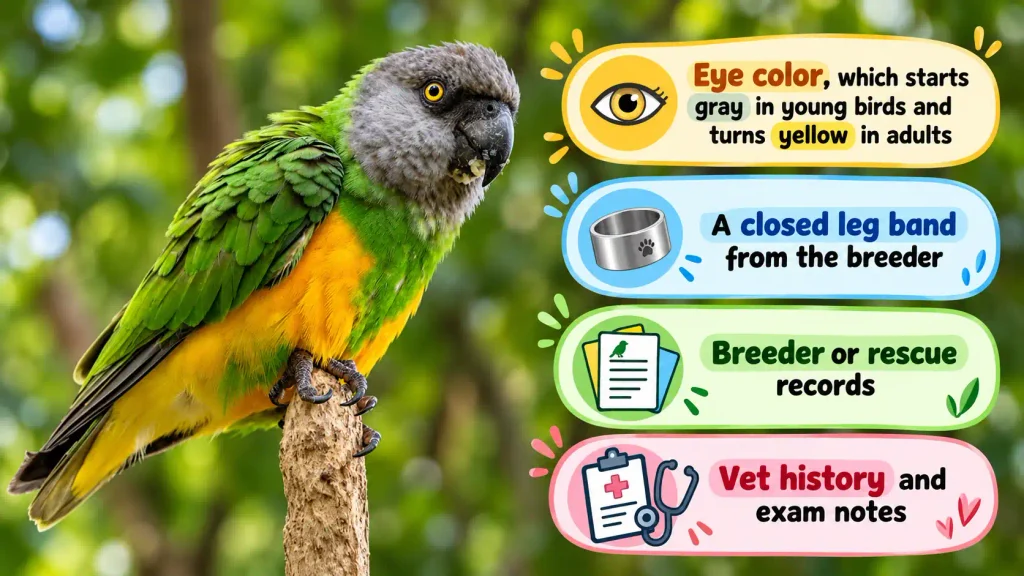
Estimating an adult bird’s age by sight is unreliable, so owners can use these clues instead:
- Eye color, which starts gray in young birds and turns yellow in adults
- A closed leg band from the breeder
- Breeder or rescue records
- Vet history and exam notes
Senegal Parrot Lifespan by Age
The table below offers a rough guide to life stages, based on the commonly cited 25 to 30-year range.
| Stage | Approximate age | Care focus |
| Chick | Hatch to 12 weeks | Warmth and expert feeding by the breeder |
| Juvenile | 3 months to 2 years | Socializing, varied foods, gentle training |
| Young adult | 2 to 5 years | Steady routines and hormone management |
| Adult | 5 to 15 years | Yearly exams, weight checks, toy rotation |
| Mature | 15 to 20 years | Closer health monitoring |
| Senior | 20 years and older | Comfort changes, twice-yearly vet visits |
Stages here are practical guidelines, not scientific categories. A bird with excellent care may age slowly, while a stressed or poorly fed bird may show senior signs early. Tracking a few basics through every stage makes changes easier to spot:
- Body weight
- Appetite
- Activity level
- Droppings and feather condition
Closing Thoughts on Senegal Parrot Care and Lifespan
Most Senegal parrots live 25 to 30 years with good care, though claims of 50 years remain unproven. Life expectancy figures differ between sources, and captive birds benefit from steady food and vet access, while wild birds face predators, drought, and trapping. Diet, sleep, housing, air quality, and mental stimulation decide how many healthy years a bird gets. Pellet-based meals, weekly weigh-ins, and yearly avian exams raise the odds of a long life.
An old Senegal parrot needs lower perches, warmth, and closer monitoring. Age stages from chick to senior explain what care looks like along the way, and leg bands, eye color, and breeder records help with estimating a bird’s age. Realistic expectations, steady routines, and a skilled avian vet give a Senegal parrot the best chance of staying a loving companion for decades.
Frequently Asked Questions
Can a Senegal parrot live 50 years?
Some reports claim 50 years, but such cases are rarely documented. Most well-cared-for birds live around 25 to 30 years, so planning for that range is more realistic.
Do male or female Senegal parrots live longer?
No reliable research shows a clear difference between the sexes. Diet, housing, and veterinary care influence longevity far more, and males and females look nearly identical.
How can you tell how old a Senegal parrot is?
Young birds have gray eyes that turn yellow in adulthood. Beyond that, a closed leg band, breeder records, or vet history give the most dependable answer.
What shortens a Senegal parrot’s life?
Poor diets, obesity, inhaled toxins such as nonstick fumes, chronic stress, and delayed veterinary care are the main preventable risks.
How often should a Senegal parrot see a vet?
At least once a year, and many avian vets suggest twice a year. Older birds or those with health problems may need more frequent visits.
How many hours of sleep does a Senegal parrot need?
Most parrots do well with 10 to 12 hours of dark, quiet rest each night, which supports steadier health and behavior.