

The Senegal Parrot is a small West African parrot known for its intelligence, affectionate personality, and relatively quiet voice. Adults are about 9 inches long, weigh roughly 120–170 grams, and can live for decades in captivity. Before buying one, prospective owners should understand its diet, cage requirements, social needs, veterinary costs, and long-term commitment.
It can learn a few words, whistles, and simple tricks, but it needs daily attention, time outside the cage, and a healthy diet of pellets, fresh vegetables, and a little fruit. Without enough social contact, it may bite or bond with only one person. A good breeder usually charges $900 to $2900, but the real cost of owning a Senegal Parrot also includes a roomy cage, vet visits, toys, and many years of your time.
Senegal Parrot Quick Overview
Poicephalus senegalus is a small African parrot from the dry wooded belt of West Africa, from southern Mauritania and Senegal east to Burkina Faso and northern Nigeria. Adults show a charcoal-grey head, a green back, and a yellow V-shaped chest patch that looks like a vest. Popularity comes from a manageable size, sharp intelligence, and a voice usually quieter than many larger parrots. The sexes look alike, so DNA testing is the only reliable way to tell males from females.
The quick facts below give a snapshot before the deeper sections.
| Quick Fact | Details |
| Scientific name | Poicephalus senegalus |
| Length | About 9 inches (23 cm) |
| Weight | Roughly 120 to 170 grams |
| Captive lifespan | Often cited as 25 to 30 years; some specialists suggest 15 to 20 |
| Native range | Dry belt of West Africa |
| Wild status | Least Concern, with a decreasing population trend |
Senegal: Lifespan and Life Stages
Captive lifespan is often quoted at 25 to 30 years, with a few reports of up to 40. Some avian specialists give a more cautious average of 15 to 20 years, so planning for two decades is realistic. Three points are worth knowing:
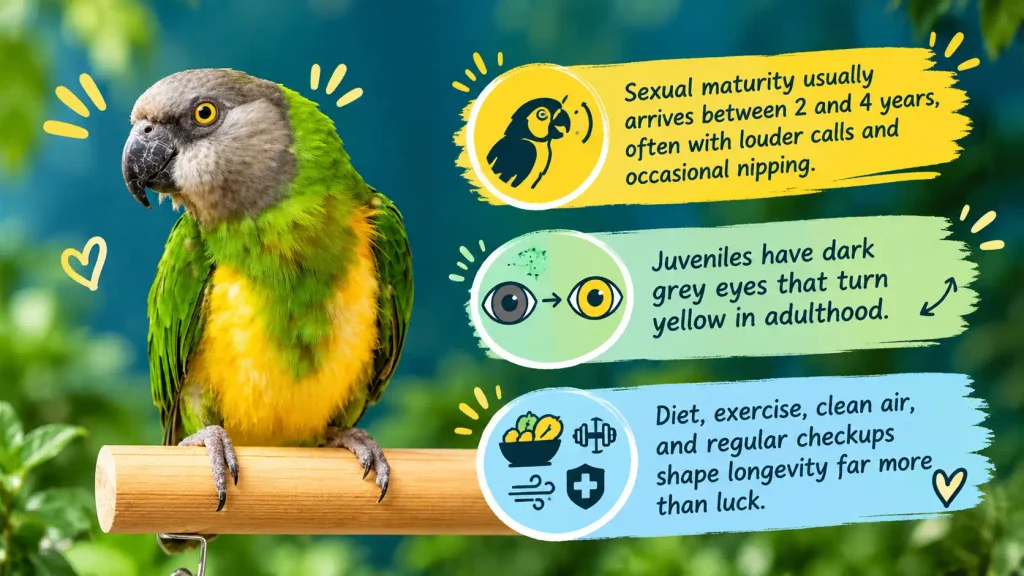
- Sexual maturity usually arrives between 2 and 4 years, often with louder calls and occasional nipping.
- Juveniles have dark grey eyes that turn yellow in adulthood.
- Diet, exercise, clean air, and regular checkups shape longevity far more than luck.
How Long Does a Senegal Parrot Live?
With good care, the species commonly lives 25 to 30 years in captivity, and a few reports reach 40. Some avian specialists suggest 15 to 20 years is a more typical average, so owners should prepare for at least two decades of feeding, vet visits, and daily attention.
Senegal Cage Size and Setup Basics
Space matters more than looks. Many retail guides list 24 x 24 x 24 inches as a bare minimum, while some avian veterinary sources point to roughly 3 x 3 x 4 feet (90 x 90 x 120 cm). Bigger is better because these birds climb, swing, and flap all day.
A few setup details protect safety and comfort:
- Natural wood perches in different thicknesses keep feet healthy.
- Zinc-free bars and stainless steel bowls help avoid metal toxicity.
- A lively, draught-free room keeps the bird included, but kitchens are risky because non-stick cookware fumes can kill birds.
- Indoor temperatures from the mid-60s to mid-80s °F suit a species from warm Africa.
- One to three hours of supervised time outside the cage daily burns energy.
What Cage Size Does This Parrot Need?
A cage of at least 24 x 24 x 24 inches with bars spaced about 1/2 to 3/4 inch apart is a common minimum, while some avian veterinary sources recommend sizes near 3 x 3 x 4 feet. Width matters more than height, since birds move horizontally.
Senegal Food and Diet Essentials
Pellets should form the base of the diet, not seeds. VCA Animal Hospitals advises pellets at 60% to 70% of daily intake, with fruits, vegetables, and greens covering roughly 20% to 40%. Seed-heavy diets are linked to vitamin A deficiency and fatty liver disease, and African parrots seem to handle calcium differently.
Rough daily proportions from veterinary guidance appear below.
| Food Group | Suggested Share | Examples |
| Formulated pellets | 60% to 70% | Species-appropriate pelleted diet |
| Vegetables, greens, and fruit | 20% to 40% combined | Leafy greens, carrots, bell peppers, squash, broccoli |
| Fruit alone | Up to 10% | Seedless apple, berries, mango, melon |
| Nuts and seeds | Small amounts | Training rewards and foraging treats |
What Should This Parrot Eat Daily?
Daily meals should be mostly formulated pellets, plus fresh vegetables, greens, and a little fruit, with nuts and seeds as treats only. Fresh water must be changed every day. Avocado, onions, chocolate, caffeine, and alcohol should never be offered.
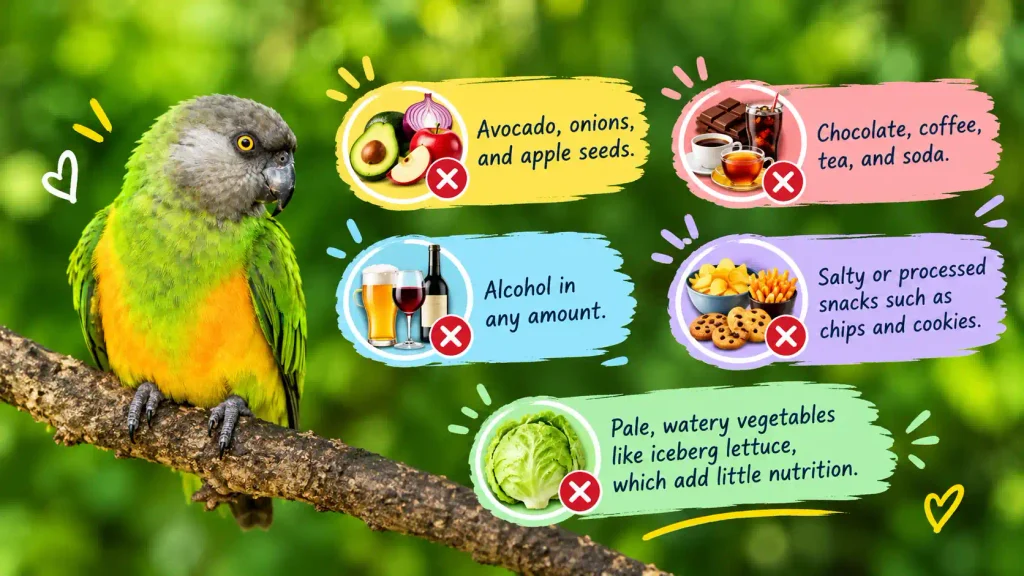
Some everyday foods are unsafe for birds:
- Avocado, onions, and apple seeds.
- Chocolate, coffee, tea, and soda.
- Alcohol in any amount.
- Salty or processed snacks such as chips and cookies.
- Pale, watery vegetables like iceberg lettuce, which add little nutrition.
Senegal Personality and Temperament
Playful, curious, and affectionate are the words used most often for Senegals. Strong bonds form with owners, and some birds pick a favorite person.
- Jealousy toward other family members can appear as nipping, so everyone should share feeding, play, and gentle handling.
- Independence runs somewhat higher than in many parrots, but daily interaction is still essential.
- Boredom often leads to screaming, feather chewing, or destructive habits.
- Cats, dogs, and other pets should never share unsupervised space with a bird.
- Homes with small children need clear rules, because sudden grabbing can lead to bites.
Senegal Size and Weight
Adults measure about 9 inches (23 cm) from head to tail tip, with a relatively large head and beak above a short, broad tail. Weight typically falls between 120 and 170 grams. Small size does not mean small needs, since a Senegal still requires a large cage, mental work, and hours of company.
- Reported averages sit around 136 grams for females and roughly 155 grams overall.
- Regular weighing on a kitchen gram scale helps catch problems early.
- Birds hide illness well, so an unexplained weight drop deserves a call to an avian vet.
- Excess weight raises fatty liver risks, especially on seed-heavy diets.
Senegal Talking and Sounds
Talking skills are decent rather than champion-level. Many birds learn a handful of words, whistles, and household sounds, though results vary from bird to bird. Volume stays lower than in many larger parrots, which suits many apartments.
Even so, contact calls and morning or evening chatter are normal. Persistent screaming usually signals boredom, loneliness, or a need for sleep. Common sounds include:
- Whistles and short melodies.
- Mimicked ringtones, beeps, and appliance sounds.
- A few words or short phrases.
- Contact calls used to locate family members.
Senegal Price and Ownership Costs
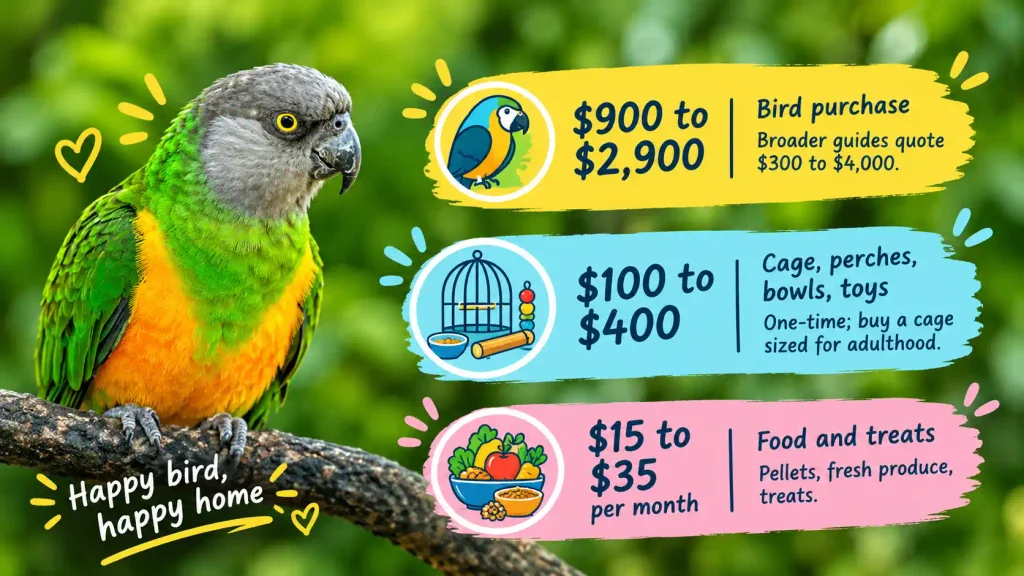
Prices swing widely depending on breeder, region, and hand-raising. Current breeder listings show a Senegal Parrot at roughly $900 to $2,900, while broader cost guides quote $300 to $4,000. Rescue adoption fees differ by organization and are worth asking about.
The table below puts purchase and upkeep costs side by side.
| Cost Item | Estimated Range (USD) | Notes |
| Bird purchase | $900 to $2,900 | Broader guides quote $300 to $4,000 |
| Cage, perches, bowls, toys | $100 to $400 | One-time; buy a cage sized for adulthood |
| Food and treats | $15 to $35 per month | Pellets, fresh produce, treats |
| Avian vet visits | Varies by clinic | Ask for a quote before booking |
Long lifespans turn small monthly costs into large lifetime totals, so a budget should include an emergency fund for avian vet care.
Senegal Daily Care Routine
Consistency makes daily care manageable. Routine matters more than perfection, and a Senegal Parrot thrives when mealtimes, sleep, and play follow a steady rhythm.
- Fresh water and pellets in clean bowls each morning.
- Fresh vegetables daily, with uneaten portions removed after a few hours.
- Regular misting or bathing to support feather health.
- Toy rotation to keep interest high.
- A quiet, dark sleep period each night, commonly about 10 to 12 hours.
- Aerosols, cigarette smoke, scented candles, and non-stick cookware fumes kept away from the bird.
- An annual wellness exam with an avian vet.
Senegal Common Health Problems
Birds hide illness until problems become serious, so a fluffed-up, quiet, or sleepy bird can already be in trouble. The Association of Avian Veterinarians maintains a directory that helps owners find a qualified avian vet before an emergency. Health issues reported in Senegals and related Poicephalus species include:
- Vitamin A deficiency, common on seed-heavy diets.
- Calcium deficiency, since African parrots seem to process calcium differently.
- Obesity and fatty liver disease.
- Aspergillosis, a fungal respiratory infection.
- Psittacosis (chlamydiosis), which can pass to humans.
- Psittacine beak and feather disease, a viral illness affecting feathers and beak.
Warning signs include weight loss, changed droppings, tail bobbing while breathing, fluffed feathers, and unusual sleepiness. Any of these calls for prompt veterinary attention rather than home treatment.
Senegal Training Basics
Positive reinforcement works best, and clicker training with small treats suits young Senegals especially well. Short, cheerful sessions keep attention high, while punishment or shouting damages trust.
- Step-up: teach the bird to step onto a hand on request.
- Target training: guide the bird toward a stick or finger with a click and reward.
- Simple tricks such as turning around, waving, or retrieving small toys.
- Early socialization to new people, toys, cages, and vet visits to reduce fear of new things.
- Body language reading: pinned pupils and a fanned tail hint at excitement or irritation, so pausing the session prevents bites.
Senegal Colors and Markings
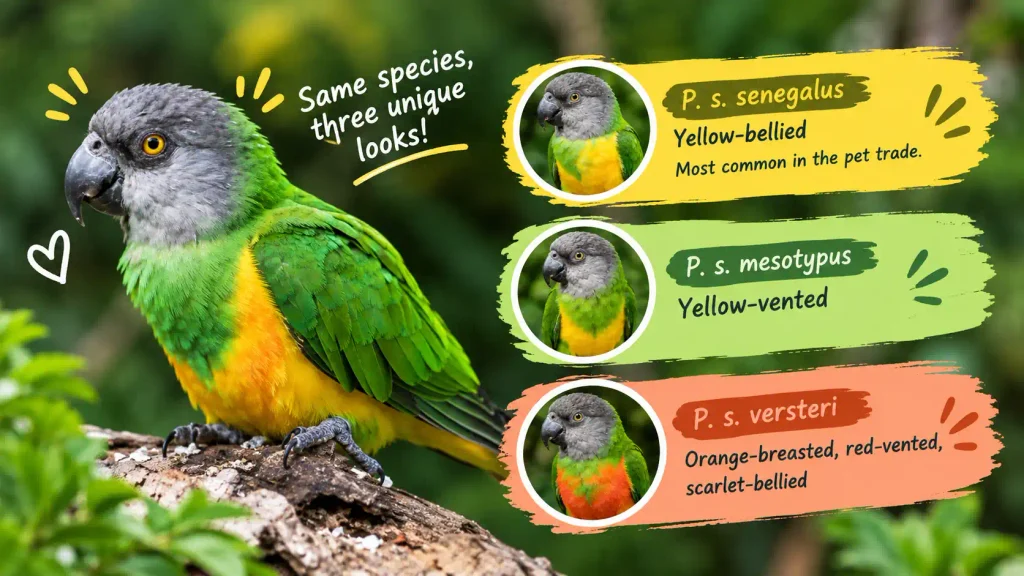
Classic coloring includes a grey head, green wings and back, and yellow to orange underparts. Adults have bright yellow eyes, while young birds have dark eyes and often more green on the chest and belly. Three subspecies exist, and belly color is the main visible difference, as compared below.
| Subspecies | Common Names | What to Notice |
| P. s. senegalus | Yellow-bellied | Most common in the pet trade |
| P. s. mesotypus | Yellow-vented | Yellow underparts |
| P. s. versteri | Orange-breasted, red-vented, scarlet-bellied | Orange to reddish underparts |
Sellers advertising unusual colors or subspecies should back the claim with breeder records.
Senegal Natural Habitat
Wild Senegals live across the dry belt of West Africa, mostly in wooded savanna, open woodland, and farmland edges. Because the climate there is warm, these birds are comfortable with indoor temperatures in the mid-60s to mid-80s °F. In the wild, they spend much of the day foraging for seeds, fruit, and blossoms, so shredding and foraging toys suit captive birds well.
Heavy trapping for the wild bird trade has also added pressure on wild populations. The IUCN Red List rates the species as Least Concern, yet its assessment notes that the population appears to be decreasing, so captive-bred birds are the responsible choice.
Senegal Adoption and Buying Tips
Rescue groups and reputable breeders both place a Senegal Parrot into new homes. Adult rescues may already know basic manners, while breeder-raised babies allow early bonding, and impulse purchases from stores often skip health screening.
- Choose captive-bred birds with documentation.
- Confirm the bird is fully weaned and eating independently.
- Look for clear eyes, smooth feathers, normal droppings, and active behavior.
- Ask about DNA sexing and health screening.
- Schedule a new-bird checkup with an avian vet soon after arrival.
- Check local rules on keeping and buying parrots.
Ownership suits patient households that can offer years of daily attention, while frequent travelers may fit better with a different species.
Choosing a Senegal Parrot Wisely
Senegals reward patient owners with decades of company, and the quick overview shows a small, intelligent West African species. Lifespan often runs 25 to 30 years, though some specialists suggest 15 to 20. Cage size should be generous, and food and diet should center on pellets with fresh vegetables and only a little fruit. Personality and temperament lean playful and loyal, while size and weight stay around 9 inches and 120 to 170 grams.
Talking and sounds include whistles, a few words, and contact calls rather than nonstop chatter. Price, care, and health problems deserve honest planning, since costs vary, routines never stop, and hidden illness needs fast avian vet attention. Training with positive rewards, the classic grey, green, and yellow colors, and the natural habitat in West Africa explain much of the behavior. Adoption from a reputable breeder or rescue, paired with patience, gives the best chance of a happy match.
FAQs
Are Senegals good pets for beginners?
Opinions differ. Some guides call Senegals beginner-friendly because of their size and moderate noise, while others rate them intermediate because of a strong will and a long lifespan.
Do Senegals bite?
Bites can happen, usually because of fear, jealousy, hormones, or rough handling. Early socialization, gentle handling, and reading body language reduce the risk.
How can male and female Senegals be told apart?
The sexes look alike, so DNA testing is the reliable method. A breeder or avian vet can arrange it.
How much time out of the cage do Senegals need?
Care guides commonly suggest one to three hours of supervised time outside the cage daily, plus regular interaction.
Are Senegals loud?
Volume is usually lower than in many larger parrots, but contact calls and morning or evening chatter are normal.
Can Senegals live with other pets?
Results vary, so introductions should be slow and supervised. Cats and dogs should never be left alone with a bird.