

The minimum Senegal parrot cage size is 18x18x24 inches, but this only works if your bird gets several hours outside the cage every day. Senegal parrots are active, intelligent birds that need room to climb, stretch their wings, and move between perches without touching the bars on both sides. If your parrot stays in the cage most of the day, a larger Senegal parrot cage size, closer to 24x24x36 inches, gives much better results for both physical health and mental well-being.
Bar spacing matters just as much as overall size: aim for 5/8 to 3/4 inch between bars, since wider gaps can trap a head or toe. A cage that is too small forces your bird to sit still for long stretches, which often leads to boredom, weight gain, and stress-related behaviors like feather plucking or loud screaming.
Understanding Senegal Parrot Cage Size Basics
Senegal parrots (Poicephalus senegalus) are compact birds, usually measuring around 9 inches from head to tail and weighing between 120 and 170 grams. Their small frame fools a lot of first-time owners into buying a cage that’s too tight for daily movement.
A bird this size still needs room to stretch both wings fully without touching the bars on either side. Cage manufacturers and avian care guides commonly reference a minimum footprint, but minimum should never be treated as ideal. Height matters just as much as width with this species. Senegals like to climb vertically along the sides of their enclosure, so a taller cage gives them more to do than a wide, shallow one.
Budget and available floor space will influence the final choice, but neither should push the decision below the safety floor. A cage that’s too small shortens the time a bird can stay inside comfortably, which then puts more pressure on out-of-cage supervision time.
What Is the Minimum Senegal Parrot Cage Size?
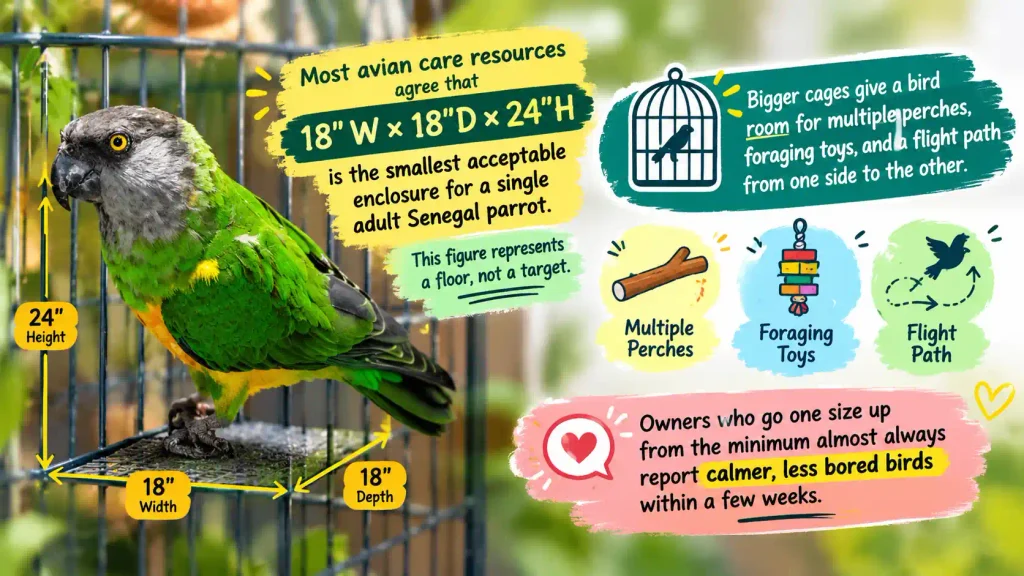
Most avian care resources agree that 18 inches wide by 18 inches deep by 24 inches tall is the smallest acceptable enclosure for a single adult Senegal parrot. This figure represents a floor, not a target.
Bigger cages give a bird room for multiple perches, foraging toys, and a flight path from one side to the other. Owners who go one size up from the minimum almost always report calmer, less bored birds within a few weeks.
Cage Dimensions and Bar Spacing That Keep Your Bird Safe
Dimensions and bar spacing work together. A wide cage with the wrong bar spacing still puts a bird at risk of getting a head or wing stuck between bars, which can cause serious injury or worse.
Horizontal bars matter more than vertical ones for this species. Senegals are natural climbers, and horizontal bars on at least two sides give them the grip they need to move around like they would in the wild.
Bar spacing recommendations vary slightly by source, generally landing between 1/2 inch and 3/4 inch, with some guides allowing up to 1 inch. Narrower spacing is always the safer choice, since it removes any chance of a head slipping through.
The table below lays out a quick reference for dimensions and spacing, useful when comparing cages online or in a pet store.
| Cage Feature | Minimum Standard | Better Standard |
| Width | 18 inches | 24–30 inches |
| Depth | 18 inches | 20–25 inches |
| Height | 24 inches | 30–36 inches |
| Bar Spacing | 3/4 inch | 1/2–5/8 inch |
| Bar Orientation | Mixed | Horizontal on 2+ sides |
Cage material affects durability just as much as size. Powder-coated steel resists a Senegal’s strong beak far better than wood or plastic components, which many birds chew through within months.
Setting Up the Cage: Placement, Perches, and Accessories
Location inside the home changes how a Senegal parrot behaves day to day. These birds bond closely with their household and tend to get anxious when isolated in a quiet back room away from daily activity.
A spot near regular foot traffic, but away from direct kitchen fumes and drafty windows, tends to work best. Kitchens carry risks beyond noise, since certain nonstick cookware releases fumes that are dangerous to birds when overheated.
Perch variety matters more than people expect. Rotating between natural wood branches of different diameters helps prevent foot problems that come from gripping the same shape over and over.
- Natural wood perches in varying thickness (avoid sandpaper-covered perches, which can irritate feet)
- At least two to three foraging toys, rotated weekly to prevent boredom
- Stainless steel food and water bowls, positioned away from perches to avoid contamination
- A secure locking mechanism, since Senegals are known for figuring out simple latches
- A washable cage liner or tray for daily cleanup

Toy placement inside the cage should leave open space for movement. Overcrowding a cage with accessories defeats the purpose of choosing a generous Senegal Parrot Cage Size in the first place.
Temperature consistency also plays a role in setup. Senegals do well at normal room temperature, but sudden drafts from air conditioning vents or open windows near the cage can stress the bird.
One Bird or Two? Choosing the Right Cage Size
Housing two Senegal parrots together changes the math on cage size considerably. A cage built for one bird will feel cramped almost immediately once a second bird moves in, even if the pair gets along well.
Bonded pairs still need personal space inside the shared enclosure. Two birds crowded onto the same few perches often leads to squabbling over food access and preferred resting spots.
Floor space should roughly double for two birds, though height doesn’t necessarily need to scale the same way. What matters more is giving each bird its own perch and its own access point to food and water, reducing daily competition.
| Setup | Recommended Minimum Size | Key Consideration |
| Single Senegal Parrot | 18″ x 18″ x 24″ | Room for full wing extension |
| Two Senegal Parrots | 30″ x 24″ x 36″ | Separate feeding stations, multiple perches |
| Breeding Pair | 36″ x 24″ x 48″+ | Nest box space, privacy zones |
What Cage Size Do Two Senegal Parrots Need?
Two Senegal parrots living together generally require a cage at least 30 inches wide, 24 inches deep, and 36 inches tall, with two separate feeding areas to reduce conflict. Anything smaller tends to create tension between birds that were previously calm on their own.
Introducing a second bird to an existing cage rarely works well without upgrading the enclosure first. A cramped shared space can undo months of bonding progress between two otherwise compatible parrots.
Travel Cages and Carriers for Senegal Parrots
Vet visits, emergencies, and short trips all call for a separate travel cage, distinct from the main home enclosure. A good travel carrier prioritizes security and visibility over floor space, since the bird only spends limited time inside.
Hard-sided acrylic or wire carriers tend to hold up better than soft-sided bags, particularly for a species known to test latches and zippers. Ventilation on multiple sides keeps airflow steady without letting the bird see too much moving scenery, which can cause stress during transport.
A single perch bar and a small, spill-resistant water cup cover most short trips. Longer travel, such as a multi-hour drive, calls for a slightly larger carrier with room for a stable perch and a covered section for a sense of security.
What Size Travel Cage Does a Senegal Parrot Need?
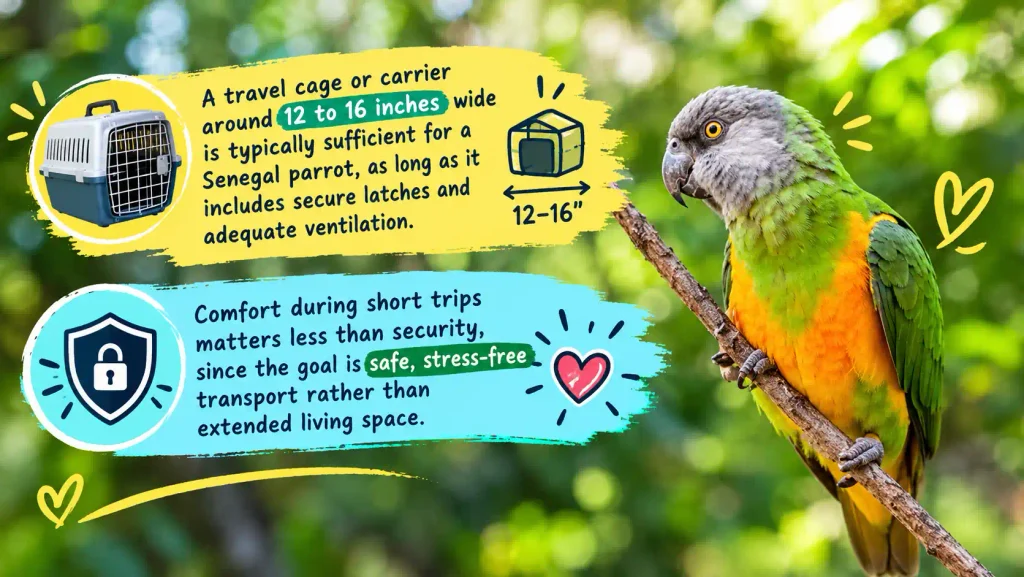
A travel cage or carrier around 12 to 16 inches wide is typically sufficient for a Senegal parrot, as long as it includes secure latches and adequate ventilation. Comfort during short trips matters less than security, since the goal is safe, stress-free transport rather than extended living space.
Cost Comparison of Senegal Parrot Cages
Prices vary widely depending on material quality, brand, and size. The following reflects typical retail ranges as of 2026, though owners should confirm current pricing with retailers since costs shift with material and shipping expenses.
| Cage Type | Typical Price Range (USD) | Notes |
| Basic minimum-size cage | $80–$150 | Suitable for short-term; upgrade recommended |
| Mid-size cage with playtop | $150–$300 | Good balance of space and cost |
| Large cage for pairs | $250–$450 | Best for two birds or active singles |
| Travel carrier | $30–$90 | Acrylic or hard-sided wire options |
Organizations such as the American Veterinary Medical Association publish general animal housing welfare guidance that owners can reference alongside species-specific cage recommendations. Checking updated pricing directly with pet retailers avoids relying on outdated figures, since costs and stock change throughout the year.
Groups like the World Parrot Trust also offer species-specific welfare resources worth reviewing before finalizing a cage purchase, particularly for housing and enrichment standards. For safety concerns tied to household hazards near bird cages, guidance from the RSPCA covers general pet housing safety that applies broadly across companion bird species.
Final Thoughts on Choosing the Right Senegal Parrot Cage Size
Choosing the right cage size shapes almost every part of a Senegal parrot’s daily comfort, from the basics of wing extension to the more detailed choices around bar spacing and horizontal climbing bars. Setup decisions like perch variety, toy rotation, and cage placement near household activity build on that foundation, while housing considerations shift noticeably once a second bird enters the picture.
Travel carriers serve a different purpose entirely, prioritizing security over space for short trips. Pricing varies by size and material, so comparing options against a bird’s actual needs, rather than settling for the cheapest option, tends to pay off in fewer behavior problems down the line.
Frequently Asked Questions
What is the smallest acceptable cage size for a Senegal parrot?
Most care guides recommend 18 inches wide, 18 inches deep, and 24 inches tall as the minimum, though larger is always better for daily comfort.
How wide should bar spacing be for a Senegal parrot cage?
Bar spacing between 1/2 inch and 3/4 inch is generally considered safe, preventing the bird’s head from slipping through.
Can two Senegal parrots share one cage?
Yes, but the cage needs to be significantly larger than a single-bird setup, ideally around 30x24x36 inches with separate feeding stations.
Do Senegal parrots need a separate travel cage?
Yes, a compact, secure travel carrier around 12 to 16 inches wide works well for vet visits and short trips.
How much does a suitable Senegal parrot cage cost?
Prices typically range from about $80 for a basic minimum-size cage to $450 for larger cages built for pairs, though checking current retailer pricing is recommended.