
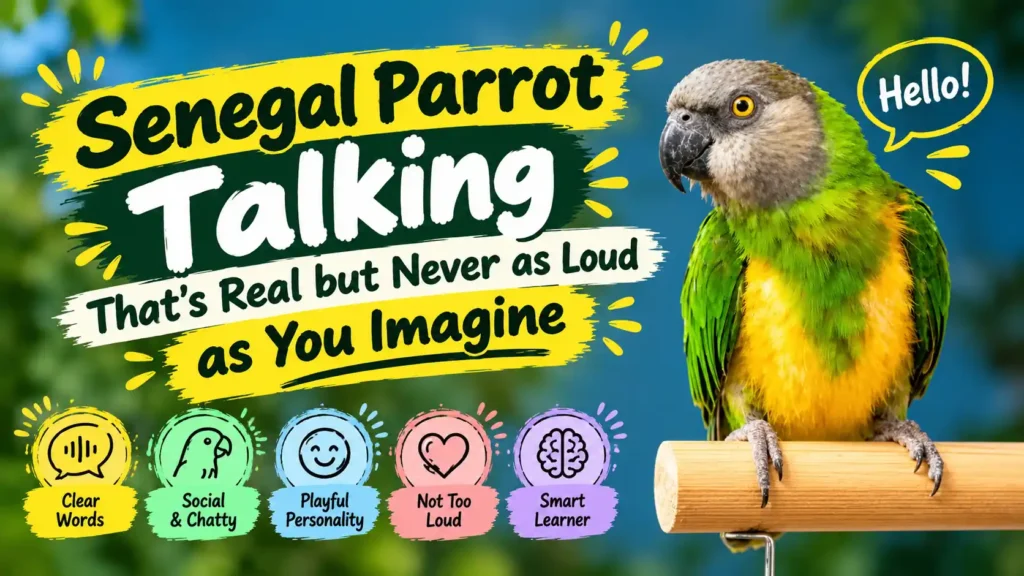
Senegal parrots can talk, but they are usually moderate talkers with soft, slightly squeaky voices. Some begin mimicking sounds at around 6 months, while first words may come later. Many learn a handful of words and household sounds, although some never develop clear speech. Personality, trust, and regular interaction all influence how much a Senegal parrot talks.
Senegal parrot talking is therefore possible, but no exact age or vocabulary can be guaranteed. A calm environment, frequent interaction, and short, positive training sessions can encourage speech without putting pressure on the bird.
Senegal Parrot Talking Ability Explained
Senegals are moderate talkers, not champions. Vocabulary usually stays modest, though a few birds surprise their owners. Wild parrots never speak human words, so pet birds copy the flock around them. At home, that flock is the family. Intelligence shows in many ways, from copying sounds to solving cage latches.
Quick facts about speaking skill:
- Voices sound soft and thin, closer to a small parakeet than a large parrot.
- Whistles and household sounds often arrive before clear words.
- Males and females show similar speaking skill.
- Hand-raised birds usually accept people more easily than wild-caught birds.
- Some birds never speak, yet still bond deeply with their owners.
Personality shapes results more than any rule. Curious, outgoing birds tend to experiment with sounds. Cautious birds may watch for weeks before trying anything.
Can a Senegal Parrot Talk?
Yes, a Senegal parrot can talk, but most stay moderate speakers. Expect a modest vocabulary plus whistles and appliance sounds. Speech sounds softer than an African Grey’s. Patience and realistic goals matter.
At What Age Senegal Parrots Start Talking
No fixed age exists for first words. Some owners report mimicry from about 6 months. Other birds wait several years before trying a word. Early, patient training gives Senegal Parrot Talking its best chance. Younger birds usually learn faster, yet older birds can still improve. Shy birds may stay quiet for a long time.
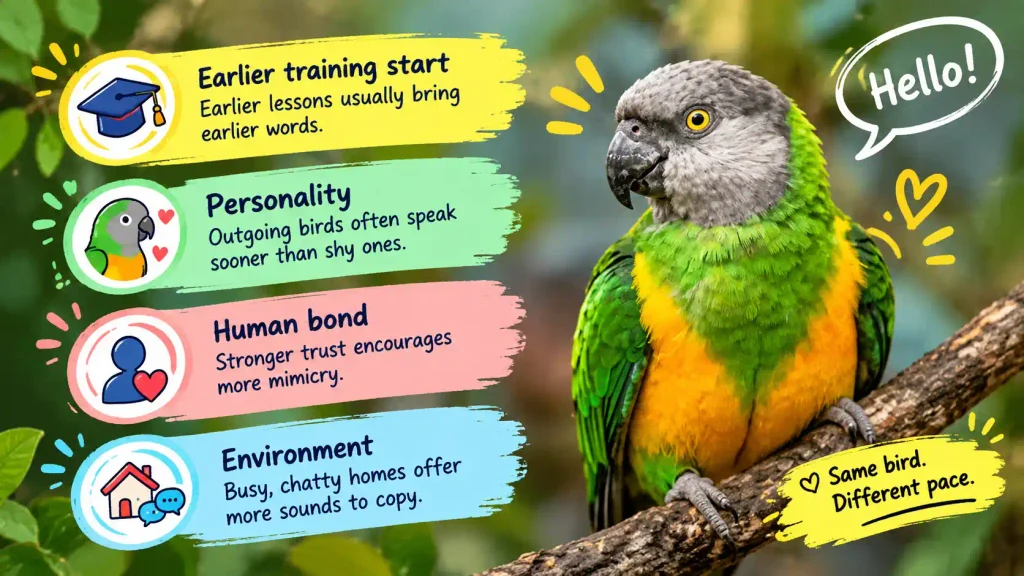
Several factors shift the timeline, so this quick table shows what matters most.
| Factor | Effect on talking age |
| Training start | Earlier lessons usually bring earlier words. |
| Personality | Outgoing birds often speak sooner than shy ones. |
| Human bond | Stronger trust encourages more mimicry. |
| Environment | Busy, chatty homes offer more sounds to copy |
| Practice | Daily repetition beats occasional long sessions. |
Simple habits encourage early mimicry:
- Talk to the bird during meals, play, and other daily routines.
- Say the bird’s name often, in a warm and steady tone.
- Whistle short tunes the bird can copy without effort.
- Keep background noise gentle, so new sounds stay easy to hear.
How Many Words Can a Senegal Parrot Learn?
Many Senegal parrots learn roughly 5 to 15 words, and a few learn more. Vocabulary depends on training, age, and bond. Household sounds such as beeps and whistles often join the list. Exact numbers vary, so treat any figure as a rough guide.
Progress rarely moves in a straight line. Birds often pause, then surprise owners with a new sound. Patience beats pressure at every stage.
Mimicking, Sounds, and Vocalizations
Natural calls include high-pitched whistles, squawks, and chatter. Wild flocks stay in touch through these sounds. Pet birds redirect that habit toward household noise. Owner reactions can reward a sound, so the bird repeats it. Body language and timing add context, so meanings never stay fixed. Family replies teach the bird that a sound gets results.
Each call type carries a different message, so a short reference helps.
| Sound | Common meaning |
| Whistles | Social contact or a happy mood |
| Chatter | Relaxed talking or flock-style bonding |
| Squawks | Alarm, boredom, or a demand for attention |
| Copied beeps | Repeated household noise learned by mimicry |
| Soft mumbling | Speech practice, often when the bird feels calm |
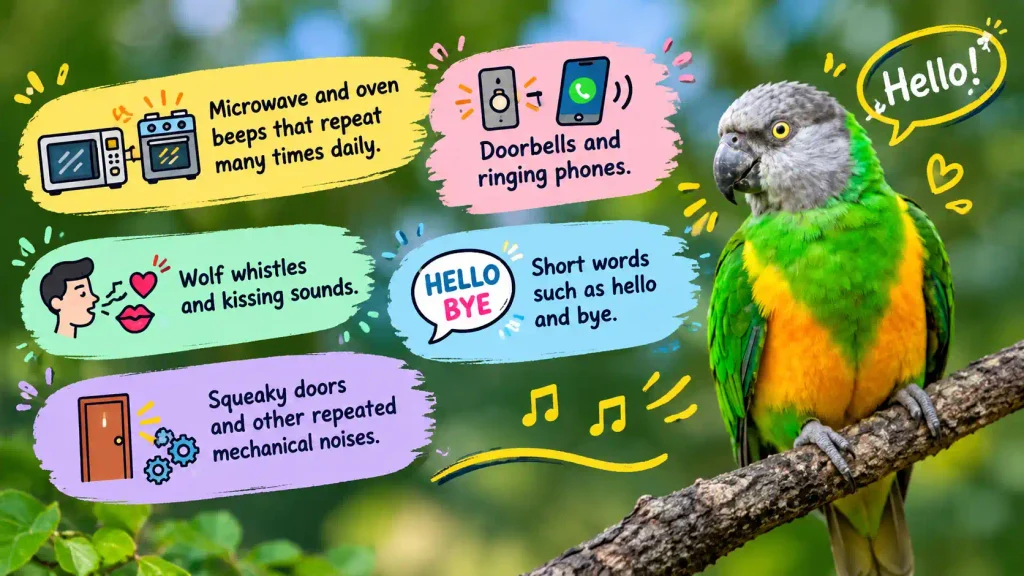
Household sounds often reported in Senegal include:
- Microwave and oven beeps that repeat many times daily.
- Doorbells and ringing phones.
- Wolf whistles and kissing sounds.
- Short words such as hello and bye.
- Squeaky doors and other repeated mechanical noises.
Mimicry also carries risks, since birds copy harsh sounds as easily as cheerful words. Owners can shape the sound library by choosing what gets repeated. Sounds worth limiting around a talking bird:
- Shouting or angry voices.
- Loud alarms or repeated sharp beeps.
- Screaming games that reward noisy behavior.
Noise Level and Daily Volume
Senegals rank among the quieter parrots. Avian sources describe them as small, fairly quiet birds. Even so, no parrot is silent. Dawn and dusk often bring louder calling. Apartment living can work with decent walls and friendly neighbors. Morning noise often follows the natural waking schedule of the flock.
Simple habits keep the volume manageable:
- Offer daily time outside the cage for play and social contact.
- Rotate toys often, since boredom can trigger squawking.
- Keep a steady sleep schedule and a quiet resting area.
- Reward calm moments with attention or a small treat.
- Ignore screaming instead of shouting back, which can become a game.
- Watch for fear triggers such as sudden movements or unfamiliar objects.
Are Senegal Parrots Loud?
No, Senegal parrots are usually quieter than macaws, cockatoos, or conures. Expect whistles and squawks, mostly around morning and evening. Boredom or fear can raise the volume. Enrichment and steady routines reduce noise, though every bird has its own voice.
Neighbors often notice pitch more than volume. High whistles can carry through thin walls. Thick curtains, rugs, and a calm daily routine soften the effect.
Speech Clarity and Favorite Words
Speech from a Senegal often sounds soft and a little squeaky. Senegal Parrot Talking improves when words stay short, clear, and repeated. Some birds mumble words that only their owner recognizes.
Clarity depends on several practical points:
- Short words with strong sounds are easier to copy.
- Hello, bye, and step up are common early goals.
- Emotional tone helps, since birds repeat sounds linked to attention.
- Some birds understand phrases before pronouncing them clearly.
- Recording sessions help owners spot faint attempts.
Understanding grows quietly. A bird may respond to step up long before saying it. Such responses show learning, even when speech stays silent.
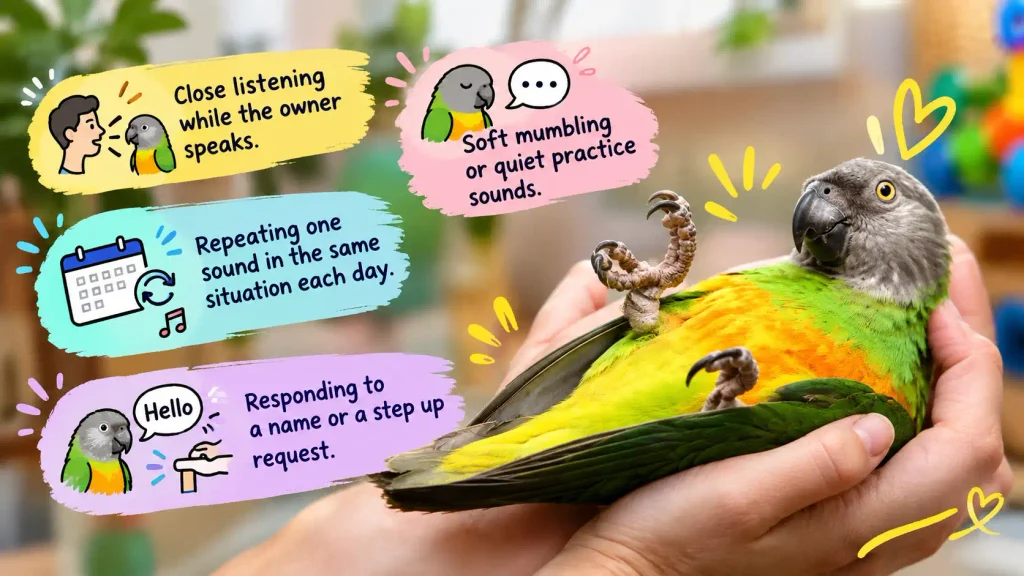
Early signs of progress often appear before clear words:
- Close listening while the owner speaks.
- Soft mumbling or quiet practice sounds.
- Repeating one sound in the same situation each day.
- Responding to a name or a step up request.
Training Tips for Senegal Parrot Speech
Training works best when sessions stay short, cheerful, and consistent. Repetition matters more than long lessons. Treats and praise keep motivation high. Start with one word and add another only after success. Older birds can learn too, though progress may feel slower.
Trust comes first, so gentle bonding should start before formal lessons:
- Offer treats from an open hand.
- Try gentle head scratches once the bird accepts touch.
- Spend calm time nearby, even without lessons.
- Respect body language and give space when the bird looks tense.
Daily Senegal Parrot Talking Practice Routine
- Choose one short word, such as hello.
- Repeat the word in a bright, steady voice.
- Keep each session to a few minutes.
- Reward every attempt, even a tiny sound.
- Stop before the bird loses interest.
- Play calm background sounds when the room is empty.
- Repeat sessions at similar times so the bird learns the pattern.
- Celebrate progress with calm praise instead of loud excitement.
Forced lessons cause stress. Silence should never be punished. A quiet bird still deserves attention, and some Senegals simply prefer whistles to words.
Senegal Parrot vs African Grey for Talking
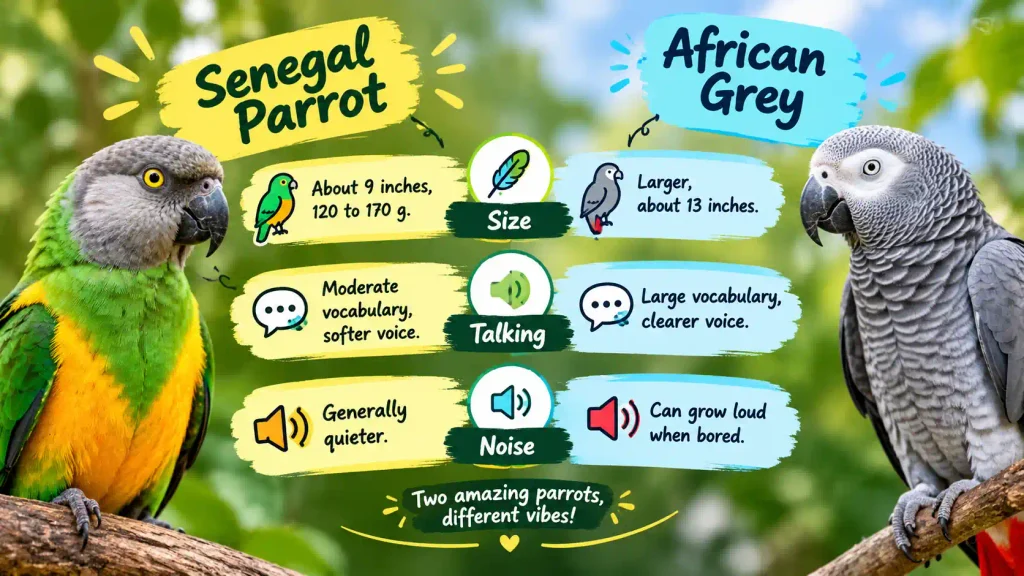
African Greys are widely regarded as top talkers with large vocabularies and clearer voices. Senegals are smaller, quieter, and usually less fluent. Greys also need more complex care and often live longer. A fair comparison depends on lifestyle, budget, and daily time. Owners who value personality over fluency often prefer a Senegal. Greys suit owners ready for intense mental stimulation. Senegals show fewer behavior problems such as plucking, though boredom can still trigger it.
Key differences show why each bird fits a different owner.
| Feature | Senegal Parrot | African Grey |
| Size | About 9 inches, 120 to 170 g | Larger, about 13 inches |
| Talking | Moderate vocabulary, softer voice | Large vocabulary, clearer voice |
| Noise | Generally quieter | Can grow loud when bored |
| Lifespan | Often 20 to 30 years | Often 40 years or more |
| Care | Moderate needs, daily interaction | High mental needs, plucking risk |
Choosing between the two depends on realistic expectations:
- Pick a Senegal for a smaller body, softer voice, and moderate speech.
- Pick an African Grey for clearer speech and a larger vocabulary.
- Expect more daily mental work and higher stress risk with a Grey.
- Accept that any parrot may speak less than hoped.
Sourcing, Health, and Legal Basics
Trust drives Senegal Parrot Talking, and wild-caught adults rarely accept people. CITES lists all parrots on Appendix II, which regulates international trade. The IUCN rates the species Least Concern. Yet declines have been reported in parts of its range.
Questions worth asking a seller:
- Is the bird hand-raised and captive-bred?
- Can paperwork prove legal origin?
- Does the seller provide a health record and feeding history?
- How old is the bird, and which sounds does it already make?
- Which foods and sleep routine has the bird followed so far?
Stress, illness, or poor sleep can silence a bird. Members of the Association of Avian Veterinarians focus on bird health. Such specialists can rule out medical causes.
Balanced meals with pellets, fresh vegetables, and small fruit portions support energy and mood. Lifespan matters too. Many Senegals live 20 to 30 years, so ownership is a long commitment.
Signs that deserve prompt veterinary attention:
- Sudden silence or low energy.
- Fluffed feathers for long periods.
- Appetite or dropping changes.
- Feather plucking, which boredom can also trigger.
Bringing It All Together
Senegal Parrot Talking works best with modest goals and steady practice. Ability stays moderate, with roughly 5 to 15 words for many birds. Age for first words varies from about 6 months to several years. Mimicking, sounds, and vocalizations show a bird that loves copying household noise.
Noise level stays lower than many parrots, though dawn and dusk calls happen. Speech clarity stays soft, so short, positive training sessions work best. African Greys win on fluency, while Senegals win on size and volume. Sourcing and health checks protect both the bird and its voice.
Frequently Asked Questions
Do Senegal parrots talk a lot?
Most do not. Senegals usually learn a modest number of words and enjoy whistles and household sounds. Individual birds vary widely.
At what age do Senegal parrots start talking?
No fixed age exists. Some birds mimic from about 6 months, while others wait years. Early, patient training helps.
Are Senegal parrots noisy?
Senegals are quieter than many parrots, yet they still call at dawn and dusk. Boredom can raise the volume.
Can a Senegal parrot talk like an African Grey?
Rarely. African Greys are known for larger vocabularies and clearer speech. Senegals usually sound softer and learn fewer words.
How do I teach a Senegal parrot to talk?
Repeat one short word daily in a cheerful voice. Reward every attempt with praise or a treat. Keep sessions brief.