
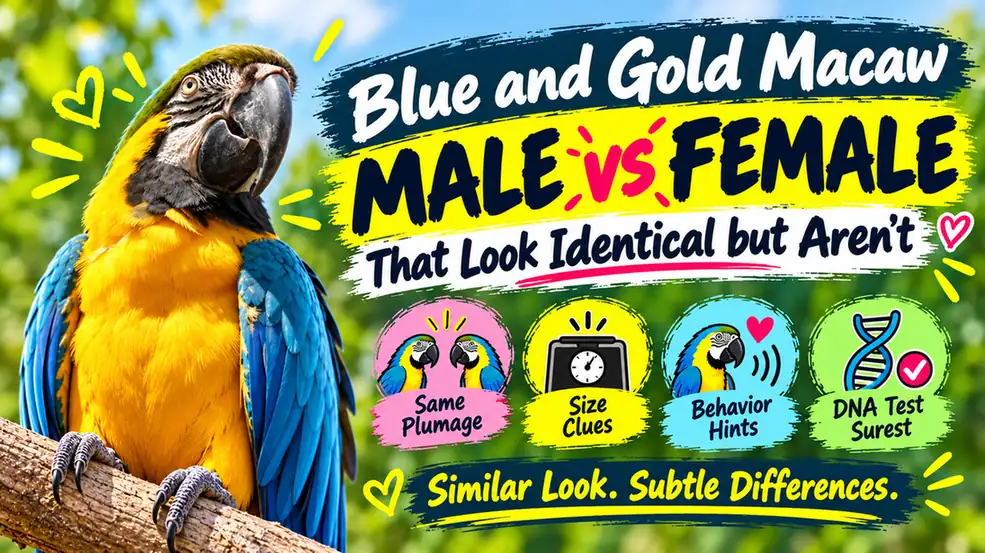
Blue and gold macaw male vs female birds look almost identical: both have a blue back, a golden-yellow chest, and a green forehead, and both weigh about 900 to 1,300 grams. Males may be slightly bigger, but the size ranges overlap too much to trust. Behavior is not a clue either, because noise, biting, and cuddling depend on training and personality, not sex.
The only reliable ways to find out are a DNA test using a few feathers or a drop of blood, or surgical sexing by an avian vet. DNA testing is safer, costs less, and usually gives results in a few days to two weeks. Knowing the blue and gold macaw male vs female answer for your bird helps you pick a name, plan a pair, and prepare for egg-laying.
Blue and Gold Macaw Male vs Female Basics
Blue and gold macaws (Ara ararauna) are sexually monomorphic, meaning males and females share the same ultramarine back, golden belly, green forehead, and white facial patch lined with tiny black feathers. Zoo and wildlife references describe adult birds of both sexes as similar in color, size, and weight. Nothing on the outside works as a built-in label.
Sex still matters in daily life, since only females lay eggs and only tested birds can be paired with confidence. Quick facts help set the scene:
- Scientific name: Ara ararauna, native to tropical South America
- Length: roughly 30 to 34 inches, including the long tail
- Lifespan: about 30 to 35 years in the wild, often 50 or more in human care
- Sexual maturity: roughly 3 to 6 years, depending on the bird
- Clutch size: 2 to 3 eggs, incubated for about four weeks
Blue and Gold Macaw Gender Differences That Are Proven
Real differences sit inside the body, not on the feathers:
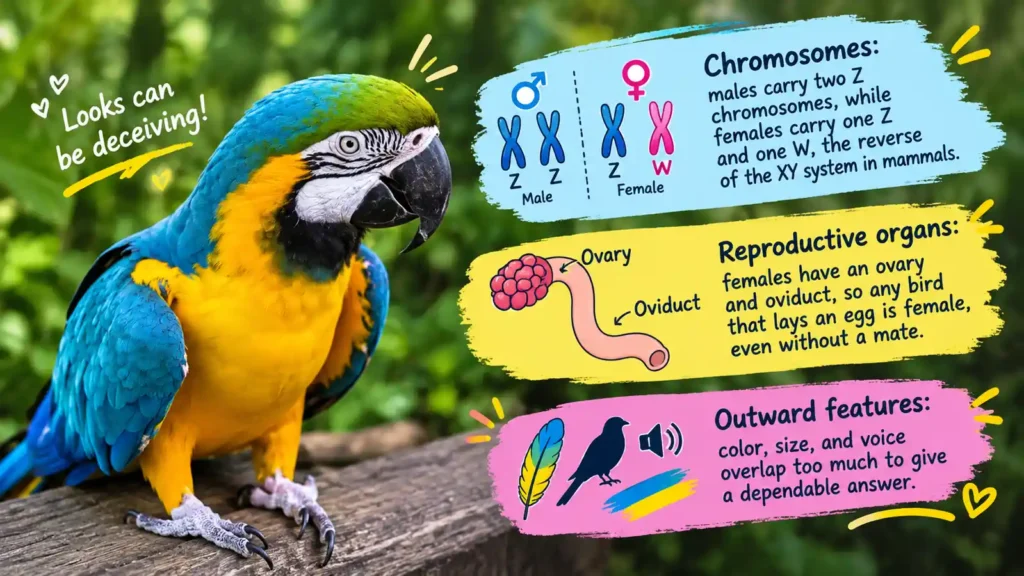
- Chromosomes: males carry two Z chromosomes, while females carry one Z and one W, the reverse of the XY system in mammals.
- Reproductive organs: females have an ovary and oviduct, so any bird that lays an egg is female, even without a mate.
- Outward features: color, size, and voice overlap too much to give a dependable answer.
Size and Weight of Male and Female Blue and Gold Macaws
Numbers help when planning your cage, perches, and food budget.
Zoo and avian references report the following adult ranges, which cover both sexes and vary by individual:
| Trait | Typical adult range | Useful for sexing? |
| Body length | 30 to 34 inches (76 to 86 cm), tail included | No |
| Wingspan | About 41 to 45 inches (102 to 113 cm) | No |
| Weight | 900 to 1,200 g (2 to 2.7 lb); some sources report up to 1,300 g | No |
| Head and beak shape | Varies from bird to bird | Unreliable |
| Eye color | Dark in youngsters, lighter with age | Shows age, not sex |
Blue and Gold Macaw Male vs Female Size and Weight Myths
Some sellers claim males have bigger, flatter heads and rounder beaks, while females look smaller with narrower beaks. Avian veterinary references, however, describe no easy guidelines for sexing birds without color differences. Each sex shows wide natural variation, so a big-headed female or a slim male is completely normal. Weighing a bird helps track health and diet, not gender, and a sudden weight drop deserves a call to an avian vet.
How to Tell if a Blue and Gold Macaw Is Male or Female
Curious whether a bird is a boy or a girl? In the blue and gold macaw male vs female debate, visual clues fail because both sexes share the same feathers, size range, and facial pattern. Even so, a few popular signs circulate in sales listings and online guides, and sorting them out prevents costly mistakes.
Can You Tell if a Blue and Gold Macaw Is Male or Female by Looking?
No. Male and female blue and gold macaws look the same in color, size, and shape, so appearance cannot reveal sex. Dependable answers come from a DNA test using blood or feathers, from surgical sexing by a vet, or from a bird laying an egg, which proves the bird is female.
Common signs that do not hold up include:
- Head shape: varies within each sex
- Beak width: overlaps too much between individual birds
- Body size: ranges match closely for males and females
- Eye color: reflects age, since young birds have dark eyes that lighten over time
- Loudness or cuddliness: shaped by handling, mood, and hormones rather than sex
Comparing the main sexing methods shows why labs have largely replaced guesswork:
| Method | How it works | Reliability | Main drawback |
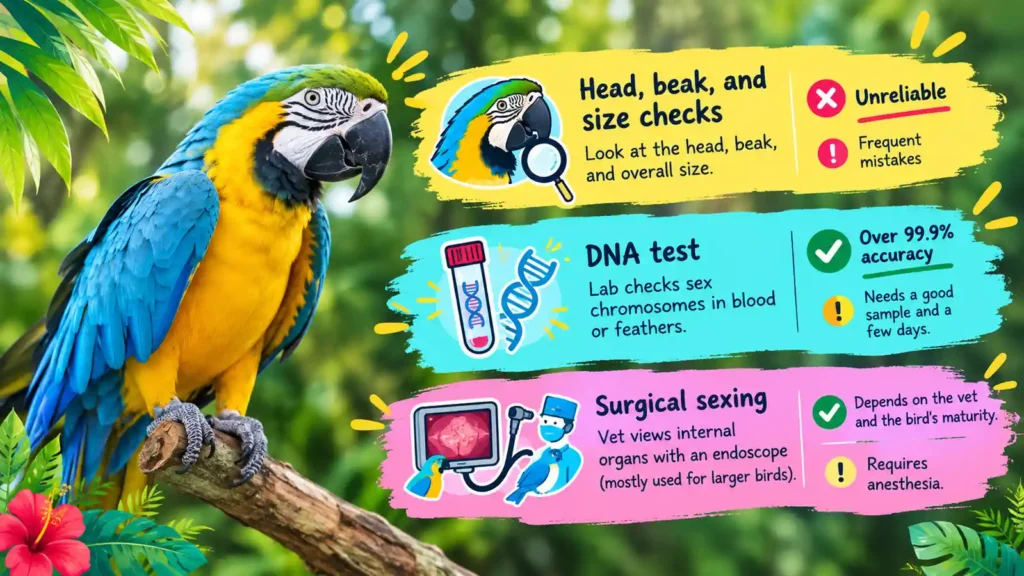
| Visual guessing | Head, beak, and size checks | Unreliable | Frequent mistakes |
| DNA test | Lab checks sex chromosomes in blood or feathers | Labs report over 99.9% accuracy | Needs a good sample and a few days |
| Surgical sexing | Vet views internal organs with an endoscope | Depends on the vet and the bird’s maturity | Requires anesthesia |
| Egg laying | Bird produces an egg | Proves female only | Cannot confirm a male |
Blue and Gold Macaw DNA Sexing
DNA sexing became the standard for monomorphic parrots because one small sample settles the blue and gold macaw male vs. female question without surgery. Labs use PCR testing to spot sex chromosome markers, and reputable labs report accuracy above 99.9%.
How Does Blue and Gold Macaw DNA Sexing Work?
A lab runs PCR testing on DNA from a blood drop, plucked feathers, or a hatched eggshell membrane to detect sex chromosomes. Males show ZZ and females show ZW. Results usually arrive within a few days to about a week, and many labs issue a certificate that can serve as proof of sex.
DNA Test Cost and Sample Options
Sample type affects both price and success rate, as this 2026 example from one online veterinary lab shows:
| Sample | How it is collected | Example price | Good to know |
| Blood | A tiny drop from a clipped toenail or a vet draw | $17.00 | Lab recommends blood because it ensures a result |
| Feathers | At least 5 small chest feathers, freshly plucked | $22.50 | Shed feathers usually fail, so resubmission may be needed |
| Eggshell | Inner membrane of a hatched egg | $25.00 | Reveals a hatched chick’s sex, and only if the membrane is intact |
Other labs and clinics price differently, so a few habits keep the process smooth:
- Book sample collection with an avian vet, since nail clipping can bleed and stress the bird. The Association of Avian Veterinarians offers a Find-a-Vet tool for locating one.
- Label each sample clearly and keep the certificate with the bird’s records.
- Ask about resubmission rules before paying.
- Request the full price first, because clinics may add exam or handling fees.

Personality and Behavior of Male and Female Blue and Gold Macaws
Owners often describe males as goofier and females as moodier, yet blue and gold macaw male vs female personality claims are opinions rather than proven rules. Early handling, daily routine, and each bird’s own nature shape behavior strongly.
Are Male Blue and Gold Macaws Friendlier Than Females?
Not reliably. Friendliness depends mostly on early socialization, handling, and each bird’s own nature, and owner opinions about male or female macaws vary widely. Hormonal seasons can make either sex louder, nippier, or more territorial, so judge behavior bird by bird instead of by gender.
Male Blue and Gold Macaw Behavior in Hormonal Seasons
Avian vets describe intense bonding, loud calls, fierce territoriality, and cavity seeking as hormone-driven behaviors in parrots generally. Adult males may show them in these ways:
- Guarding a favorite person, perch, or corner
- Screaming louder than usual
- Lunging or nipping when moods shift
A hormonal male is not being naughty on purpose, and steady routines, enough sleep, and calm training help you both through the rough weeks.
Female Blue and Gold Macaw Behavior and Nesting Urges
Nesting urges can look like this in adult females, though either sex may shred paper or seek cavities:
- Hunting for dark corners, boxes, or cabinets
- Shredding paper and other soft materials
- Laying eggs, even without a mate
Nesting spots such as boxes, tents, and cabinets can encourage this, so limiting them makes sense. Egg laying remains the only behavior that clearly points to a female.
Health, Breeding, and Buying Tips for Males and Females
Sex-related health risks weigh more heavily on females, while both sexes need regular checkups, a balanced diet, and plenty of enrichment.
Egg Laying and Reproductive Risks in Females
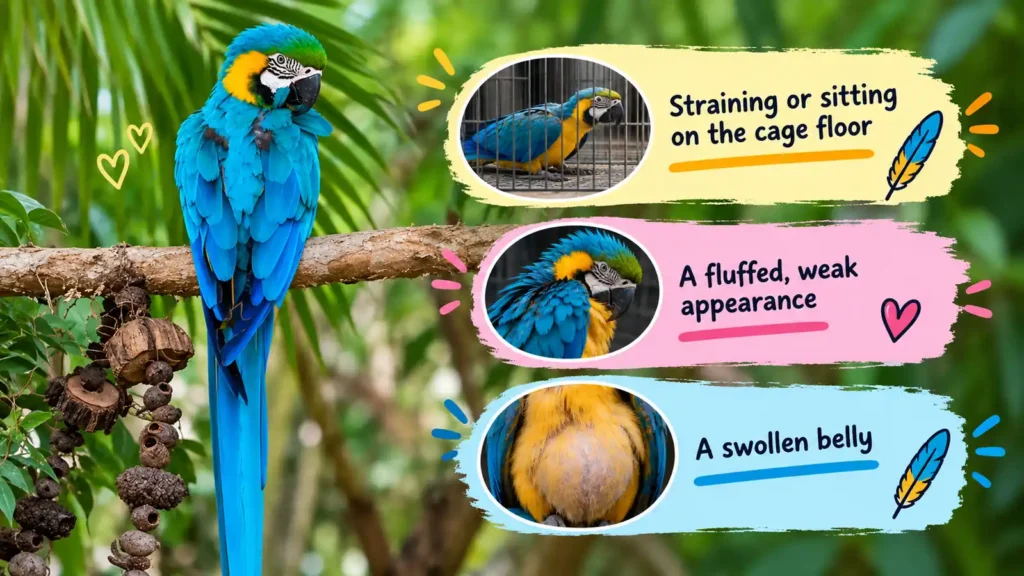
Females can lay infertile eggs without a mate, and repeated laying drains calcium and body condition. VCA Animal Hospitals notes that chronic egg layers can develop low calcium and egg binding, and that affected birds need an avian vet promptly. Warning signs need urgent care rather than home treatment:
- Straining or sitting on the cage floor
- A fluffed, weak appearance
- A swollen belly
Simple habits can lower hormonal triggers:
- Keep a steady day and night schedule with enough sleep.
- Remove nest-like hiding spots such as boxes and tents.
- Feed measured portions of a balanced diet.
- Skip calcium supplements unless an avian vet recommends them.
Buying, Pairing, and Paperwork
Buyers planning a breeding pair need DNA papers because two birds of the same sex can bond closely yet never produce chicks. Other buying facts worth knowing:
- Price: recent 2026 price guides list hand-raised blue and gold macaws from roughly $1,300 to $6,000 or more, depending on age, breeder, and documentation.
- Trade rules: international trade in the species is regulated under Appendix II of CITES, so reputable sellers can explain where a bird came from.
- Paperwork: ask for a DNA certificate, recent avian vet exam records, and proof of captive breeding before you pay a deposit.
Local rules differ, so check with a wildlife agency where you live. Personality, health, and socialization matter more than gender when choosing a companion.
Final Thoughts on Male and Female Blue and Gold Macaws
Blue and gold macaws are monomorphic, so the basics come down to one fact: outward looks cannot separate males from females. Size and weight ranges overlap almost completely, which explains why head shape and beak claims fall apart.
Reliable answers on how to tell sex come from DNA results, surgical sexing by a vet, or an unexpected egg. DNA sexing stays the easiest route, with sample options and lab prices starting around $17.
Personality and behavior follow socialization, age, and hormones more than sex, though egg-laying points only to females. Health planning, buying paperwork, and a trusted avian vet round out smart ownership. Quick answers follow in the FAQs.
Frequently Asked Questions
Are male blue and gold macaws bigger than females?
Adult males and females fall within the same reported length and weight ranges, so size cannot reliably reveal sex. Only a DNA test or surgical sexing gives a dependable answer.
Which makes a better pet, a male or a female blue and gold macaw?
Neither sex holds a proven advantage. Early socialization, daily attention, and the individual bird matter more, and both sexes can turn loud or territorial in hormonal seasons.
How much does DNA sexing cost for a blue and gold macaw?
One online veterinary lab lists $17.00 for blood, $22.50 for feathers, and $25.00 for eggshell samples. Clinics may add exam or collection fees, so ask for the full price first.
How accurate is DNA sexing in macaws?
Labs report accuracy above 99.9% when the sample is good. Poor samples, shed feathers, or mislabeled cards can cause problems, so follow the collection instructions and label carefully.
Can a female blue and gold macaw lay eggs without a male?
Yes. Females can lay infertile eggs without a mate. Repeated laying can drain calcium, so persistent laying, straining, or weakness calls for a visit to an avian vet.
At what age can a blue and gold macaw be DNA sexed?
DNA sexing does not require a mature bird, so young chicks can be tested once a usable sample is collected. Feather samples need fresh, intact shafts, while eggshell testing suits hatched eggs.