
Blue and Gold Macaw Training starts with trust, short sessions, and small food rewards. This parrot (Ara ararauna) is smart, social, and food-driven, so it learns fast when every good behavior earns a treat right away. Keep sessions short and schedule them when your macaw is naturally alert and interested in treats, and use favorite treats like walnut pieces or almonds.
Teach the step-up cue first, then move on to target training, recall, and other basic skills. Never punish or shout, because a macaw can remember fear for a long time. Reward calm behavior, ignore screaming, and use the same cues every day. With patience, Blue and Gold Macaw Training builds a strong bond that can last 50 years or more.
Blue and Gold Macaw Training and Characteristics
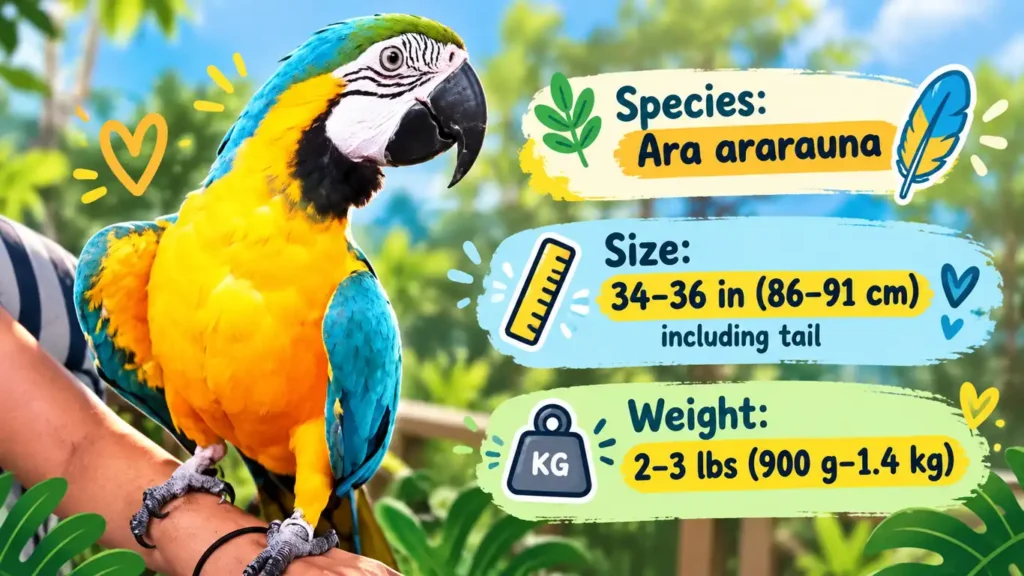
Native to forests, swamps, and gallery woodlands across Central and South America, the Blue and Gold Macaw shows a bright blue back, golden-yellow chest, and a bare white face lined with fine black feathers. Adult birds reach 34 to 36 inches beak to tail and weigh 2 to 3 pounds, among the larger commonly kept parrot species.
Highly social by nature, these macaws bond strongly with their flock, human or feathered, and often become “one-person” birds without regular exposure to different people. A few traits shape almost everything about raising and training one:
- Forms one especially deep bond, often called a “one-person bird.”
- Uses loud contact calls as normal flock communication, not misbehavior.
- Chews constantly, driven by curiosity and natural beak growth.
- Thrives on daily interaction, novelty, and mental enrichment.
The table below gathers the core facts worth knowing before a Blue and Gold Macaw joins the household.
| Category | Details |
| Species | Ara ararauna |
| Size | 34-36 in (86-91 cm) including tail |
| Weight | 2-3 lbs (900 g-1.4 kg) |
| Lifespan | 30-50 years in captivity, occasionally longer |
| Conservation Status | Least Concern (IUCN) |
| Native Range | Central and South America |
| Temperament | Social, intelligent, vocal, bond-driven |
How Blue and Gold Macaw Training Builds Trust From Day One
Trust forms the base of every successful session, since a macaw that feels safe offers behaviors far faster than one that feels cornered. Positive reinforcement, rewarding a desired action immediately, works better with macaws than correction-based methods, and certified avian behavior consultants generally recommend it as the standard approach. Blue and Gold Macaw Training that relies on force, such as grabbing a resistant bird, creates fear-based aggression that takes far longer to undo than it does to build trust from the start.
Core principles guide every session, regardless of the specific skill being taught:
- Reward immediately, within one to two seconds of the behavior.
- Keep tone calm and body language relaxed and unhurried.
- End on a successful repetition rather than a struggle.
- Stay consistent so the bird always knows what to expect.
How Long Should Each Daily Training Session Last?
Five to ten minutes per session, repeated once or twice daily, suits most macaws better than one long marathon attempt. Shorter, frequent sessions match the bird’s natural attention span and lower the risk of frustration-driven biting.
Blue and Gold Macaw Talking Training
Blue and gold macaws are highly intelligent parrots that can learn to speak human words with proper training. Talking training starts with simple, short words, such as “hello” or the bird’s own name, which are repeated clearly and consistently. Positive reinforcement is essential during training; whenever the macaw attempts to say a word, it should be immediately rewarded with a treat or praise to encourage it.
For best results, short daily training sessions are more effective than long ones, since the bird’s attention span is limited. With patience and regular practice, the macaw gradually expands its vocabulary, and many macaws even learn to speak full sentences.
Blue and Gold Macaw Recall and Leash Training
Recall training teaches a macaw to fly to an outstretched hand on cue, useful for supervised indoor flight or time in a secured aviary.
- Call the bird’s name plus a consistent cue word such as “come.”
- Reward every successful flight to the hand, even short distances.
- Increase distance gradually across several weeks, not one session.
- Practice recall only within a fully enclosed, escape-proof space.
Leash or harness training extends a macaw’s world beyond the cage, though it needs a properly fitted bird harness, never a standard leash and collar, which risks injury to the neck or wings.
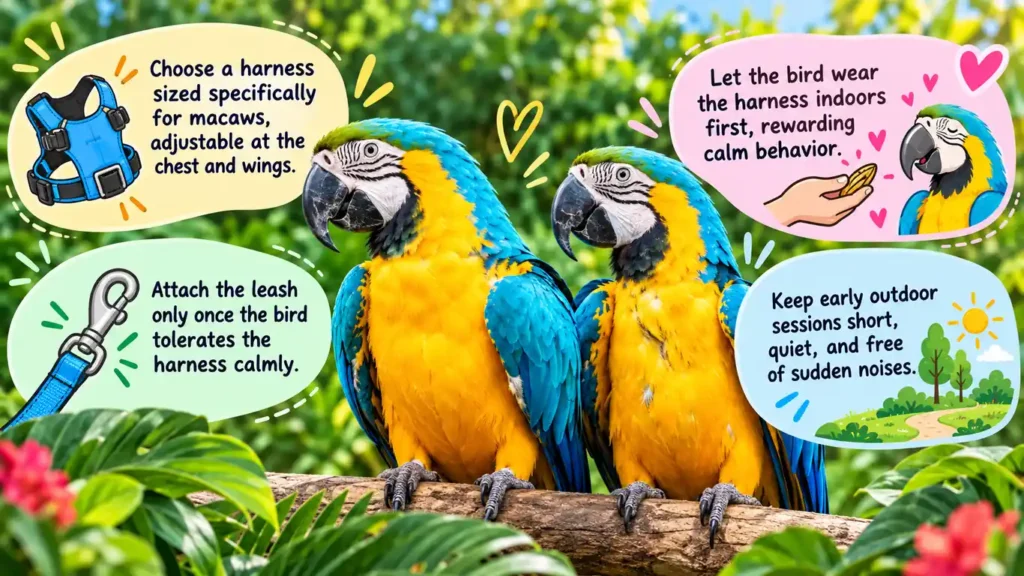
- Choose a harness sized specifically for macaws, adjustable at the chest and wings.
- Let the bird wear the harness indoors first, rewarding calm behavior.
- Attach the leash only once the bird tolerates the harness calmly.
- Keep early outdoor sessions short, quiet, and free of sudden noises.
Blue and Gold Macaw Flight Training
Blue and gold macaws are intelligent and energetic parrots that benefit greatly from proper flight training, especially for their physical and mental health. Training begins with the step-up command, where the bird learns to confidently perch on its owner’s hand without fear or stress.
Next comes recall training, where the macaw is taught to fly immediately to its owner when called, using treats and positive reinforcement throughout the process. Free-flight training outdoors is a specialized activity with substantial escape and safety risks. Regular and consistent training strengthens the bond between the macaw and its owner while also making the bird more obedient.
Blue and Gold Macaw Clicker Training
Clicker training pairs a distinct click with an immediate reward, marking the exact moment a macaw performs the correct behavior. Accuracy matters more with parrots than most pets, since a reward delivered even a few seconds late can reinforce the wrong action.
- Charge the clicker first: click, then immediately treat, repeated 10-15 times.
- Click the instant the desired behavior happens, not a moment after.
- Follow every click with a reward within one to two seconds.
- Keep sessions short, five minutes or less, to hold focus.
- Phase out treats gradually once a behavior becomes reliable.
Many trainers use clicker methods to teach targeting, where the bird touches its beak to a stick on cue, which then becomes the foundation for recall and step-up refinement.
What Age Should a Blue and Gold Macaw Start Training?
Young macaws can begin gentle handling and basic step-up work as early as a few weeks after weaning, roughly 4 to 5 months old. Older or rescued birds with no handling history can still learn, though progress usually takes longer.
Blue and Gold Macaw Behavior Training for Biting and Screaming
Biting almost always signals fear, overstimulation, or an ignored warning rather than random aggression. Reading the signs- pinned eyes, raised neck feathers, a lunging posture- lets an owner remove the bird from the trigger before it bites.
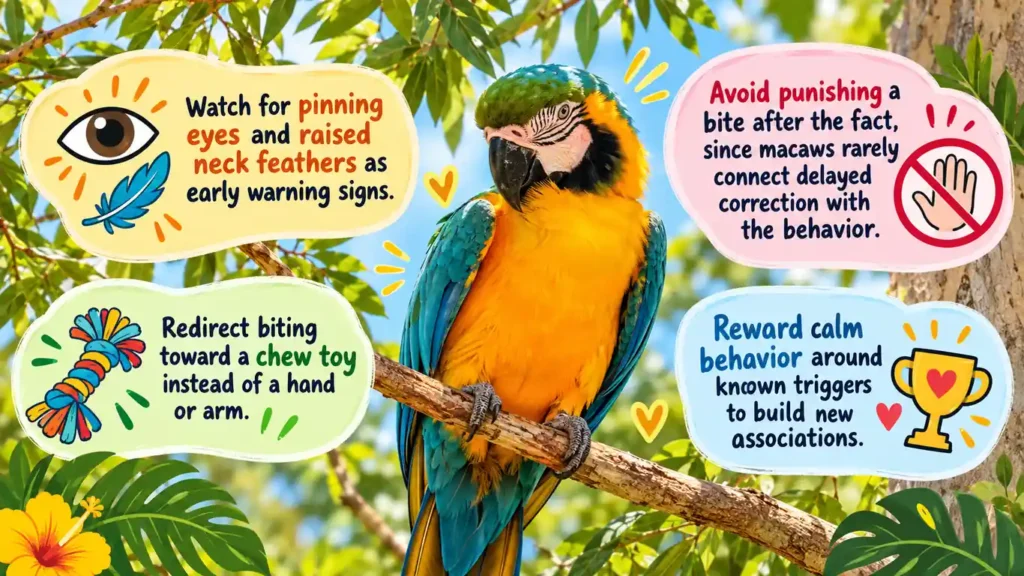
- Watch for pinning eyes and raised neck feathers as early warning signs.
- Avoid punishing a bite after the fact, since macaws rarely connect delayed correction with the behavior.
- Redirect biting toward a chew toy instead of a hand or arm.
- Reward calm behavior around known triggers to build new associations.
Blue and Gold Macaw Training Tips for Screaming and Nipping
A few practical habits make the biggest difference with these two common complaints:
- Ignore attention-seeking screaming instead of reacting with eye contact or scolding.
- Reward quiet moments with attention so calm behavior gets reinforced.
- Redirect nipping toward a toy the instant teeth touch skin.
- Consult a certified avian behavior consultant if either persists despite consistent effort.
Diet, Health, and Cost Considerations for Training Success
Nutrition affects how receptive a bird is to Blue and Gold Macaw Training, since a stressed or malnourished macaw struggles to focus. A formulated pellet base, supplemented with fresh vegetables and occasional nuts as training treats, supports both health and motivation.
The chart below breaks down which foods belong in a healthy macaw diet and which ones to avoid entirely.
| Food Group | Examples | Notes |
| Pellets | High-quality formulated pellets | Should form the base of daily intake |
| Vegetables | Leafy greens, carrots, sweet potato | Offer fresh daily; wash thoroughly |
| Fruit and Nuts | Apple, berries, walnuts, almonds | Use sparingly; great as training treats |
| Foods to Avoid | Avocado, chocolate, caffeine, salt, onion, alcohol | Toxic or harmful even in small amounts |
A handful of warning signs deserve a prompt call to an avian-certified veterinarian, since parrots instinctively mask illness until it becomes advanced:
- Feather plucking or unexplained bald patches
- Sudden, persistent, out-of-character screaming
- Reduced appetite or noticeable weight loss
- Fluffed feathers, lethargy, or sitting low on the perch
The Association of Avian Veterinarians publishes husbandry guidance that many rescues and breeders reference for nutrition and behavior standards.
Cost, Legal Considerations, and Choosing the Right Home
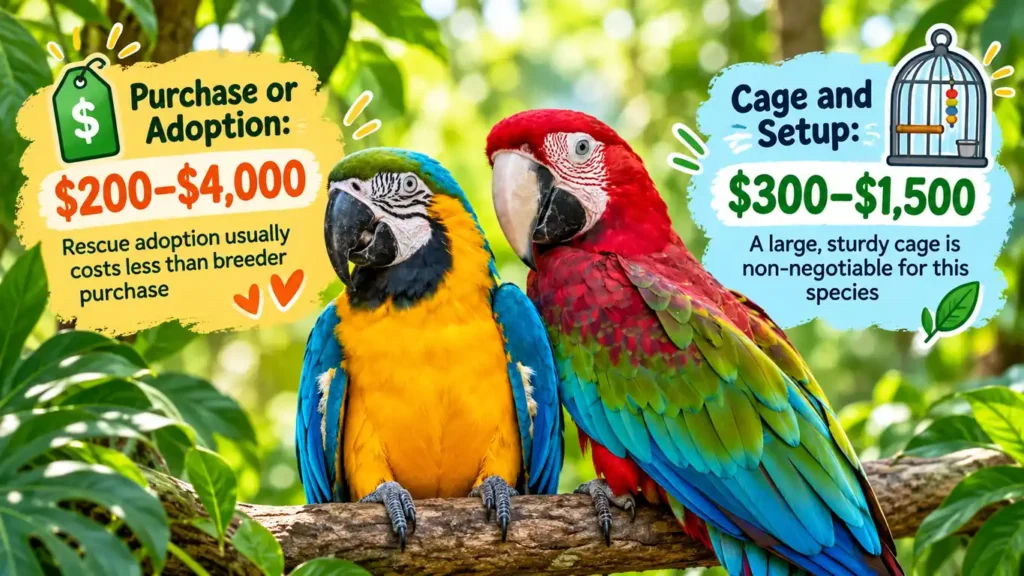
Purchase prices from a reputable breeder commonly range from roughly $1,000 to $4,000, depending on age, lineage, and location, while rescue adoption typically costs far less. Ongoing costs, food, a large cage, toys, and vet care, add up over a lifespan of 50 years.
The table below outlines the main cost categories a prospective owner should plan for before bringing a macaw home.
| Category | Typical Range | Notes |
| Purchase or Adoption | $200-$4,000 | Rescue adoption usually costs less than breeder purchase |
| Cage and Setup | $300-$1,500 | A large, sturdy cage is non-negotiable for this species |
| Monthly Food and Toys | $50-$150 | Includes pellets, fresh produce, and enrichment items |
| Veterinary Care | $100-$500+ per visit | Annual checkups plus an emergency fund are recommended |
International trade in wild-caught Blue and Gold Macaws falls under CITES Appendix II, requiring documentation, even though the species holds Least Concern status from the International Union for Conservation of Nature. A responsible breeder or rescue typically shows a few clear signs:
- Willing to share hatch or import records on request
- Offers a health guarantee and a vet reference
- Answers questions about socialization and diet openly
- Never rushes a sale or avoids paperwork
Is a Blue and Gold Macaw a Good Pet for Beginners?
Blue and Gold Macaws suit dedicated, experienced owners better than first-time pet owners, given their size, volume, lifespan, and behavioral needs. First-timers who still want one often benefit from a rescue that offers behavior support.
Bringing It All Together
Bringing a Blue and Gold Macaw home means preparing for a vivid, vocal, endlessly curious companion that can live alongside a family for decades. Knowing its natural characteristics and temperament first makes every later training step easier, since instincts explain most of its behavior.
Building trust through short, reward-based sessions lays the groundwork before any specific skill gets introduced. Step-up work creates the single most practical daily behavior, while recall and leash training extend a macaw’s world safely beyond the cage. Potty training rewards consistency, and clicker work sharpens the precision of every lesson after it. Behavior challenges like biting and screaming respond best to understanding the trigger rather than punishing the symptom.
Diet, vet care, and the real financial commitment shape how training turns out long-term, and a legal, reputable source protects both the bird and its wild relatives. Blue and Gold Macaw Training succeeds most often when it stays positive, short, and consistent from day one.
Frequently Asked Questions
How long does it take to train a Blue and Gold Macaw?
Step-up often develops within weeks of short daily sessions, while recall and behavior fixes can take several months.
Can Blue and Gold Macaws be potty trained?
Yes, most macaws learn to eliminate in a designated spot by pairing a consistent cue word with their natural elimination schedule, typically within 10 to 20 minutes of waking or eating.
Do Blue and Gold Macaws need a harness for outdoor time?
A properly fitted bird harness is strongly recommended, since an unclipped macaw can fly off in seconds, and a standard leash and collar risk injuring the neck or wings.
What is the best age to start training a Blue and Gold Macaw?
Gentle handling and step-up basics can start around 4 to 5 months old, right after weaning, though older or rescued birds can still learn with patience.
Why do Blue and Gold Macaws scream so much?
Screaming is a natural contact call used to locate flock members in the wild, and it often continues in captivity as attention-seeking behavior if reinforced with eye contact or reaction.
Are Blue and Gold Macaws good with children?
Their size, strength, and unpredictable moments make close supervision essential around young children, and most breeders and rescues recommend them for households with older children or adults.