Senegal Parrot Colors start plain and change fast in the first year. A chick hatches with pink skin and sparse gray down, and its eyes stay closed for the first two weeks. By fledging, the head and back feathers turn dark gray, and the eyes look dark brown or black. Once their eyes open, young Senegal parrots typically have very dark brown to nearly black irises. The iris gradually becomes lighter as the bird matures, eventually developing the pale yellow to yellowish adult color seen in mature birds.
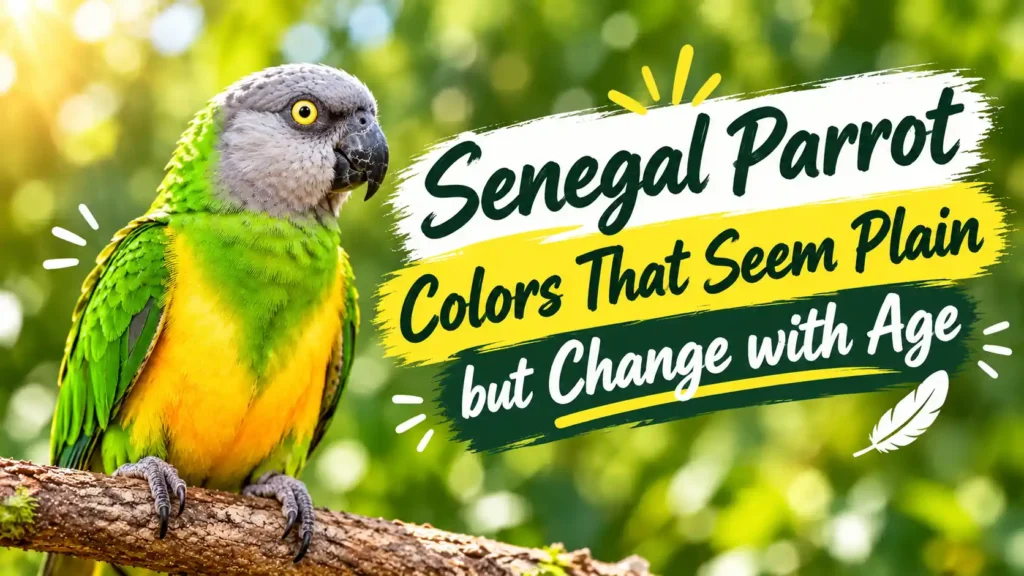
The bright green “vest” on the chest and the yellow-orange belly appear in stages, and the wings and back become a rich green with dark edges. Adults keep a soft gray hood, and the bright yellow eyes are one of the best ways to tell a mature bird from a young one. Knowing how Senegal Parrot Colors develop helps you judge your bird’s age, spot poor health early, and enjoy each stage of its growth.
Senegal Parrot Colors and Markings
Wild-type Senegal parrots follow a fairly predictable pattern, unlike many parrot species that show wide natural color variation. A gray hood covers the head, a bright green shade covers the back, wings, and tail, and the belly carries a yellow-to-orange patch shaped roughly like a V. Feather edges stay crisp and well-defined on a healthy bird, while a molting or stressed parrot often shows patchy or uneven blending between these zones. Markings stay largely symmetrical on both sides of the body, so a lopsided pattern can sometimes point to feather damage rather than a natural trait.
Quick facts worth knowing about the base pattern:
- Gray covers the crown, cheeks, and upper chest area.
- Green dominates the back, wings, and tail feathers.
- Yellow through orange fills the lower belly and thighs.
- Flight feathers often look slightly darker gray-green than the back.
- Feet and beak stay a plain gray-black regardless of body color.
What Are the Main Senegal Parrot Colors?
A healthy adult shows three main zones: a gray head and upper chest, a green back and wings, and a yellow-orange belly patch. Breeders sometimes call this the “three-band” look, and it stays consistent across nearly every wild-type bird. Small variations in shade depth exist between individual birds, but the overall three-color layout rarely changes.
Senegal Parrot Color Mutations You Might See
Standard wild-type coloring dominates the pet trade, though breeders have documented a handful of genuine mutations over recent decades. Pied Senegals show random patches of yellow or white feathers breaking up the usual gray-green pattern, and no two pied birds look exactly alike. Cinnamon mutations replace the typical black-based gray with a warmer, softer brown tone across the head and back. Blue, or parblue, mutations remove the yellow pigment from feathers, turning the usual green into shades of turquoise or soft blue.
Senegal Parrot Colors don’t stop at the standard wild-type pattern once breeders start selecting for rare traits, though these mutations remain far less common than in species like cockatiels or budgies. A table makes the differences easier to compare at a glance.
| Mutation | Typical Appearance | Rarity in Captivity |
| Pied | Random yellow or white patches over normal coloring | Uncommon |
| Cinnamon | Warm brown-gray replacing standard dark gray | Rare |
| Blue (Parblue) | Green tones shift toward turquoise or blue | Very rare |
| Lutino | Largely undocumented and unstable in this species | Extremely limited |
Buyers hoping for a specific mutation should confirm lineage with a reputable breeder, since mislabeled color names show up fairly often in casual listings. The World Parrot Trust publishes species profiles that document natural coloring and conservation status for Poicephalus senegalus, offering a useful reference point beyond hobbyist color labels.
Senegal Parrot Eye Color and What It Reveals
Iris color changes gradually as Senegal parrots mature, making it a useful but approximate clue when estimating age. Newly hatched chicks keep their eyes closed for roughly the first two weeks. After the eyes open, the iris is typically very dark brown to nearly black during the early juvenile stage. As the bird grows, the iris gradually lightens, eventually reaching the pale yellow to yellowish adult color characteristic of mature Senegal parrots. Individual birds can develop at slightly different rates, so eye color should not be used as a precise age measurement without hatch records.
Eye color is one of the clearest Senegal Parrot color clues available for guessing a bird’s approximate age when hatch records are missing. A fully mature Senegal typically shows a pale yellow to almost whitish-yellow iris by around eighteen to twenty-four months. Sudden changes in eye color outside this normal timeline, especially cloudiness or redness, warrant a visit to an avian vet rather than a wait-and-see approach.
When Do Senegal Parrots’ Eyes Change Color?
Senegal parrots begin life with their eyes closed, and once the eyes open, young birds generally have very dark brown to nearly black irises. The iris gradually lightens during juvenile development and eventually becomes pale yellow to yellowish in mature birds. The exact timing varies between individuals, so age estimates based on eye color should be treated as approximate rather than definitive.
Senegal Parrot Green, Yellow, and Orange Coloring
Three core shades define the wild-type look, and each one carries its own quirks worth understanding separately.
Senegal Parrot Green Color
Green covers the back, wings, and tail on a standard Senegal, ranging from a slightly yellowish-green to a deeper grass tone depending on the individual bird. Feather condition affects how vibrant this green appears, since poor nutrition or chronic stress tends to dull the shade over time. Healthy green feathers also carry a subtle sheen under good lighting, which fades noticeably during illness or heavy molting.
Senegal Parrot Yellow Color
Yellow fills part of the belly patch and blends into the orange tones lower on the body. Brighter, richer yellow generally reflects a diet with enough beta-carotene and other pigment-supporting nutrients. Pale or washed-out yellow, especially paired with low energy, deserves a mention during the next vet checkup rather than being brushed off as normal variation.
Senegal Parrot Orange Color
Orange typically concentrates at the lower edge of the belly patch, deepening in some individuals almost into a true orange-red. This shade often intensifies slightly with age, so a two-year-old bird may show richer orange tones than the same bird did as a yearling. Breeders and longtime keepers sometimes use orange saturation as a rough, informal way to judge a bird’s condition, though it should never replace an actual health check.
Senegal Parrot Head Color and Chest Color
Head and chest patterning sits right next to each other, but each zone carries slightly different meaning for owners watching for changes.
Senegal Parrot Head Color
A soft gray hood covers the crown, cheeks, and back of the neck on nearly every wild-type bird. This gray stays fairly stable throughout adulthood, making sudden darkening, patchiness, or feather loss around the head worth mentioning to a vet. Juvenile birds sometimes show a slightly duller, more brownish-gray head that sharpens into true gray within the first year.
Senegal Parrot Chest Color
The upper chest continues the gray from the head before transitioning into the yellow-orange belly patch lower down. This transition zone often shows the most individual variation, with some birds displaying a crisp line and others a soft gradient blend. Feather plucking, a behavior some Senegals develop under stress, frequently starts around this chest area and shows up as bare or stubbled patches.
Senegal Parrot Baby Colors and How They Change
Hatchlings arrive covered in sparse gray down, offering no hint yet of the green, yellow, or orange to come. Juvenile feathers, appearing around three to five weeks of age, come in duller and less defined than the eventual adult pattern. Senegal Parrot Colors during the first year change quickly enough to work as a rough, informal calendar for tracking a young bird’s development. Full adult plumage, alongside the final adult eye shade, typically finishes settling in somewhere between twelve and eighteen months.
| Age Range | Eye Appearance | Feather Appearance |
| 0-2 weeks | Eyes closed, no visible color | Sparse gray down only |
| 3-8 weeks | Dark brown to black | Duller juvenile feathers emerging |
| 10-14 weeks (fledging) | Dark brown to black | Full juvenile pattern, muted tones |
| 6-12 months | Gradual lightening begins | Colors deepen toward adult richness |
| 12-24 months | Pale yellow adult tone | Full adult coloring established |
Senegal Parrot Gender and Health Color Signals
Plumage alone cannot reliably confirm a Senegal’s sex, since males and females share nearly identical wild-type coloring. Reputable breeders and vets rely on DNA testing or surgical sexing rather than color guesses, and casual “color sexing” claims circulating online generally lack solid evidence.
Does Feather Color Reveal a Senegal Parrot’s Gender?
No reliable visual difference separates male and female Senegal parrots based on color alone. DNA feather or blood testing remains the accepted method for confirming sex in this species. Any breeder or seller claiming to sex Senegals purely by color should be treated with some skepticism.
Diet plays a measurable role in keeping feather color rich and consistent over a bird’s lifetime.
| Nutrient | Common Food Sources | Effect on Color |
| Beta-carotene / Vitamin A | Leafy greens, carrots, sweet potato | Supports vibrant yellow and orange tones |
| Omega-3 fatty acids | Flaxseed, unsalted walnuts | Supports feather sheen and quality |
| Quality protein | Formulated pellets, limited seed mix | Supports strong feather regrowth after molting |
- Avocado, chocolate, caffeine, and salty snacks remain unsafe for parrots and should never be offered.
- Seed-only diets tend to leave feathers duller and less vibrant over time.
- A vet-approved pellet base with fresh produce generally supports the best long-term color and condition.
Owners unsure about a diet plan can ask an avian vet listed through the Association of Avian Veterinarians for guidance tailored to their bird’s age and health history.
Anyone buying or importing a Senegal parrot should also confirm paperwork lines up with CITES regulations, since Poicephalus senegalus is listed under Appendix II for international trade oversight.
Senegal Parrot Colors: A Quick Recap
Senegal Parrot Colors tell a fairly complete story once the basic pattern becomes familiar, starting with the gray hood, green back, and yellow-orange belly that define the wild-type look. Markings stay mostly symmetrical on a healthy bird, while mutations like pied, cinnamon, and blue occasionally turn up through selective breeding. Eye color shifts from dark brown at hatching to a pale adult yellow over roughly eighteen to twenty-four months, offering a handy way to estimate age.
Green, yellow, and orange each carry their own cues about diet and condition, and head or chest changes often show up first when something is off. Baby birds arrive in plain gray down before slowly building toward full adult plumage across their first year or so. Color alone can’t confirm gender, so DNA testing remains the only dependable option there. Diet, particularly beta-carotene and quality protein, plays a real part in keeping every shade looking its healthiest.
Frequently Asked Questions
How long does it take for a Senegal parrot to reach full adult coloring?
Most Senegals finish developing full adult plumage and eye color somewhere between twelve and twenty-four months, though individual timing can vary slightly.
Can a Senegal parrot’s color change due to illness?
Yes, dull, patchy, or discolored feathers can sometimes signal poor nutrition, stress, or an underlying health issue, so a noticeable change is worth mentioning to an avian vet.
Are blue or cinnamon Senegal parrots common?
No, these mutations remain fairly rare in captivity compared to the standard wild-type gray, green, and yellow-orange pattern.
Do male and female Senegal parrots have different colors?
No, both sexes share nearly identical coloring, so DNA or surgical testing is needed to confirm gender reliably.
Why do some Senegal parrots look duller than others?
Diet, molting stage, lighting, and overall health can all affect how vibrant a bird’s feathers appear at any given time.