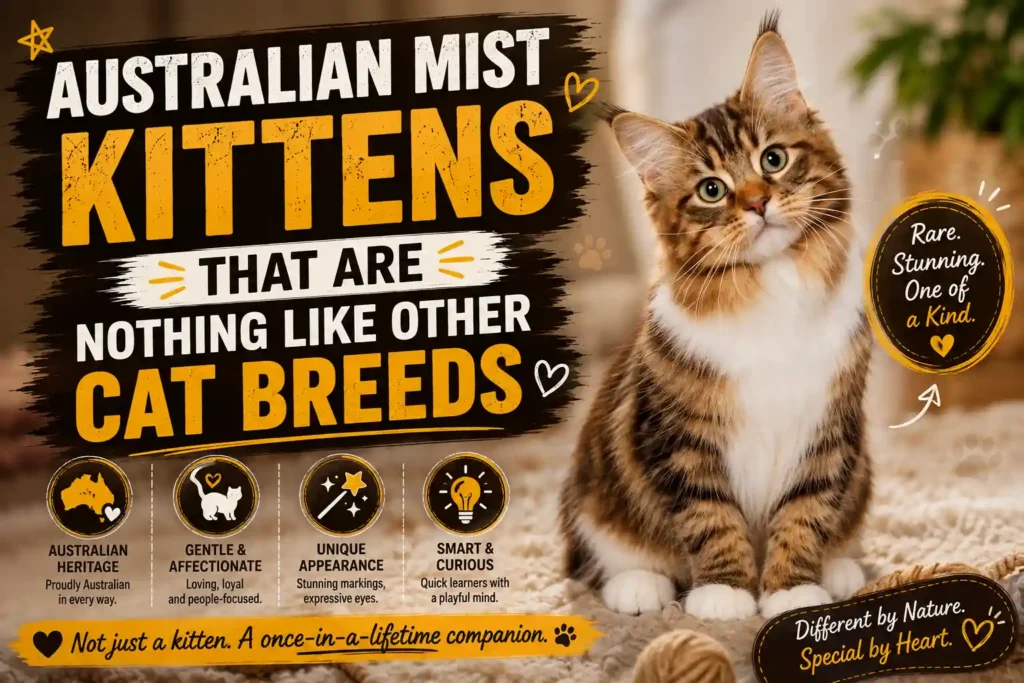
Australian Mist kittens come from a breed first developed in Australia in the 1970s, using Burmese, Abyssinian, and domestic shorthair cats. Breeders built the whole breed from around 30 foundation cats, and this small gene pool still shapes every litter born today. Australian Mist kittens are known for their soft, misted coat pattern and a calm, people-focused personality that stays playful well into adulthood.
In 2026, prices from registered breeders typically range from $800–$1,200, depending on pedigree, coat type, and location. They adapt easily to indoor life, get along well with children and other pets, and make a strong choice for families who want an affectionate, low-maintenance cat.
Australian Mist Kittens Breed Overview
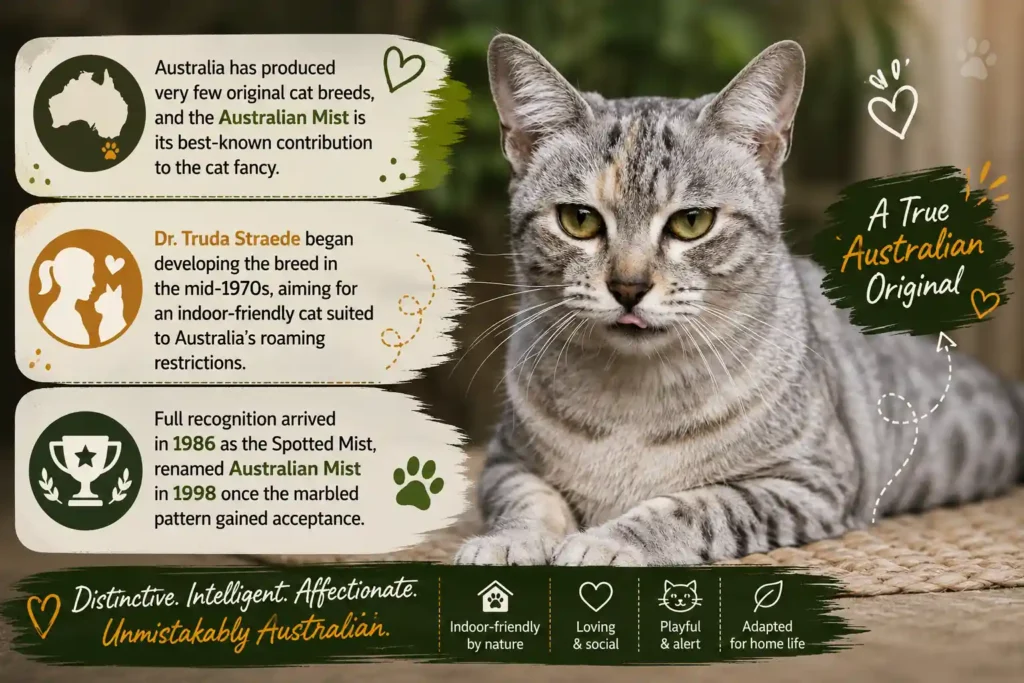
Australia has produced very few original cat breeds, and the Australian Mist is its best-known contribution to the cat fancy. Dr. Truda Straede began developing the breed in the mid-1970s, aiming for an indoor-friendly cat suited to Australia’s roaming restrictions.
Burmese cats contributed the dilution gene, Abyssinians added ticking, and domestic shorthairs brought spotting plus hybrid vigor. Full recognition arrived in 1986 as the Spotted Mist, renamed Australian Mist in 1998 once the marbled pattern gained acceptance. GCCF granted preliminary recognition in 2011 and championship status in 2017; TICA followed in 2014.
Discover Everything You Need to Know About Australian Mist Kittens. Read more in 7 Australian Mist Cat Facts, Including One Big Hypoallergenic Myth.
Appearance and Coat
Moderate foreign type defines the build: not as slender as an Oriental, not as chunky as a British Shorthair. A round, broad-nosed head sits atop a muscular body that feels heavier than it looks. Large, wide-set eyes range from chartreuse to deep aquamarine green, giving a soft, expressive face. Short, dense, glossy fur carries a signature misted effect from ticking that blurs the spotted or marbled markings. Rufous toning typically appears on the nose, cheeks, and ear tips.
Personality and Temperament
Australian Mist personality is best described as even-tempered, confident, and highly sociable. This breed usually welcomes strangers instead of hiding, and its friendly Australian Mist temperament makes it comfortable around children and other pets. Many owners even compare its loyalty to that of a dog. Vocalization remains moderate, especially compared with its Burmese relatives, although a soft chirp may signal excitement. For this breed, boredom is often a greater behavioral concern than anxiety, so regular play and companionship are important
What Makes the Australian Mist’s Temperament So Special?
Affection combined with genuine patience sets this breed apart from many other pedigree cats. Tolerance for handling and household chaos runs high, which is why the Australian Mist regularly suits homes with young children. Calm confidence, not nervous energy, defines how the breed reacts to new people.
Kittens and Development
Lively barely covers how Australian Mist kittens behave in their first year. Puberty typically arrives around five months, and kittenhood energy runs noticeably higher than adult energy. Play behavior peaks between eight and sixteen weeks, the ideal window for introducing toys and handling. Socialization during this window shapes adult confidence, so kittens exposed to varied noise grow into calmer cats. A settling-down happens by twelve to eighteen months, when the mellow adult temperament takes over.
Size and Weight
Weight ranges stay fairly consistent across registries, and the table below breaks down what to expect at each stage.
| Life Stage | Typical Weight | Notes |
| Newborn kitten | 90–120 g | Weighed weekly to track growth |
| 8-week-old kitten | 0.7–1 kg | Ready for new homes from 12+ weeks |
| Adult female | 3.5–5.5 kg (8–12 lb) | Reaches full size around 18 months |
| Adult male | 4–7 kg (9–15 lb) | Slightly heavier and more muscular |
Full skeletal growth finishes close to eighteen months, though chest depth can keep filling out until age two. Overweight body condition shows up easily on this breed’s compact frame, and GCCF specifically flags overeating as a concern. Monthly weigh-ins during the first year help catch growth problems early.
Colors and Patterns
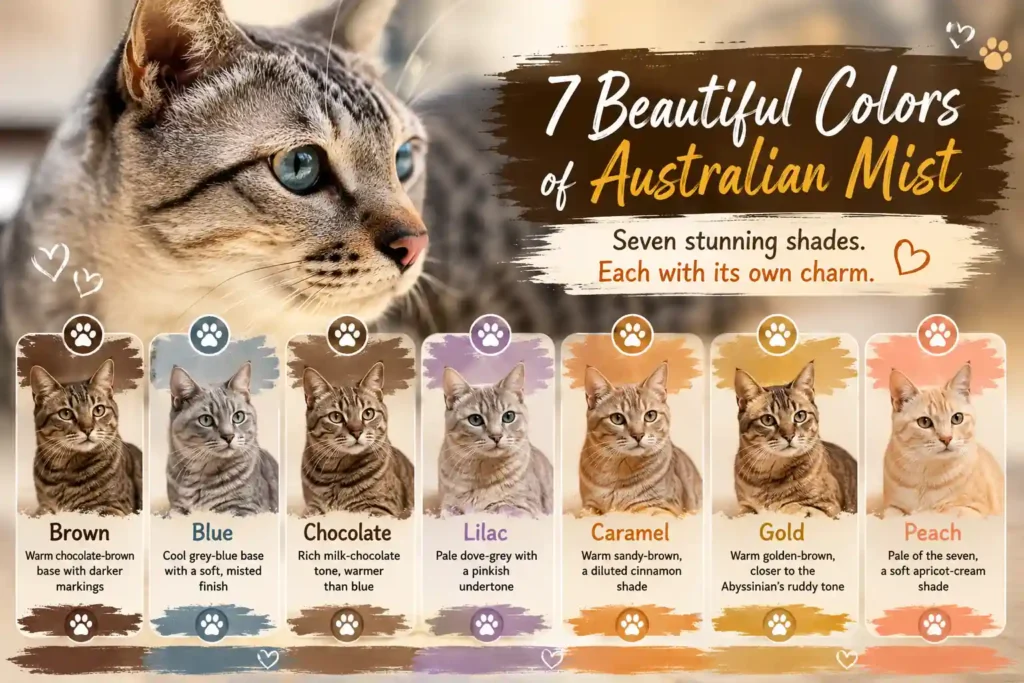
Seven official colors exist within the breed standard, and the table below lists each one with its defining trait.
| Color | Description |
| Brown | Warm chocolate-brown base with darker markings |
| Blue | Cool grey-blue base with a soft, misted finish |
| Chocolate | Rich milk-chocolate tone, warmer than blue |
| Lilac | Pale dove-grey with a pinkish undertone |
| Caramel | Warm sandy-brown, a diluted cinnamon shade |
| Gold | Warm golden-brown, closer to the Abyssinian’s ruddy tone |
| Peach | Pale of the seven, a soft apricot-cream shade |
Spotted tabby and marbled tabby are the two accepted patterns, both requiring spotted bellies under the breed standard. Random-sized spots, including arrowhead and rosette shapes, are permitted in the spotted variety. Kittens are born considerably paler than adults, with full color intensity developing closer to age two.
Grooming Needs
Australian Mist kitten grooming is simple and low-maintenance because the short coat has no undercoat that easily mats or tangles. Weekly brushing with a soft brush removes loose fur and spreads natural oils, keeping the coat smooth and glossy. Trim the nails every one to two weeks to prevent overgrowth, especially in indoor kittens. Daily tooth brushing with pet-safe toothpaste also helps support good dental health. Bathing is rarely needed because the coat naturally sheds dirt and stays clean with minimal care.
Diet and Feeding
No breed-specific nutritional requirements apply, though a tendency toward overeating makes portion control genuinely important. High-protein, life-stage-appropriate food works well, whether kitten formula, adult maintenance, or senior recipe after age ten.
Three to four smaller meals suit kittens up to twelve months, while two measured meals work for adults. The AAFP recommends annual body condition scoring, a simple check that catches creeping weight gain early. Treats should stay under ten percent of daily calories, a guideline that applies here as much as anywhere.
Exercise and Play
Moderate activity levels describe this breed accurately, sitting between a lazy lap cat and an athletic breed like the Abyssinian. Interactive play, ideally ten to fifteen minutes twice daily, satisfies most adult cats’ needs. Cat towers, window perches, and puzzle feeders give indoor cats useful vertical space and mental outlets. Toys that mimic prey movement, like wand toys, tend to get the most engagement. Rotating toys weekly keeps interest up and helps prevent boredom-driven mischief.
Health Problems
Few inherited conditions affect the Australian Mist’s health, and the breed has a reputation among vets as genuinely robust. Pyruvate kinase deficiency, a red blood cell disorder, showed up in exactly one carrier cat during early GCCF testing. Breeders now screen for it routinely, plus mandatory blood typing to prevent incompatibilities between mothers and kittens.
Obesity ranks as the most common real-world issue, driven by appetite rather than genetics. Dental disease, kidney issues, and hyperthyroidism can develop with age, mirroring risks across most cat breeds.
Are Australian Mist Cats Prone to Health Problems?
No major inherited health problems affect the Australian Mist breed as a whole. Routine DNA testing for pyruvate kinase deficiency and blood type compatibility keeps the gene pool clean among GCCF-registered cats. Age-related conditions like obesity and dental disease remain the most realistic long-term concerns.
Lifespan
Fifteen to eighteen years is the typical lifespan range cited by GCCF and most veterinary sources. Genetics play a role, but consistent preventive care shapes long-term outcomes just as much. Indoor-only living, common for this breed, removes major risks like traffic and predators. Some individuals documented in breed records live past twenty years with good care. Senior wellness exams after age ten give the best chance of catching decline early.
Kitten Care
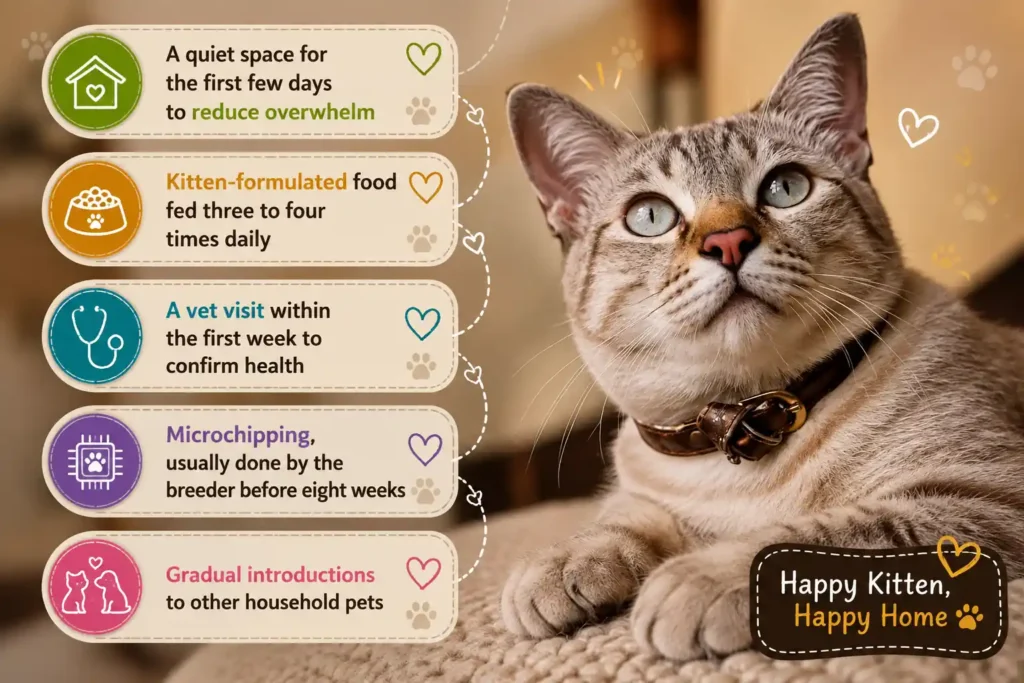
Preparation before bringing a kitten home makes the first weeks noticeably smoother. Twelve weeks marks the earliest age reputable breeders release kittens, allowing full weaning and vaccinations. Core needs during the first year include:
- A quiet space for the first few days to reduce overwhelm
- Kitten-formulated food fed three to four times daily
- A vet visit within the first week to confirm health
- Microchipping, usually done by the breeder before eight weeks
- Gradual introductions to other household pets
Litter box training rarely poses problems, since kittens learn the habit by watching their mother.
Kitten Price
Cost varies by country, pedigree, and coat pattern, and the table below reflects verified 2026 price ranges in USD.
| Source / Context | Price Range (USD) |
| Pet-quality kitten, reputable breeder | $800 – $1,200 |
| Show-quality or rare coat pattern | $1,200 – $2,000 |
| Neutered/spayed, non-breeding kitten | $700 – $1,000 |
| Additional first-year costs (vet, supplies, food) | $1,000+ |
Location can significantly affect the Australian Mist price, as catteries outside Australia are still relatively uncommon and may charge more. Marbled Australian Mist kittens can sometimes cost more than spotted ones, mainly due to demand rather than quality. The advertised Australian Mist price should ideally include pedigree papers, health-testing records, and microchipping.
How Much Do Australian Mist Cats and Kittens Cost in 2026?
Reputable breeders typically price Australian Mist kittens between $800 and $1,200 USD as of 2026. Rare coat patterns or show-quality lines can push that figure toward $2,000 in the US and UK. Ongoing costs, including food and veterinary care, generally add $1,000 or more in the first year.
Finding a Reputable Breeder
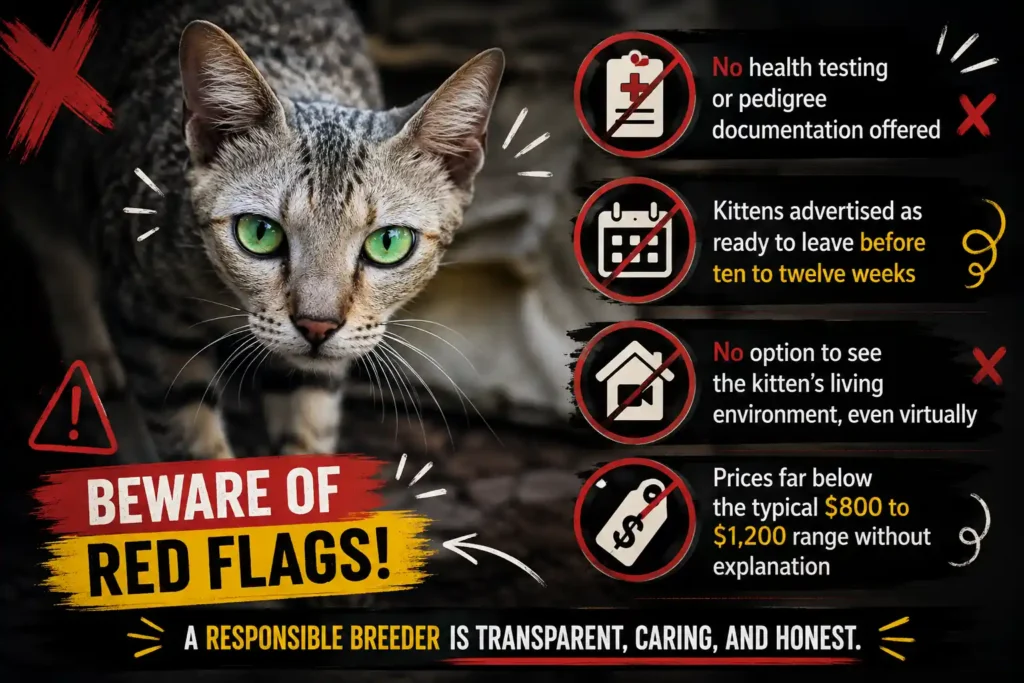
Patience matters more than speed when searching for this breed, since catteries remain genuinely rare outside Australia. GCCF and TICA both maintain breeder directories, a more reliable starting point than classified ad sites. Red flags worth avoiding include:
- No health testing or pedigree documentation offered
- Kittens advertised as ready to leave before ten to twelve weeks
- No option to see the kitten’s living environment, even virtually
- Prices far below the typical $800 to $1,200 range without explanation
Waiting lists commonly run several months to a year, and honest breeders say so upfront.
Choosing a Healthy Kitten
Physical signs of good health should be checked in person or via video before any commitment. Clear, bright eyes without discharge, plus clean ears and a glossy coat, indicate a kitten in solid condition. Confident movement and comfortable interaction with humans suggest good early socialization. Quiet, easy breathing matters too, since wheezing can point toward respiratory issues in poorly raised litters. Documentation should include a health certificate, vaccination record, and PKDef testing confirmation on the parents.
Is This Breed Right for You? What Australian Mist Cats and Kittens Need From an Owner
Families with children, first-time owners, and people working from home tend to suit this breed particularly well. Apartment living works fine given the indoor-oriented temperament, though vertical space and daily play remain non-negotiable. Allergy sufferers should note that no scientific evidence supports hypoallergenic claims for this breed.
Budget planning should extend beyond the $800 to $1,200 purchase price, covering food, litter, and vet costs across fifteen-plus years. Anyone drawn to Australian Mist kittens for looks alone should weigh the personality commitment just as seriously.
Frequently Asked Questions
Are Australian Mist cats hypoallergenic?
No. No cat breed is truly hypoallergenic, and the Australian Mist produces the same Fel d 1 protein as other cats.
How much do Australian Mist kittens cost in 2026?
Reputable breeders typically charge $800 to $1,200 USD, with rare or show-quality lines reaching $2,000.
Do Australian Mist cats get along with children and other pets?
Yes. The breed is known for tolerance, sociability, and adapting well to busy, multi-pet households.
How long do Australian Mist cats live?
Most live 15 to 18 years, with some individuals reaching past 20 with good care.
Is the Australian Mist a rare cat breed?
Yes. Most catteries remain in Australia, and only a small number operate in the UK, US, and Europe.