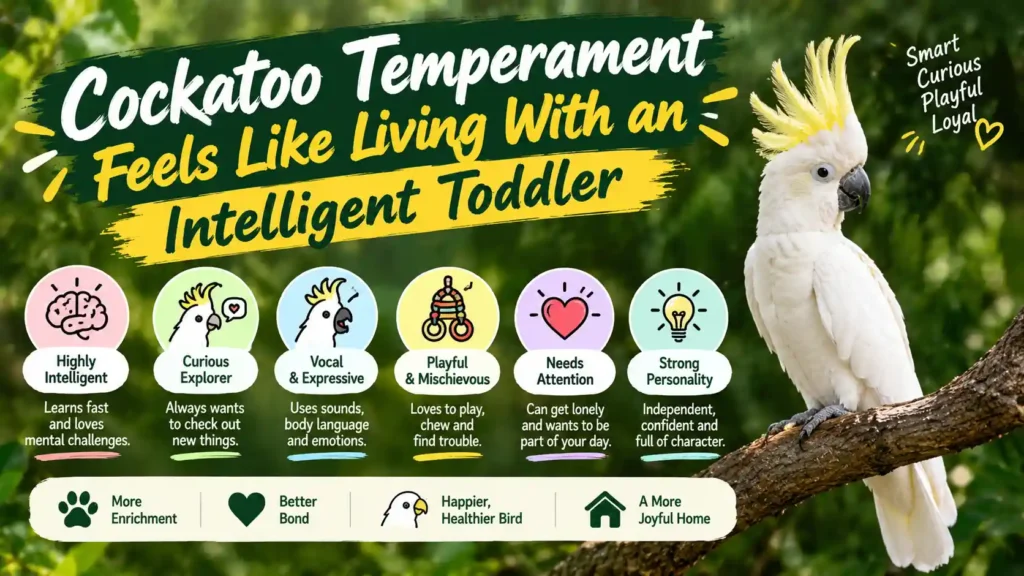
Cockatoo temperament is best described as intense, emotional, and deeply social, closer to a needy toddler than a typical pet bird. These birds bond so strongly with their owners that they often demand hours of daily interaction, and without it, they can become loud, anxious, or destructive. A cockatoo’s mood can shift fast, moving from cuddly and affectionate to nippy or defensive within minutes, especially during hormonal periods.
This emotional intensity comes from high intelligence combined with a strong need for physical touch, something wild cockatoos get from constant contact with their flock. Understanding cockatoo temperament early helps new owners set realistic expectations, since this is not a bird that thrives being left alone in a cage for most of the day.
What Is a Cockatoo’s Temperament Like?
Five traits define most cockatoos across the family’s two dozen or so species: sharp intelligence, deep social need, low boredom tolerance, high emotional sensitivity, and loud, frequent vocalizing. Cockatoo temperament research consistently ranks these birds among the most emotionally complex parrots, with cognitive ability often compared to a three- to five-year-old child. Wild cockatoo flocks stay in constant contact through calls, movement, and mutual grooming, and a pet cockatoo instinctively expects that same level of engagement from its human flock.
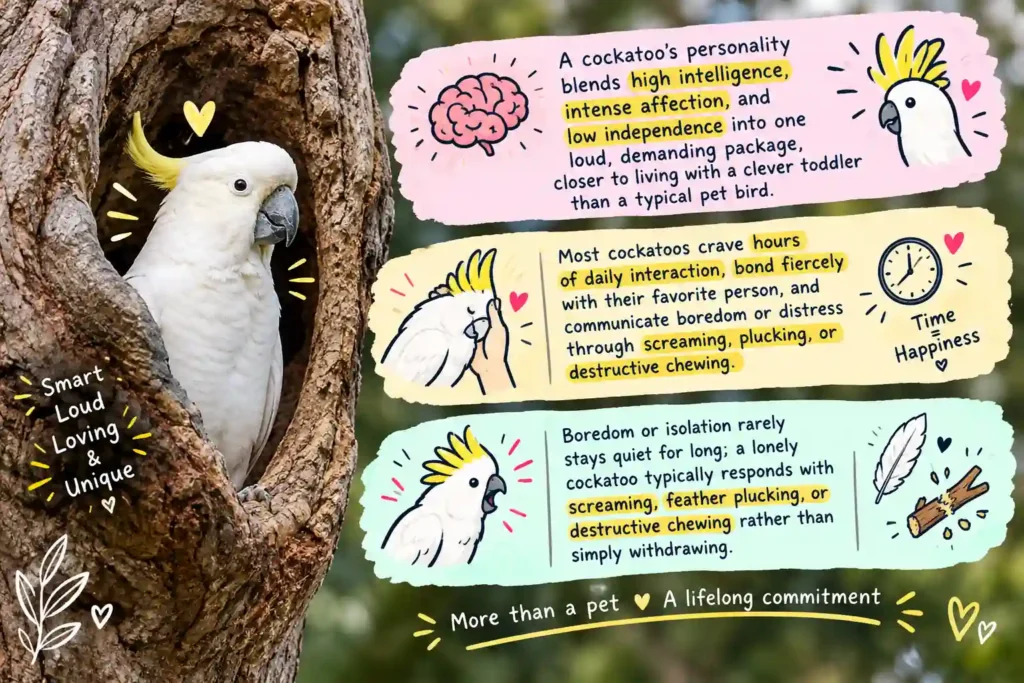
Boredom or isolation rarely stays quiet for long; a lonely cockatoo typically responds with screaming, feather plucking, or destructive chewing rather than simply withdrawing. Genetics set the baseline personality, but early handling, consistent routines, and daily mental stimulation shape how that personality actually shows up day to day. Owners who commit to structured play, foraging challenges, and predictable schedules generally see calmer, more balanced birds within months, according to guidance from the Association of Avian Veterinarians.
What Is a Cockatoo’s Personality Like in One Sentence?
A cockatoo’s personality blends high intelligence, intense affection, and low independence into one loud, demanding package, closer to living with a clever toddler than a typical pet bird. Most cockatoos crave hours of daily interaction, bond fiercely with their favorite person, and communicate boredom or distress through screaming, plucking, or destructive chewing.
Meet the Playful and Intelligent Cockatoo Parrot. Read more in Cockatoo Parrot Diet, Temperament, and the Commitment Few Expect.
A side-by-side look at the most common pet cockatoo species shows just how much temperament varies even within one bird family.
| Species | Typical Temperament | Noise Level | Best Suited For |
| Umbrella Cockatoo | Extremely affectionate, clingy, prone to separation anxiety | Very high | Owners with flexible schedules, patient neighbors |
| Moluccan Cockatoo | Deeply emotional, intense bonder, sensitive to change | Very high | Experienced owners with substantial free time |
| Sulphur-Crested Cockatoo | Bold, playful, attention-seeking | Very high | Active households, experienced keepers |
| Goffin’s Cockatoo | Curious, clever, mischievous problem-solver | Moderate-high | Owners who enjoy training and puzzle toys |
| Galah (Rose-Breasted) Cockatoo | Even-tempered, sociable, generally calmer | Moderate | First-time cockatoo owners |
Cockatoo Personality and Behavior
Morning and dusk bring the loudest vocal bursts, echoing wild flock behavior where cockatoos call out to locate other flock members before roosting. Mimicry ability varies by individual; some cockatoos pick up a handful of words and household sounds, while others rely almost entirely on body language and natural calls.
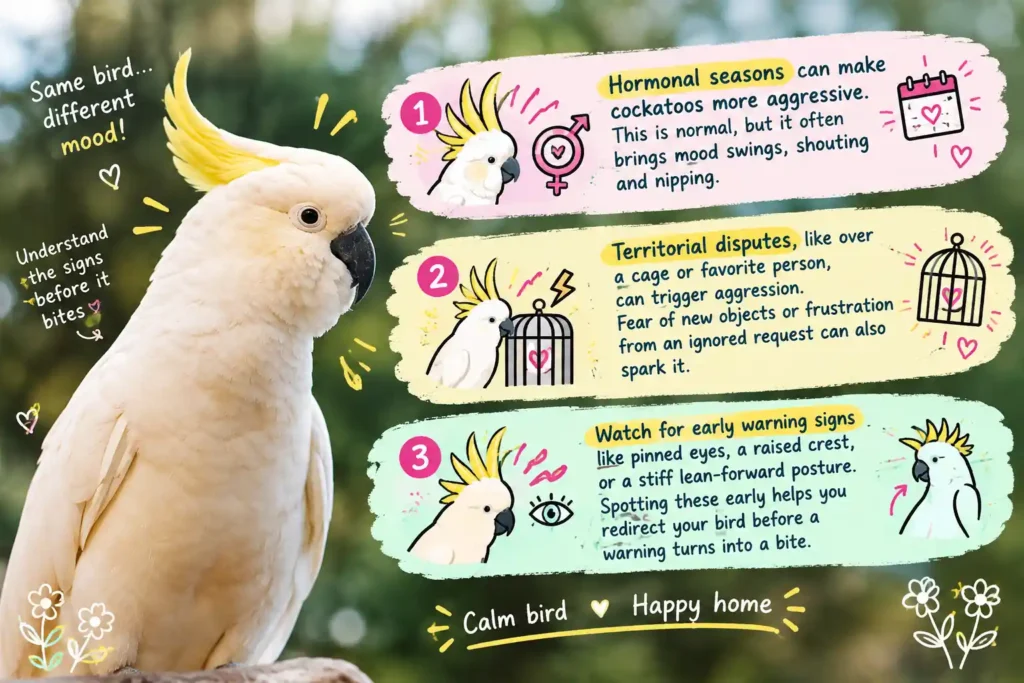
Crest position offers one of the clearest behavior signals available to owners: a raised, relaxed crest usually signals curiosity or excitement, while a flattened crest paired with pinned eyes often warns of overstimulation or irritation. Hormonal seasons, typically triggered by longer daylight hours, can temporarily intensify clinginess, nipping, or possessive behavior toward a favorite person.
Fine white powder coats a cockatoo’s feathers and settles on nearby furniture, a normal grooming byproduct rather than a health concern. Behavior that shifts suddenly, such as new aggression, unusual quietness, or a change in droppings, deserves a same-week call to an avian veterinarian rather than a wait-and-see approach, a point emphasized throughout the Merck Veterinary Manual‘s companion bird guidance.
Are Cockatoos Friendly?
Friendliness comes naturally to most well-socialized cockatoos, particularly toward the household member who provides the bulk of daily attention. Early, gentle exposure to multiple people, sounds, and handling styles during the first year strongly predicts how open an adult cockatoo stays toward guests and less-familiar family members later on. Single-person bonding remains the more common outcome, though, especially in birds raised with limited social variety as chicks.
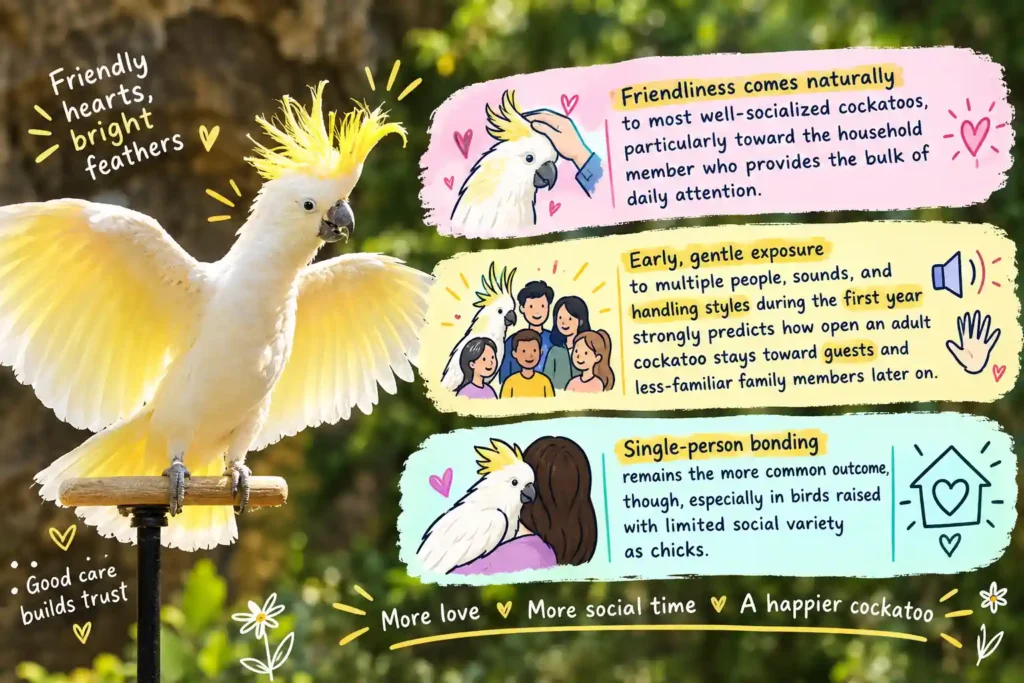
A friendly cockatoo typically leans toward its person, lowers its head for scratches, and vocalizes softly when approached. Fear or mistrust shows up differently, through flattened feathers, backing away, or defensive lunging toward unfamiliar hands. Rescue cockatoos often need a slower, patience-heavy reintroduction process, since past neglect or inconsistent handling can leave lasting caution around new people.
Are Cockatoos Affectionate?
Affection ranks among the strongest, most consistent cockatoo traits across every species in the family. Physical closeness matters enormously to these birds; many actively seek out cuddling, head scratches, and prolonged physical contact with their favorite person throughout the day. Excessive cuddling during the juvenile stage, however, can accidentally trigger hormonal or possessive behavior once a cockatoo reaches sexual maturity around two to four years old.
Balanced affection, meaning physical contact mixed with independent play, training sessions, and foraging time, tends to produce a more emotionally stable adult bird. Neglect or inconsistent attention rarely goes unnoticed; an under-stimulated cockatoo often escalates from soft calling to sustained screaming within days.
Do Cockatoos Bond With One Person or the Whole Family?
Most cockatoos form their strongest bond with one primary caregiver, though consistent, positive exposure to the rest of the household can widen that circle over time. Rotating who feeds, trains, and handles the bird from an early age generally produces a cockatoo that accepts affection from multiple family members rather than just one.
Are Cockatoos Aggressive?
Aggression in cockatoos usually traces back to specific triggers rather than random temperament shifts. Hormonal surges, territorial protectiveness over a cage or favorite person, fear, and redirected frustration account for the majority of biting incidents reported by avian behaviorists. Warning signs typically appear well before an actual bite: pinned eyes, a raised crest combined with a lunging posture, growling, or feather fluffing followed by sudden stillness.
Punishment-based responses tend to backfire badly with cockatoos, often escalating fear-based aggression rather than reducing it. Positive reinforcement training, consistent boundaries, and recognizing early warning signals give owners the best chance of preventing bites altogether. Surgical or hormonal intervention is not a standard option for parrots, so behavior modification remains the primary long-term tool, a view supported by welfare guidance from the American Society for the Prevention of Cruelty to Animals (ASPCA).
What Triggers Cockatoo Aggression?
Cockatoo temperament shifts toward aggression most often during hormonal seasons, territorial disputes over a cage or favorite person, fear of an unfamiliar object, or frustration from an ignored request. Reading early body language, including pinned eyes, a raised crest, or a stiff lean-forward posture, lets an owner redirect the bird before a warning turns into a bite.
A quick body-language checklist helps separate a playful cockatoo from one heading toward a bite.
| Signal | What It Usually Means |
| Relaxed, slightly raised crest | Curiosity or calm alertness |
| Eyes pinning rapidly | Excitement or rising overstimulation |
| Crest flat against the head | Fear or submission |
| Growling or hissing | Clear warning to back off |
| Feathers fluffed, then a quick shake. | Contentment, often after preening |
Are Cockatoos Good Pets?
Cockatoo temperament suits a fairly narrow slice of potential owners, despite how charming these birds appear in videos and pet store displays. Daily time commitment sits at the center of the decision; most cockatoos need two to four hours of direct interaction outside the cage, on top of feeding, cleaning, and enrichment setup. Noise tolerance matters just as much, since apartment living, close neighbors, or noise-sensitive households rarely mix well with a bird capable of sustained, ear-splitting calls. Lifespan adds another layer most first-time buyers underestimate, since cockatoos regularly live 40 to 70 years and occasionally longer, meaning a young adopter is making a multi-decade, sometimes multi-generational, commitment.
Purchase price alone runs from roughly $600 to $3,000 for common species, with rarer types reaching well into five figures, and that number sits before ongoing food, toys, and avian veterinary costs of $1,000 to $2,000 a year.
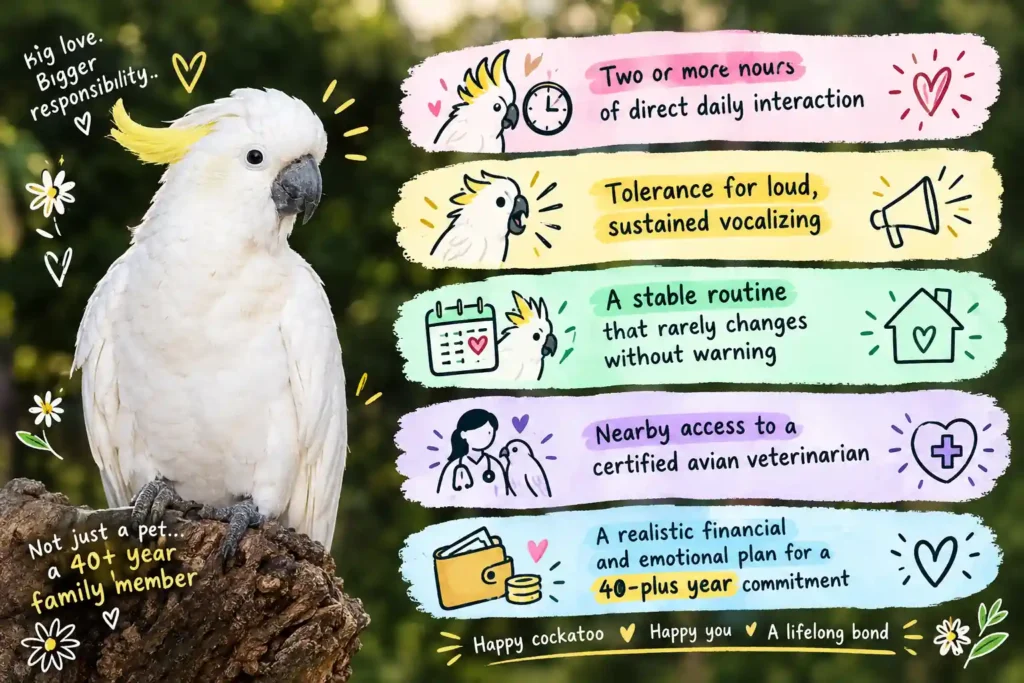
A cockatoo tends to fit best in a household that can offer:
- Two or more hours of direct daily interaction
- Tolerance for loud, sustained vocalizing
- A stable routine that rarely changes without warning
- Nearby access to a certified avian veterinarian
- A realistic financial and emotional plan for a 40-plus year commitment
Comparing a cockatoo against three other popular companion parrots highlights exactly where the demands differ.
| Trait | Cockatoo | African Grey | Macaw | Cockatiel |
| Affection Level | Very high, often clingy | Moderate, reserved | High | Moderate |
| Average Noise Level | Very high | Low-moderate | High | Low-moderate |
| Typical Lifespan | 40-70 years | 40-60 years | 30-50 years | 15-25 years |
| Beginner-Friendly | Rarely | Sometimes | Rarely | Yes |
The Truth About Cockatoo Temperament
Cockatoo temperament, pulled together across every section above, boils down to one central truth: enormous affection paired with equally enormous demands. General temperament traits, including intelligence, social need, low boredom tolerance, emotional sensitivity, and vocal intensity, shape daily life with any cockatoo species.
Personality and behavior patterns reveal themselves through crest position, vocal timing, and hormonal cycles that every owner eventually learns to read. Friendliness and affection come easily to well-socialized birds, though single-person bonding remains common without deliberate, varied socialization. Aggression, when it appears, almost always traces back to identifiable triggers like hormones, fear, or territorial protectiveness rather than random moodiness.
Suitability as a pet depends heavily on available time, noise tolerance, and readiness for a 40-to-70-year commitment backed by real financial planning. Prospective owners who weigh these factors honestly, ideally alongside guidance from an avian veterinarian, stand the best chance of building a genuinely happy, lifelong partnership with one of the most complex birds in aviculture.
Cockatoo Temperament FAQs
Are cockatoos good for beginners?
Beginner suitability rates are low for nearly every cockatoo species, according to avian rescue organizations and the majority of experienced bird keepers. Noise output, high social demands, and a genuine risk of feather-destructive or aggressive behavior when needs go unmet make cockatoos a poor match for first-time bird owners. Smaller, calmer species like the Goffin’s or Galah occasionally work for a dedicated first-time owner who has researched avian care thoroughly and lined up access to an avian veterinarian in advance.
Are cockatoos cuddly?
Cuddliness ranks among the most reliable cockatoo traits, with most individuals actively seeking physical closeness, head scratches, and prolonged contact with a trusted person. Excessive cuddling during the chick and juvenile stage can backfire, though, often triggering hormonal or possessive behavior once the bird matures. A healthier long-term approach balances physical affection with independent play, foraging, and training sessions rather than constant handling.
Are cockatoos easy to handle?
Physical handling itself stays fairly simple once a cockatoo trusts its owner, since most respond well to step-up and step-down cues taught through positive reinforcement. Emotional handling presents the real challenge, requiring patience, consistent routines, and quick recognition of stress signals like pinned eyes or a flattened crest. Novice handlers sometimes underestimate bite strength, given that a large cockatoo’s beak can exert several hundred pounds of pressure per square inch when provoked.